


Amid the downturn in the semiconductor industry, many high-tech firms at Hsinchu Science Park (新竹科學園區) have cut jobs to weather the crisis.
The country’s top two chipmakers, Taiwan Semiconductor Manufacturing Co (TSMC, 台積電) and United Microelectronics Corp (UMC, 聯電), are no exception.
But many wonder why the only layoffs to arouse controversy in the past few months were those made by TSMC, which announced last week its readiness to rehire hundreds of laid-off workers.
On Wednesday, TSMC chairman Morris Chang (張忠謀) told employees via a televised speech that the world’s largest contract chipmaker was inviting all of its laid-off workers back to work on June 1.
Chang also apologized for the company’s mishandling of its annual Performance Management and Development (PMD) employee appraisal, saying TSMC would compensate the laid-off workers for the harm resulting from the evaluations.
But the main cause of controversy was TSMC’s refusal to provide its laid-off workers with documentation confirming their involuntary unemployment. Some laid-off employees said the company had threatened to label them as “unfit for the job” if they asked for proof of involuntary leave, which would make it hard for them find new jobs.
By law, when a worker is laid off, he or she can apply for up to six months of government unemployment benefits after obtaining proof of involuntary unemployment from their former employer.
TSMC’s refusal to provide such documentation forced its laid-off workers to protest for the first time in the company’s 22-year history, which severely damaged its image.
Chang admitted that the company failed to respect the dignity of its workers and did not take into account the difficulty of finding employment amid the economic downturn.
The global financial crisis that intensified late last year has had a strong negative impact on the operations of many high-tech firms at Hsinchu Science Park, forcing many to ask their staff to take unpaid days off and reduce their headcount.
Almost all the companies, including UMC, issued proof of involuntary unemployment to workers who were laid off. TSMC, however, did not consider its employees as laid-off and therefore refused to issue such proof, causing the issue to snowball into a major controversy.
Under the company’s PMD system, the 5 percent of its workers with the lowest performance evaluation scores are to be fired, with no proof of involuntary unemployment.
TSMC workers have long criticized the PMD system as unfair and biased. But most of the workers laid off in the past did not protest because it wasn’t as difficult for them to find new jobs.
But this year is different. Most of TSMC’s laid-off workers found it impossible to find jobs, and they had no proof of involuntary unemployment to apply for government unemployment benefits.
Against this backdrop, some laid-off workers formed a group in the middle of February to represent them. With the help of the Labor Party, since March the group has staged protests at the Hsinchu Science Park Administration, the Council of Labor Affairs and the Presidential Office.
The group twice protested in front of Chang’s house in Dazhi, Taipei, which caught media attention and prompted TSMC to give in to workers’ demands.
On May 1, Chang’s wife, Sophie Chang (張淑芬), greeted the laid-off workers. On May 13, Morris Chang also appointed TSMC vice president Chin Yung-pei (秦永沛) as head of a five-member group to listen to the workers’ complaints and improve the PMD system.
Last week, TSMC announced it would rehire its laid-off workers, with employee seniority and stock bonuses remaining unchanged. Those workers who do not wish to return to the company will receive severance pay and an extra bonus, with the company saying it wishes to help them through difficult times.
Chang said in a speech that the company would not use the PMD system as a mean to fire employees, but his announcement that the former employees would be rehired at the beginning of next month is certain to have repercussions among other local electronics companies who cut payrolls earlier this year.

Among the rows of vibrators, rubber torsos and leather harnesses at a Chinese sex toys exhibition in Shanghai this weekend, the beginnings of an artificial intelligence (AI)-driven shift in the industry quietly pulsed. China manufactures about 70 percent of the world’s sex toys, most of it the “hardware” on display at the fair — whether that be technicolor tentacled dildos or hyper-realistic personalized silicone dolls. Yet smart toys have been rising in popularity for some time. Many major European and US brands already offer tech-enhanced products that can enable long-distance love, monitor well-being and even bring people one step closer to

Malaysia’s leader yesterday announced plans to build a massive semiconductor design park, aiming to boost the Southeast Asian nation’s role in the global chip industry. A prominent player in the semiconductor industry for decades, Malaysia accounts for an estimated 13 percent of global back-end manufacturing, according to German tech giant Bosch. Now it wants to go beyond production and emerge as a chip design powerhouse too, Malaysian Prime Minister Anwar Ibrahim said. “I am pleased to announce the largest IC (integrated circuit) Design Park in Southeast Asia, that will house world-class anchor tenants and collaborate with global companies such as Arm [Holdings PLC],”

Sales in the retail, and food and beverage sectors last month continued to rise, increasing 0.7 percent and 13.6 percent respectively from a year earlier, setting record highs for the month of March, the Ministry of Economic Affairs said yesterday. Sales in the wholesale sector also grew last month by 4.6 annually, mainly due to the business opportunities for emerging applications related to artificial intelligence (AI) and high-performance computing technologies, the ministry said in a report. The ministry forecast that retail, and food and beverage sales this month would retain their growth momentum as the former would benefit from Tomb Sweeping Day
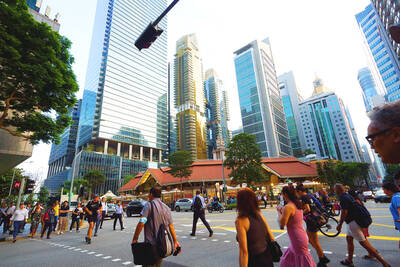
Thousands of parents in Singapore are furious after a Cordlife Group Ltd (康盛人生集團), a major operator of cord blood banks in Asia, irreparably damaged their children’s samples through improper handling, with some now pursuing legal action. The ongoing case, one of the worst to hit the largely untested industry, has renewed concerns over companies marketing themselves to anxious parents with mostly unproven assurances. This has implications across the region, given Cordlife’s operations in Hong Kong, Macau, Indonesia, the Philippines and India. The parents paid for years to have their infants’ cord blood stored, with the understanding that the stem cells they contained


 RSS
RSS