


As governments around the world turn their attention to alternative sources of energy, Taiwan is focusing on solar power and AC light-emitting diodes (LED) as the main drivers of the nation’s green technology initiatives.
The local AC LED Alliance, under the direction of the Industrial Technology Research Institute (ITRI, 工研院), is ready to submit the world’s first AC-powered LED technology standard proposal to the International Commission on Illumination in the hopes of taking a lead in the field and setting standards for the burgeoning technology.
Taiwan owns 80 patents on various AC LED innovations and is working closely with the National Institute of Standards and Technology, a US federal technology agency that develops and promotes measurements and scientific standards, as well as Germany’s Underwriters Laboratories Inc, which provides product safety certification and compliance solutions in Germany.
“From upstream to downstream, we are strategically mapping our AC LED-related patents to avoid patent disputes because we don’t own the core technologies,” Ian Chan (詹益仁), vice president and director-general of ITRI’s Electronics and Optoelectronics Research Laboratories, said at a product exhibition in Taipei yesterday.
“Out goal is to become the international leader in AC LED technology,” he said.
By 2015, ITRI expects Taiwan’s AC LED industry to generate more than NT$60 billion (US$1.84 billion), Can Wei-ji (甘薇璣), senior specialist at the Ministry of Economic Affairs’ industrial technology department, said at the meeting.
“Currently, Taiwan is the world leader in terms of LED shipment value and volume,” Can said.
Also present at the product exposition were companies such as Liquidleds Lighting Corp (液光固態照明), Everlight Electronic Light (億光電子), Forward Electronics Co (福華電子) and Lustrous Technology Ltd (齊瀚光電).
AC LED is basically LED lighting that can operate on AC power without the need for a DC converter, Epistar Corp (晶元光電) executive assistant Wang Shi-wei (王希維) told the Taipei Times yesterday.
Espistar is Taiwan’s largest maker of LED and began shipping AC LED chips to downstream companies this quarter for mainstream mass manufacturing.
The major benefits of AC LED are its lack of requirement for a power transformer, low cost, compact size and no electrostatic discharges, Wang said.
“What makes AC LED green is its energy efficiency, which effectively saves between 15 percent and 30 percent of electricity compared with regular LED. It can replace traditional light bulbs, incandescent tubes and halogen used in households,” Wang said.
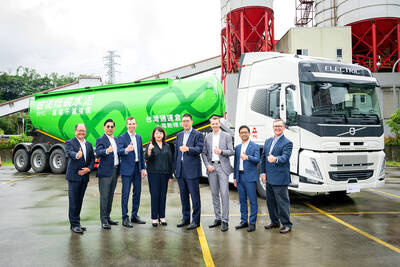
Taiwan Transport and Storage Corp (TTS, 台灣通運倉儲) yesterday unveiled its first electric tractor unit — manufactured by Volvo Trucks — in a ceremony in Taipei, and said the unit would soon be used to transport cement produced by Taiwan Cement Corp (TCC, 台灣水泥). Both TTS and TCC belong to TCC International Holdings Ltd (台泥國際集團). With the electric tractor unit, the Taipei-based cement firm would become the first in Taiwan to use electric vehicles to transport construction materials. TTS chairman Koo Kung-yi (辜公怡), Volvo Trucks vice president of sales and marketing Johan Selven, TCC president Roman Cheng (程耀輝) and Taikoo Motors Group

Among the rows of vibrators, rubber torsos and leather harnesses at a Chinese sex toys exhibition in Shanghai this weekend, the beginnings of an artificial intelligence (AI)-driven shift in the industry quietly pulsed. China manufactures about 70 percent of the world’s sex toys, most of it the “hardware” on display at the fair — whether that be technicolor tentacled dildos or hyper-realistic personalized silicone dolls. Yet smart toys have been rising in popularity for some time. Many major European and US brands already offer tech-enhanced products that can enable long-distance love, monitor well-being and even bring people one step closer to

RECORD-BREAKING: TSMC’s net profit last quarter beat market expectations by expanding 8.9% and it was the best first-quarter profit in the chipmaker’s history Taiwan Semiconductor Manufacturing Co (TSMC, 台積電), which counts Nvidia Corp as a key customer, yesterday said that artificial intelligence (AI) server chip revenue is set to more than double this year from last year amid rising demand. The chipmaker expects the growth momentum to continue in the next five years with an annual compound growth rate of 50 percent, TSMC chief executive officer C.C. Wei (魏哲家) told investors yesterday. By 2028, AI chips’ contribution to revenue would climb to about 20 percent from a percentage in the low teens, Wei said. “Almost all the AI innovators are working with TSMC to address the

Malaysia’s leader yesterday announced plans to build a massive semiconductor design park, aiming to boost the Southeast Asian nation’s role in the global chip industry. A prominent player in the semiconductor industry for decades, Malaysia accounts for an estimated 13 percent of global back-end manufacturing, according to German tech giant Bosch. Now it wants to go beyond production and emerge as a chip design powerhouse too, Malaysian Prime Minister Anwar Ibrahim said. “I am pleased to announce the largest IC (integrated circuit) Design Park in Southeast Asia, that will house world-class anchor tenants and collaborate with global companies such as Arm [Holdings PLC],”


 RSS
RSS