


A bald, child-like creature dangles its legs from a chair as its shoulders rise and fall with rhythmic breathing and its black eyes follow movements across the room.
It’s not human — but it is paying attention.
Below the soft silicon skin of one of Japan’s most sophisticated robots, processors record and evaluate information. The 130cm humanoid is designed to learn just like a human infant.
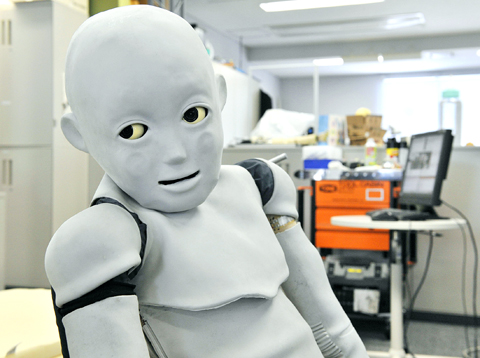
PHOTO: AFP
The creators of the Child-robot with Biomimetic Body, or CB2, say it’s slowly developing social skills by interacting with humans and watching their facial expressions, mimicking a mother-baby relationship.
“Babies and infants have very, very limited programs. But they have room to learn more,” said Osaka University professor Minoru Asada, as his team’s 33kg invention kept its eyes glued to him.
The team is trying to teach the pint-sized android to think like a baby who evaluates its mother’s countless facial expressions and “clusters” them into basic categories, such as happiness and sadness.
Asada’s project brings together robotics engineers, brain specialists, psychologists and other experts, and is supported by the state-funded Japan Science and Technology Agency.
With 197 film-like pressure sensors under its light gray rubbery skin, CB2 can also recognize human touch, such as stroking of its head.
The robot can record emotional expressions using eye-cameras, then memorize and match them with physical sensations and cluster them on its circuit boards, Asada said.
The professor, also a member of the Japanese Society of Baby Science, said his team has made progress on other fronts since first presenting CB2 to the world in 2007.
In the two years since then, he said, CB2 has taught itself how to walk with the aid of a human and can now move its body through a room quite smoothly, using 51 “muscles” driven by air pressure.
In coming decades, Asada expects science will come up with a “robo species” that has learning abilities somewhere between those of a human and other primate species such as the chimpanzee.
And he hopes that this little CB2 may lead the way into this brave new world, with the goal of having the robo-kid speaking in basic sentences within about two years, matching the intelligence of a two-year-old child.
By 2050, Asada wants a robotic team of football players to be able take on the human World Cup champions — and win.
Welcome to the cutting edge of robotics and artificial intelligence.
More than a decade since automaker Honda stunned the world with the walking humanoid P2, a forerunner to the popular ASIMO, robotics has come a long way.
Researchers across Japan have unveiled increasingly sophisticated robots with different functions — including a talking office receptionist, a security guard and even a primary school teacher.
Electronics giant Toshiba is developing a new model of domestic helper, AppriAttenda, which moves on wheels and can fetch containers from a refrigerator with its two arms — a potentially lucrative invention in fast-aging Japan.
“We aim to make a robot that elderly people can count on when living alone,” said Takashi Yoshimi, a senior research scientist at a Toshiba laboratory in Kawasaki city south of Tokyo.
Last month also saw the debut of Japan’s first robotic fashion model, cybernetic human HRP-4C, which can strut a catwalk, smile and pout thanks to 42 motion motors programmed to mimic flesh-and-blood models.
Its makers at the National Institute of Advanced Industrial Science and Technology outside Tokyo plan to sell the 158cm fashion-bots for around US$200,000 each.
Thousands of humanoids could be working alongside humans in a decade or so, if that is what society wants, said Fumio Miyazaki, engineering science professor at the Toyonaka Campus of Osaka University.
If the world is ready for a functioning robot secretary, for example, there is “no need for a major technical breakthrough,” he said.
A Tokyo subsidiary of Hello Kitty maker Sanrio, Kokoro — which means heart or mind in Japanese — has also produced advanced talking, life-size humanoids.
“Robots have hearts,” said Kokoro planning department manager Yuko Yokota.
“They don’t look human unless we put souls in them,” Yokota said. “When manufacturing a robot, there comes a moment when light flickers in its eyes. That’s when we know our work is done.”
Public opinion in Japan may be more open to robots than in the West, where dark science fiction visions from movies such as Bladerunner and Terminator have conjured images of robo-soldiers taking over the world.
Thanks to such benign cartoon characters as Astro Boy, “Japanese people have a friendly image towards robots,” Toshiba’s Yoshimi said.
Asada said Japan’s indigenous animistic belief system may also have readied people to accept human-like robots with minds of their own.
“Everything has a mind — the mind of the lamp, the mind of the chair, the soul of the desk,” he said, pointing at objects in his office.
“Therefore the machines should have their mind too. If we proceed in this study, machines may have something like a human mind or ‘robo-mind’,” he said.

Taiwan Transport and Storage Corp (TTS, 台灣通運倉儲) yesterday unveiled its first electric tractor unit — manufactured by Volvo Trucks — in a ceremony in Taipei, and said the unit would soon be used to transport cement produced by Taiwan Cement Corp (TCC, 台灣水泥). Both TTS and TCC belong to TCC International Holdings Ltd (台泥國際集團). With the electric tractor unit, the Taipei-based cement firm would become the first in Taiwan to use electric vehicles to transport construction materials. TTS chairman Koo Kung-yi (辜公怡), Volvo Trucks vice president of sales and marketing Johan Selven, TCC president Roman Cheng (程耀輝) and Taikoo Motors Group

Among the rows of vibrators, rubber torsos and leather harnesses at a Chinese sex toys exhibition in Shanghai this weekend, the beginnings of an artificial intelligence (AI)-driven shift in the industry quietly pulsed. China manufactures about 70 percent of the world’s sex toys, most of it the “hardware” on display at the fair — whether that be technicolor tentacled dildos or hyper-realistic personalized silicone dolls. Yet smart toys have been rising in popularity for some time. Many major European and US brands already offer tech-enhanced products that can enable long-distance love, monitor well-being and even bring people one step closer to

RECORD-BREAKING: TSMC’s net profit last quarter beat market expectations by expanding 8.9% and it was the best first-quarter profit in the chipmaker’s history Taiwan Semiconductor Manufacturing Co (TSMC, 台積電), which counts Nvidia Corp as a key customer, yesterday said that artificial intelligence (AI) server chip revenue is set to more than double this year from last year amid rising demand. The chipmaker expects the growth momentum to continue in the next five years with an annual compound growth rate of 50 percent, TSMC chief executive officer C.C. Wei (魏哲家) told investors yesterday. By 2028, AI chips’ contribution to revenue would climb to about 20 percent from a percentage in the low teens, Wei said. “Almost all the AI innovators are working with TSMC to address the

Malaysia’s leader yesterday announced plans to build a massive semiconductor design park, aiming to boost the Southeast Asian nation’s role in the global chip industry. A prominent player in the semiconductor industry for decades, Malaysia accounts for an estimated 13 percent of global back-end manufacturing, according to German tech giant Bosch. Now it wants to go beyond production and emerge as a chip design powerhouse too, Malaysian Prime Minister Anwar Ibrahim said. “I am pleased to announce the largest IC (integrated circuit) Design Park in Southeast Asia, that will house world-class anchor tenants and collaborate with global companies such as Arm [Holdings PLC],”


 RSS
RSS