


Japanese researchers say they have developed a form of rubber that is able to conduct electricity well, paving the way for robots with stretchable “e-skin” that can feel heat and pressure like humans.
The material is the first to solve the problems faced by metals — which are conductive but do not stretch — and rubber, which hardly transmits electricity, University of Tokyo researchers said.
The new technology is flexible like ordinary rubber but boasts conductivity some 570 times as fast as commercially available rubbers filled with carbon particles, said the team led by Takao Someya at the university’s School of Engineering.
If used as wiring, the material can make elastic integrated circuits, which can be stretched to up to 1.7 times their original size and mounted on curved surfaces with no mechanical damage or major change in conductivity.
One application of the material would be artificial skin on robots, said Tsuyoshi Sekitani, a research associate in the team.
“As robots enter our everyday life, they need to have sensors everywhere on their bodies like humans,” he said.
“Imagine they bump into babies. Robots need to feel temperatures, heat and pressure like we do to coexist. Otherwise it would be dangerous,” he said.
The material itself can be stretched up to 2.3 times the original size but conductivity drops roughly by half at the maximum extension.
It can be stretched by 38 percent with no significant change in conductivity — still a breakthrough considering that metal wires break on strains of 1 percent to 2 percent, the team said.
The material is made by grinding carbon nanotubes, or tube-shaped carbon molecules, with an ionic liquid and adding it to rubber.
Carbon nanotubes often bunch up together but the millimeter-long tubes coupled with the ionic liquid can be uniformly dispersed in rubber to realize both high conductivity and flexibility.
Sekitani said the new material could be used on the surface of steering wheels, which would analyze perspiration, body temperature and other data of the driver and judge whether he or she is fit enough to drive.
“It could be completely integrated into the normal driving system, making users unaware of using it,” he said.
Or it could be used on top of a mattress for bed-ridden people, tilting the bed to change the patient’s posture to prevent bedsores, he said.
“Objects that come into contact with humans are often not square or flat. We believe interfaces between humans and electronics should be soft,” Sekitani said.
The team aims to put the elastic conductor to practical use in several years, Sekitani said.
“We can’t rule out the possibility of using this in living bodies but we’re sticking to using it in electronics,” Sekitani said.
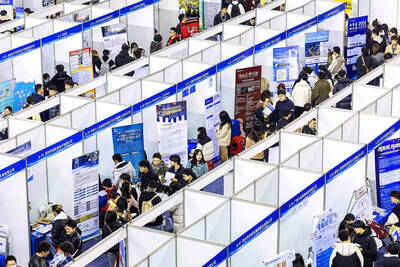
Stephen Garrett, a 27-year-old graduate student, always thought he would study in China, but first the country’s restrictive COVID-19 policies made it nearly impossible and now he has other concerns. The cost is one deterrent, but Garrett is more worried about restrictions on academic freedom and the personal risk of being stranded in China. He is not alone. Only about 700 American students are studying at Chinese universities, down from a peak of nearly 25,000 a decade ago, while there are nearly 300,000 Chinese students at US schools. Some young Americans are discouraged from investing their time in China by what they see

MAJOR DROP: CEO Tim Cook, who is visiting Hanoi, pledged the firm was committed to Vietnam after its smartphone shipments declined 9.6% annually in the first quarter Apple Inc yesterday said it would increase spending on suppliers in Vietnam, a key production hub, as CEO Tim Cook arrived in the country for a two-day visit. The iPhone maker announced the news in a statement on its Web site, but gave no details of how much it would spend or where the money would go. Cook is expected to meet programmers, content creators and students during his visit, online newspaper VnExpress reported. The visit comes as US President Joe Biden’s administration seeks to ramp up Vietnam’s role in the global tech supply chain to reduce the US’ dependence on China. Images on

New apartments in Taiwan’s major cities are getting smaller, while old apartments are increasingly occupied by older people, many of whom live alone, government data showed. The phenomenon has to do with sharpening unaffordable property prices and an aging population, property brokers said. Apartments with one bedroom that are two years old or older have gained a noticeable presence in the nation’s six special municipalities as well as Hsinchu county and city in the past five years, Evertrust Rehouse Co (永慶房產集團) found, citing data from the government’s real-price transaction platform. In Taipei, apartments with one bedroom accounted for 19 percent of deals last
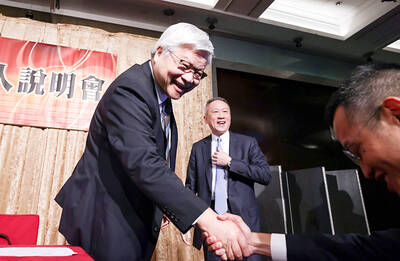
US CONSCULTANT: The US Department of Commerce’s Ursula Burns is a rarely seen US government consultant to be put forward to sit on the board, nominated as an independent director Taiwan Semiconductor Manufacturing Co (TSMC, 台積電), the world’s largest contract chipmaker, yesterday nominated 10 candidates for its new board of directors, including Ursula Burns from the US Department of Commerce. It is rare that TSMC has nominated a US government consultant to sit on its board. Burns was nominated as one of seven independent directors. She is vice chair of the department’s Advisory Council on Supply Chain Competitiveness. Burns is to stand for election at TSMC’s annual shareholders’ meeting on June 4 along with the rest of the candidates. TSMC chairman Mark Liu (劉德音) was not on the list after in December last


 RSS
RSS