


It has become received wisdom on Wall Street that the Sarbanes-Oxley Act has damaged US competitiveness. It made listings in the US market less attractive to foreign companies and drove initial public offerings overseas. It raised costs for US companies without providing any significant benefit.
But do the facts support that wisdom?
No.
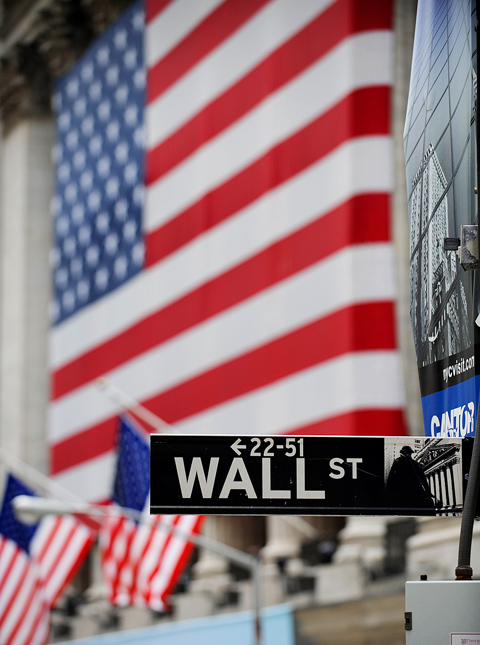
PHOTO: AFP
A new study of the foreign companies that fled the US market after the Securities and Exchange Commission (SEC) made it easy for them to do so last year suggests that the companies that left were largely ones whose slow growth, and poor market performance, had reduced their need and ability to attract US capital. There is even some indication that the market punished companies that decided to leave even though they could still use the capital.
What the study shows, said one of the authors, G. Andrew Karolyi, a finance professor at Ohio State, is that the market did not react favorably when companies got out from under US regulation.
Instead, the paper by Korolyi, along with Rene Stulz, also of Ohio State, and Craig Doidge of the University of Toronto, found that share prices suffered in the few cases where foreign companies with good growth prospects left the US market.
“When they choose to leave even though they are benefiting” from the US listing, Karolyi said in an interview, “shareholders may wonder if there is something sneaky going on.”
There has long been evidence that overseas firms benefit, through a lower cost of capital, when they choose to list their shares in the US. Their shares trade for higher prices than do those of similar companies that do not choose to list here.
Why is that? The traditional answer is that investors have more faith in companies that comply with US disclosure rules and reconcile their books to US accounting standards.
The advantage of a US listing faded early in this decade, although it did not vanish.
The scandals at Enron and WorldCom did not renew faith in US rules, and it turned out that the US listing premium had soared in the late 1990s in part because foreign technology companies flocked to the US to take advantage of what turned out to be a bubble. Their collapse made the US premium seem smaller.
The premium hit bottom in 2002, and recovered somewhat after that. Was that a reflection of investor confidence being renewed by passage of Sarbanes-Oxley? Not to hear the critics tell it. The Committee on Capital Markets Regulation, an independent panel whose creation in 2006 was heralded by US Treasury Secretary Henry Paulson cited that data as proof that Sarbanes-Oxley hurt the markets.
Their logic: The average premium after 2002, when the law passed, was lower than it was before the bubble burst. The committee ignored the fact the premium rose after the law was passed.
There is no question that the costs of complying with Section 404 of the law — requiring audits of corporate internal controls — has scared executives in the US and abroad. The first year of audits found lots of problems, but for the vast majority of large companies those problems have since been fixed. And the costs of audits, which soared, have stabilized.
That does not prove the audits were worth the cost, although the fact that so many problems were fixed — in some cases requiring substantial accounting restatements — does indicate there was considerable benefit.
Those benefits are not yet available to owners of microcap US companies, those with less than US$75 million in market capitalization. The SEC has repeatedly delayed requiring them to obey the law. The heads of the congressional small-business committees, Senator John Kerry and Representative Nydia Velazquez have pushed for the delays, arguing that Sarbanes-Oxley compliance would hurt the companies.
Historically, the US made it difficult for any company, foreign or domestic, to abandon its SEC registration. The logic was that investors had bought securities with the promise that they would have the protection of US securities laws, and it was unfair to remove that protection so long as a significant number of Americans still owned the shares.
The result was that a foreign company listed on the New York Stock Exchange or NASDAQ could drop its listing, but it still had to comply with US disclosure requirements and accounting rules. Critics called it the Hotel California rule, after the Eagles song about a place where “you can check out anytime you like, but you can never leave.”
That changed last year, when the SEC made it easy for most foreign companies to leave, producing the exodus that the authors study. They focus on 59 companies that dropped their US registration. That number is too small to be definitive, but the study finds no evidence to support the thesis that companies that leave the US are rewarded by investors, and some evidence to indicate that those who could benefit from a US listing are punished.
There is some reason to think the US premium is destined to disappear anyway. By letting companies walk away easily, the advantage of a US registration is reduced, Stulz has argued. The SEC is moving to allow foreign companies to use international accounting rules, so any advantage from confidence in US accounting rules will vanish. And the commission is making it much easier for brokers to sell unregistered foreign shares to Americans.
“I think there is a grave risk that the advantage may be lost because of the continued chipping away at the rock,” Karolyi said. “It just doesn’t seem like the right time or the right place to be engaged in a serious deregulation of financial markets.”

Stephen Garrett, a 27-year-old graduate student, always thought he would study in China, but first the country’s restrictive COVID-19 policies made it nearly impossible and now he has other concerns. The cost is one deterrent, but Garrett is more worried about restrictions on academic freedom and the personal risk of being stranded in China. He is not alone. Only about 700 American students are studying at Chinese universities, down from a peak of nearly 25,000 a decade ago, while there are nearly 300,000 Chinese students at US schools. Some young Americans are discouraged from investing their time in China by what they see

Taiwan Transport and Storage Corp (TTS, 台灣通運倉儲) yesterday unveiled its first electric tractor unit — manufactured by Volvo Trucks — in a ceremony in Taipei, and said the unit would soon be used to transport cement produced by Taiwan Cement Corp (TCC, 台灣水泥). Both TTS and TCC belong to TCC International Holdings Ltd (台泥國際集團). With the electric tractor unit, the Taipei-based cement firm would become the first in Taiwan to use electric vehicles to transport construction materials. TTS chairman Koo Kung-yi (辜公怡), Volvo Trucks vice president of sales and marketing Johan Selven, TCC president Roman Cheng (程耀輝) and Taikoo Motors Group

MAJOR DROP: CEO Tim Cook, who is visiting Hanoi, pledged the firm was committed to Vietnam after its smartphone shipments declined 9.6% annually in the first quarter Apple Inc yesterday said it would increase spending on suppliers in Vietnam, a key production hub, as CEO Tim Cook arrived in the country for a two-day visit. The iPhone maker announced the news in a statement on its Web site, but gave no details of how much it would spend or where the money would go. Cook is expected to meet programmers, content creators and students during his visit, online newspaper VnExpress reported. The visit comes as US President Joe Biden’s administration seeks to ramp up Vietnam’s role in the global tech supply chain to reduce the US’ dependence on China. Images on

New apartments in Taiwan’s major cities are getting smaller, while old apartments are increasingly occupied by older people, many of whom live alone, government data showed. The phenomenon has to do with sharpening unaffordable property prices and an aging population, property brokers said. Apartments with one bedroom that are two years old or older have gained a noticeable presence in the nation’s six special municipalities as well as Hsinchu county and city in the past five years, Evertrust Rehouse Co (永慶房產集團) found, citing data from the government’s real-price transaction platform. In Taipei, apartments with one bedroom accounted for 19 percent of deals last


 RSS
RSS