


Feeling the chill from the US subprime crisis, Chinese exporters such as Zhejiang New Oriental Fastener Company (浙江新東方緊固件公司) no longer take it for granted that their customers will pay them.
The company, whose 600 staff members produce screws, nuts and bolts by the millions, has found that in an age of uncertainty it has to rethink the nuts and bolts of global trade.
“With the subprime crisis, each of our clients has become potentially exposed to unpredictable risks such as bankruptcy,” said Xiang Guihong, sales manager at the company, which focuses on North American and Australian markets.
Xiang said his company used to have “great faith” in its regular customers, but early this year it started to buy credit insurance for all orders to guard against possible payment defaults.
“As late as last year we felt no need for such a practice. Now we understand that it will help our credit risk management,” he said.
Xiang said the company was particularly affected by the gloomy US property market because its products are widely used in construction.
Based in Zhejiang Province — a major export powerhouse — the company saw shipments to the US slump more than 30 percent in the first five months of this year from a year earlier.
Stories like this help explain why in the first five months of this year, China’s overall trade surplus declined 8.6 percent from the same period a year ago to US$78 billion.
This has served as a wake-up call for Xiang and thousands of other Chinese businesspeople, who have traditionally under-emphasized the need for hedging against customer default.
“There is underestimation of the credit risks in Asia in general and in China in particular,” said Jerome Cazes, chief executive of Coface, a Paris-based trade insurer.
Many local firms simply rely on trading records and site visits for credit evaluation.
“The subprime crisis is now impacting the real economy, meaning that the B2B [business-to-business] credit crisis kicked in January 2008 and will continue at least for the full year 2008,” he said.
Xiang said New Oriental, which had allowed for payment terms as long as 60 days in the past, now requires its US clients to pay for the goods within seven to 10 days after delivery.
“Steelmakers and steel trading firms only accept cash for payments,” he said. “Our working capital is so tight that if we had a large amount of account receivables, we’d run out of money needed to buy raw materials for new orders.”
This is a situation felt by a large number of exporting Chinese companies, Coface said.
“Domestic companies exporting to the US are affected by payment incidents in the United States and in turn cannot pay their suppliers in China,” said Richard Burton, the insurer’s regional managing director for Greater China.
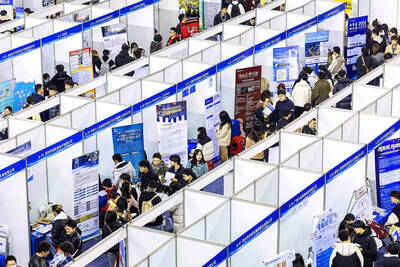
Stephen Garrett, a 27-year-old graduate student, always thought he would study in China, but first the country’s restrictive COVID-19 policies made it nearly impossible and now he has other concerns. The cost is one deterrent, but Garrett is more worried about restrictions on academic freedom and the personal risk of being stranded in China. He is not alone. Only about 700 American students are studying at Chinese universities, down from a peak of nearly 25,000 a decade ago, while there are nearly 300,000 Chinese students at US schools. Some young Americans are discouraged from investing their time in China by what they see
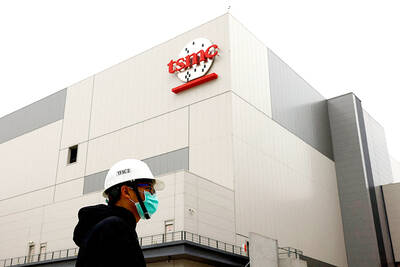
Taiwan Semiconductor Manufacturing Co (TSMC, 台積電), the world’s largest contract chipmaker, yesterday reported record sales for the first quarter, which analysts attributed to solid demand for emerging technologies. Consolidated revenue totaled NT$592.64 billion (US$18.51 billion) in the January-to-March period, up 16.5 percent from a year earlier, but down 5.26 percent from the previous quarter, TSMC said in a statement. The first-quarter revenue beat analysts’ average projection of NT$579.5 billion, Bloomberg News reported. That performance lends weight to expectations that the world’s most valuable chipmaker would return to solid growth this year after weathering a post-COVID-19-pandemic cratering of smartphone and computer sales. TSMC is budgeting

MAJOR DROP: CEO Tim Cook, who is visiting Hanoi, pledged the firm was committed to Vietnam after its smartphone shipments declined 9.6% annually in the first quarter Apple Inc yesterday said it would increase spending on suppliers in Vietnam, a key production hub, as CEO Tim Cook arrived in the country for a two-day visit. The iPhone maker announced the news in a statement on its Web site, but gave no details of how much it would spend or where the money would go. Cook is expected to meet programmers, content creators and students during his visit, online newspaper VnExpress reported. The visit comes as US President Joe Biden’s administration seeks to ramp up Vietnam’s role in the global tech supply chain to reduce the US’ dependence on China. Images on
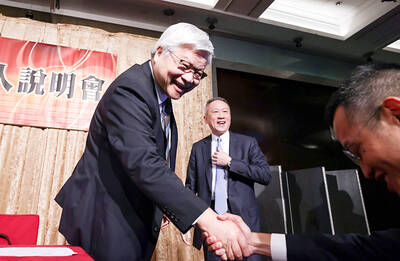
US CONSCULTANT: The US Department of Commerce’s Ursula Burns is a rarely seen US government consultant to be put forward to sit on the board, nominated as an independent director Taiwan Semiconductor Manufacturing Co (TSMC, 台積電), the world’s largest contract chipmaker, yesterday nominated 10 candidates for its new board of directors, including Ursula Burns from the US Department of Commerce. It is rare that TSMC has nominated a US government consultant to sit on its board. Burns was nominated as one of seven independent directors. She is vice chair of the department’s Advisory Council on Supply Chain Competitiveness. Burns is to stand for election at TSMC’s annual shareholders’ meeting on June 4 along with the rest of the candidates. TSMC chairman Mark Liu (劉德音) was not on the list after in December last


 RSS
RSS