


The government must provide incentives to the nation’s high-tech manufacturing industries to encourage companies to deepen their roots in Taiwan, the Taiwan Semiconductor Industry Association (TSIA, 台灣半導體協會) said yesterday.
“The government should provide more incentives, such as land acquisition and personnel training, to high-tech manufacturing industries — such as semiconductor, liquid crystal display (LCD), light-emitting diode and solar energy — so that they will stay in Taiwan,” TSIA chairman Frank Huang (黃崇仁) said during an opening speech at the 2008 SemiTech Taipei yesterday.
Huang is also chairman of Powerchip Semiconductor Corp (PSC, 力晶半導體), the nation’s top computer memory chipmaker.
Huang’s remarks came as the Statute for Upgrading Industries (促進產業升級條例) is scheduled to expire in December next year, whereupon the government would stop offering tax breaks and other preferential treatment to tech companies.
Addressing the opening of the trade show, President Ma Ying-jeou (馬英九) said the government would reconsider the needs of high-tech companies if the statute were not renewed next year.
In addition, the government would also move toward deregulation to provide maximum development opportunities for high-tech industries in Taiwan, he said.
The nation’s tech companies are facing a tougher operating environment this year, mostly as a result of the US subprime mortgage crisis, rising raw material costs worldwide, a stricter labor law, the rising yuan and a stronger NT dollar.
But a new regulation marking employee bonuses as company expenses is posed to provide the greatest impact on the tech sector’s operating cash flow this year, Taiwan Ratings Corp (中華信評) said in a report yesterday.
Taiwanese high-tech firms used to issue new shares to employees as bonuses without affecting their bottom lines.
Under the new regulation, however, these companies are required to pay their employee bonuses mostly in cash, which reduces cash flow.
“We believe that the impact is absorbable, as all the rated tech companies have restricted total bonuses to less than 15 percent of their net income,” Taiwan Ratings credit analyst Raymond Hsu (�?M) wrote in the report. “In the longer term, this could nevertheless affect tech companies’ ability to compete for new talent against neighboring countries.”
The report, titled Tech Companies’ Entrenched Market Positions Ensure Credit Quality Under Tougher Operating Conditions, said that the slowing US economy had had no visible effect on the tech companies rated by Taiwan Ratings in the first quarter of this year.
But slowing US demand following the subprime crisis raised worries within the industry, particularly for semiconductor foundry companies that are typically sensitive to changing demand, the report said, adding that chip companies had consequently slowed the pace of capacity expansion plans, but had still managed to make good profits during the first quarter.
“We expect their profitability will not significantly weaken over the next two quarters,” Hsu said.
Leaders in the dynamic random access memory and thin-film-transistor LCD sectors are expected to show a stable credit outlook in the coming quarter, which Taiwan Ratings has attributed to their “entrenched market positions, competent management and somewhat satisfactory profitability,” the report said.
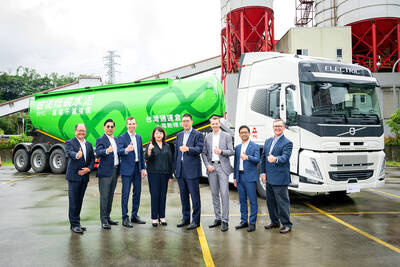
Taiwan Transport and Storage Corp (TTS, 台灣通運倉儲) yesterday unveiled its first electric tractor unit — manufactured by Volvo Trucks — in a ceremony in Taipei, and said the unit would soon be used to transport cement produced by Taiwan Cement Corp (TCC, 台灣水泥). Both TTS and TCC belong to TCC International Holdings Ltd (台泥國際集團). With the electric tractor unit, the Taipei-based cement firm would become the first in Taiwan to use electric vehicles to transport construction materials. TTS chairman Koo Kung-yi (辜公怡), Volvo Trucks vice president of sales and marketing Johan Selven, TCC president Roman Cheng (程耀輝) and Taikoo Motors Group

Among the rows of vibrators, rubber torsos and leather harnesses at a Chinese sex toys exhibition in Shanghai this weekend, the beginnings of an artificial intelligence (AI)-driven shift in the industry quietly pulsed. China manufactures about 70 percent of the world’s sex toys, most of it the “hardware” on display at the fair — whether that be technicolor tentacled dildos or hyper-realistic personalized silicone dolls. Yet smart toys have been rising in popularity for some time. Many major European and US brands already offer tech-enhanced products that can enable long-distance love, monitor well-being and even bring people one step closer to
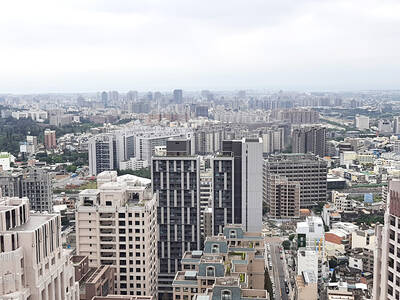
New apartments in Taiwan’s major cities are getting smaller, while old apartments are increasingly occupied by older people, many of whom live alone, government data showed. The phenomenon has to do with sharpening unaffordable property prices and an aging population, property brokers said. Apartments with one bedroom that are two years old or older have gained a noticeable presence in the nation’s six special municipalities as well as Hsinchu county and city in the past five years, Evertrust Rehouse Co (永慶房產集團) found, citing data from the government’s real-price transaction platform. In Taipei, apartments with one bedroom accounted for 19 percent of deals last
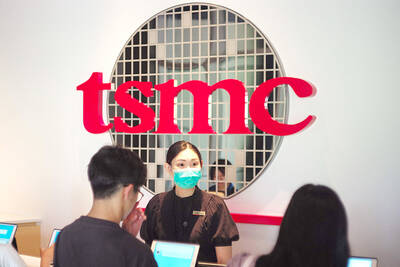
RECORD-BREAKING: TSMC’s net profit last quarter beat market expectations by expanding 8.9% and it was the best first-quarter profit in the chipmaker’s history Taiwan Semiconductor Manufacturing Co (TSMC, 台積電), which counts Nvidia Corp as a key customer, yesterday said that artificial intelligence (AI) server chip revenue is set to more than double this year from last year amid rising demand. The chipmaker expects the growth momentum to continue in the next five years with an annual compound growth rate of 50 percent, TSMC chief executive officer C.C. Wei (魏哲家) told investors yesterday. By 2028, AI chips’ contribution to revenue would climb to about 20 percent from a percentage in the low teens, Wei said. “Almost all the AI innovators are working with TSMC to address the


 RSS
RSS