


The New Taiwan dollar and the Thai baht led gains among Asian currencies this week as investor appetite for the region's assets returned.
The Taiwanese currency advanced 0.8 percent, the second-best performer of the 10 most-traded Asian currencies excluding the yen. Exchange rates also rose on speculation central banks are allowing their currencies to appreciate to temper inflation. The baht climbed to its highest level since 1997 after the government said it was reviewing capital controls imposed after the ouster of former Thai prime minister Thaksin Shinawatra in late 2006.
The Taiwanese currency added 0.8 percent this week to NT$31.740, said Taipei Forex Inc, the biggest advance since the period ended Sept. 28 and a fifth week of gains.
"There were a lot of overseas fund inflows and exporters were dumping the US dollar," said Gary Huang, a currency trader at Union Bank of Taiwan (
The rupiah gained 0.8 percent this week to 9,169 per dollar and the Singapore dollar rose 0.4 percent to S$1.4138.
Thailand's baht rose the most in the five days since November in onshore trading on speculation exporters had exchanged overseas earnings to guard against further losses in the dollar.
The baht advanced past 32.70 per US dollar on Friday for the first time since August 1997 and was the best performing Asian currency this week. The government on Tuesday said it will decide by April whether to lift remaining restrictions on capital entering the nation.
"The central bank hasn't been aggressively intervening" to slow baht appreciation, said Tetsuo Yoshikoshi, a market analyst in Singapore at Sumitomo Mitsui Banking Corp Exporters "are selling dollars, fearing some sort of change to capital controls will push the dollar lower."
The baht climbed 1.2 percent to 32.56, according to data compiled by Bloomberg.
South Korea's won posted a weekly loss as overseas investors added to sales of the nation's shares. The won is the second-worst performer of the 16 most-active currencies this year as funds abroad sold Korean stocks on every day except three this year, offloading US$10.4 billion more than they bought.
Benchmark Asian stock markets on Friday followed declines in US equities after Federal Reserve Chairman Ben Bernanke said the "downside risks to growth have increased."
"Both onshore and offshore players are inclined to go long with dollars after the drop in US shares," said Kim Sung-soon, a currency dealer at state-run Industrial Bank of Korea in Seoul. "Foreign selling of stocks is heavily on the mind of traders."
Korea's currency fell 0.4 percent this week to 945.05 against the dollar, according to Seoul Money Brokerage Services Ltd. A long position is a bet an asset will gain.
The KOSPI index of shares declined 0.2 percent on Friday, adding to this year's 11 percent loss.
The Philippine peso fell for a second week on concern an Associated Press report of a plan to assassinate Philippine President Gloria Macapagal Arroyo will cause investors to shun the nation's assets.
The currency was the second-worst performer this month among the 10-most active Asian currencies before yesterday's protest rally against alleged corruption in government.
The Philippine currency traded at 40.70 in Manila, according to data compiled by Bloomberg. It closed at 41.00 on Thursday and 40.65 on Feb. 8, based on data from the Bankers Association of the Philippines.
Elsewhere, Vietnam's dong added 0.1 percent in the week to 15,957.5 per dollar.

Stephen Garrett, a 27-year-old graduate student, always thought he would study in China, but first the country’s restrictive COVID-19 policies made it nearly impossible and now he has other concerns. The cost is one deterrent, but Garrett is more worried about restrictions on academic freedom and the personal risk of being stranded in China. He is not alone. Only about 700 American students are studying at Chinese universities, down from a peak of nearly 25,000 a decade ago, while there are nearly 300,000 Chinese students at US schools. Some young Americans are discouraged from investing their time in China by what they see

Taiwan Transport and Storage Corp (TTS, 台灣通運倉儲) yesterday unveiled its first electric tractor unit — manufactured by Volvo Trucks — in a ceremony in Taipei, and said the unit would soon be used to transport cement produced by Taiwan Cement Corp (TCC, 台灣水泥). Both TTS and TCC belong to TCC International Holdings Ltd (台泥國際集團). With the electric tractor unit, the Taipei-based cement firm would become the first in Taiwan to use electric vehicles to transport construction materials. TTS chairman Koo Kung-yi (辜公怡), Volvo Trucks vice president of sales and marketing Johan Selven, TCC president Roman Cheng (程耀輝) and Taikoo Motors Group

MAJOR DROP: CEO Tim Cook, who is visiting Hanoi, pledged the firm was committed to Vietnam after its smartphone shipments declined 9.6% annually in the first quarter Apple Inc yesterday said it would increase spending on suppliers in Vietnam, a key production hub, as CEO Tim Cook arrived in the country for a two-day visit. The iPhone maker announced the news in a statement on its Web site, but gave no details of how much it would spend or where the money would go. Cook is expected to meet programmers, content creators and students during his visit, online newspaper VnExpress reported. The visit comes as US President Joe Biden’s administration seeks to ramp up Vietnam’s role in the global tech supply chain to reduce the US’ dependence on China. Images on
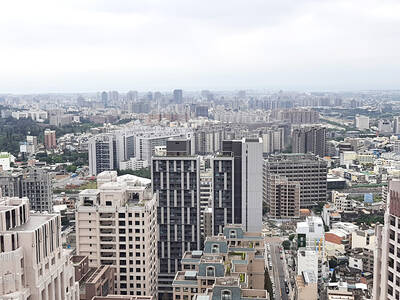
New apartments in Taiwan’s major cities are getting smaller, while old apartments are increasingly occupied by older people, many of whom live alone, government data showed. The phenomenon has to do with sharpening unaffordable property prices and an aging population, property brokers said. Apartments with one bedroom that are two years old or older have gained a noticeable presence in the nation’s six special municipalities as well as Hsinchu county and city in the past five years, Evertrust Rehouse Co (永慶房產集團) found, citing data from the government’s real-price transaction platform. In Taipei, apartments with one bedroom accounted for 19 percent of deals last


 RSS
RSS