


A sub-market of the Taiwan Stock Exchange (TAIEX) will soon be launched, allowing the nation's small and medium-sized enterprises (SMEs) based in Asia to raise funds from the world's institutional investors, Financial Supervisory Commission chairman Hu Sheng-cheng (
"To expand the nation's capital market, the commission will soon launch the TAIEX's sub-market, similar to what had formerly been coined the major bourse's international slate," Hu was quoted as saying.
"We plan to first target Taiwa-nese SMEs based outside China, such as Vietnam, Thailand and Indonesia, with capital of between NT$50 million (US$1.6 million) and NT$600 million," Hu said, without giving a definite timetable.
Modeling itself on the London Stock Exchange's alternative investment market, the commission will also offer incentives for companies to get listed, including a more flexible regulatory system than that in place for the approximately 600 companies listed on the TAIEX.
Companies that are allowed to list in the sub-market will not be required to install independent directors to their boards, Hu said, adding that they would also enjoy lax accounting standards as long as they incorporated using international standards.
Although sub-listed companies can bring fatter rewards, they can also pose a higher risk, Hu said, adding that the market would only be open to institutional investors to share investments.
He also extended his welcome to multinational companies to obtain a listing.
The commission's new proposal seeks to attract foreign capital, but market watchers yesterday said the nation will need to rid itself of political uncertainty to avoid scaring potential investors.
"It is political uncertainty, before or after the upcoming elections, that is keeping foreign investors from buying Taiwanese shares," said Renee Chan (
Chan said, however, that the commission's sub-market proposal was a good idea.
Despite local listed companies' robust earning performance, the TAIEX has lagged behind major Asian markets, Chan said.
She said the company expected TAIEX-listed companies to average a 26 percent earning growth, with an averaged price-to-earning ratio of 14 this year, although their earning growth could decline to 13 percent next year.
In this context, we would expect domestic and international investors to be very bullish about the TAIEX, Chan said. But because of the unstable political climate in Taiwan, investors have avoided the market.
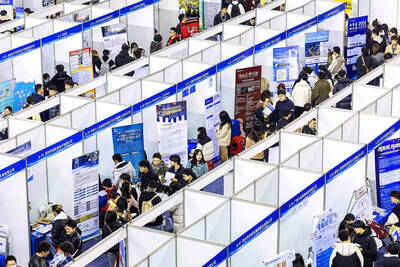
Stephen Garrett, a 27-year-old graduate student, always thought he would study in China, but first the country’s restrictive COVID-19 policies made it nearly impossible and now he has other concerns. The cost is one deterrent, but Garrett is more worried about restrictions on academic freedom and the personal risk of being stranded in China. He is not alone. Only about 700 American students are studying at Chinese universities, down from a peak of nearly 25,000 a decade ago, while there are nearly 300,000 Chinese students at US schools. Some young Americans are discouraged from investing their time in China by what they see
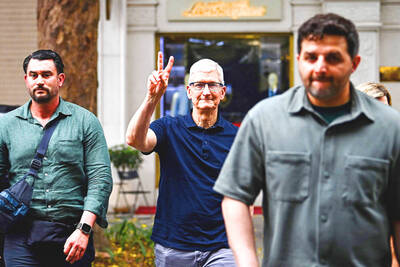
MAJOR DROP: CEO Tim Cook, who is visiting Hanoi, pledged the firm was committed to Vietnam after its smartphone shipments declined 9.6% annually in the first quarter Apple Inc yesterday said it would increase spending on suppliers in Vietnam, a key production hub, as CEO Tim Cook arrived in the country for a two-day visit. The iPhone maker announced the news in a statement on its Web site, but gave no details of how much it would spend or where the money would go. Cook is expected to meet programmers, content creators and students during his visit, online newspaper VnExpress reported. The visit comes as US President Joe Biden’s administration seeks to ramp up Vietnam’s role in the global tech supply chain to reduce the US’ dependence on China. Images on
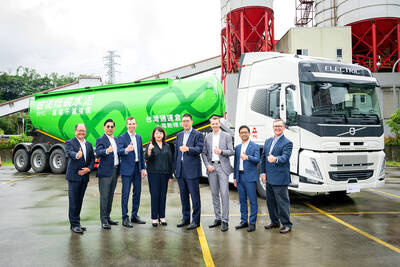
Taiwan Transport and Storage Corp (TTS, 台灣通運倉儲) yesterday unveiled its first electric tractor unit — manufactured by Volvo Trucks — in a ceremony in Taipei, and said the unit would soon be used to transport cement produced by Taiwan Cement Corp (TCC, 台灣水泥). Both TTS and TCC belong to TCC International Holdings Ltd (台泥國際集團). With the electric tractor unit, the Taipei-based cement firm would become the first in Taiwan to use electric vehicles to transport construction materials. TTS chairman Koo Kung-yi (辜公怡), Volvo Trucks vice president of sales and marketing Johan Selven, TCC president Roman Cheng (程耀輝) and Taikoo Motors Group
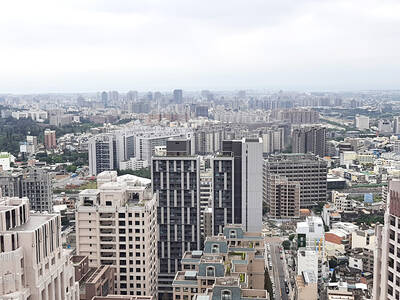
New apartments in Taiwan’s major cities are getting smaller, while old apartments are increasingly occupied by older people, many of whom live alone, government data showed. The phenomenon has to do with sharpening unaffordable property prices and an aging population, property brokers said. Apartments with one bedroom that are two years old or older have gained a noticeable presence in the nation’s six special municipalities as well as Hsinchu county and city in the past five years, Evertrust Rehouse Co (永慶房產集團) found, citing data from the government’s real-price transaction platform. In Taipei, apartments with one bedroom accounted for 19 percent of deals last


 RSS
RSS