


Armed with a soldering iron and a large supply of energy drinks, a teenager has developed a way to make the iPhone, arguably the gadget of the year, available to a much wider audience.
George Hotz of New Jersey spent his last summer before college figuring out how to "unlock" the iPhone, freeing it from being restricted to a single carrier, AT&T Inc.
The procedure, which the 17-year-old posted on his blog on Thursday, raises the possibility of a small industry springing up to buy iPhones, unlocking them and then selling them to people who do not want AT&T service or cannot get it, particularly overseas.
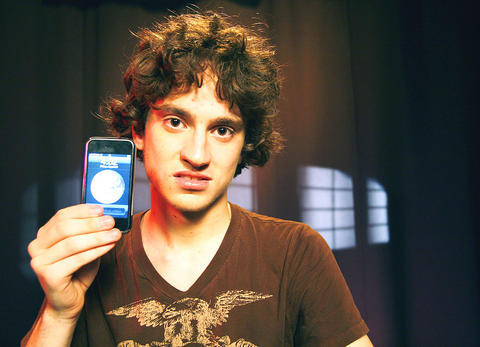
PHOTO: AP
The phone, which combines an innovative touch-screen interface with the media-playing abilities of the iPod, is currently sold only in the US
An AP reporter was able to verify that an iPhone Hotz brought to the AP's headquarters on Friday was unlocked. Hotz placed the reporter's T-Mobile SIM card, a small chip that identifies a phone to the network, in the iPhone. It then connected to T-Mobile's network and placed calls using the reporter's account.
T-Mobile is the only major US carrier apart from AT&T that is compatible with the iPhone's cellular technology, but smaller carriers also use the technology, known as GSM. In Europe and Asia, GSM is the dominant network technology.
The hack is complicated and requires skill with both soldering and software, and missteps may result in the iPhone becoming useless, so few people will be able to follow the instructions.
"But that's the simplest I could make them," Hotz said. The next step, he said, would be for someone to develop a way to unlock the phone using only software.
no comment
AT&T spokesman Mark Siegel and Apple spokeswoman Jennifer Bowcock said their companies had no comment. Hotz said the companies had not been in touch with him.
Apple shares rose US$4.23, or 3.2 percent, to close at US$135.30 on Friday. AT&T shares gained US$0.26, or 0.7 percent, to close at US$40.36.
The iPhone has already been made to work on overseas networks using another method, which involves copying information from the SIM chip.
The SIM-chip method does not involve any soldering, but does require special equipment, and it does not unlock the phone -- each new SIM chip has to be reprogrammed for use on a particular iPhone.
Both hacks leave intact the iPhone's many functions, including a built-in camera and the ability to access Wi-Fi networks. The only thing that will not work is the "visual voicemail" feature, which lists voice messages as if they were incoming e-mail.
Since the details of both hacks have been made public, Apple may be able to modify the iPhone production line to make new phones invulnerable.
Analysts said it is unlikely Apple would overhaul the iPhone's wiring to thwart the new hack because the difficulty of the procedure is likely to keep it confined to hardcore hobbyists.
"I'm having a hard time figuring out where the real pain is going to come from in this," said David Chamberlain, principal analyst with market researcher In-Stat who follows mobile devices and services. "Just selling the piece of hardware, they've made a nice profit off that."
Apple has said it plans to introduce the phone in Europe this year, but it has not set a date or identified carriers.
There is apparently no US law against unlocking cell phones. Last year, the Library of Congress specifically excluded cellphone unlocking from coverage under the Digital Millennium Copyright Act. Among other things, the law has been used to prosecute people who modify game consoles to play a wider variety of games.
collaborator
Hotz collaborated online with a large number of people to develop the unlocking process. Of the smaller core group, two were in Russia.
"Then there are two guys who I think are somewhere US-side," Hotz said. He knows them only by their online handles.
Hotz himself spent about 500 hours on the project since the iPhone went on sale. On Thursday, he put the unlocked iPhone up for sale on eBay, where the high bid was at US$12,600 late on Friday. The model, with 4 gigabytes of memory, sells for US$499 new.
"Some of my friends think I wasted my summer, but I think it was worth it," he told the Record of Bergen County, which reported Hotz's hack on Friday.
Hotz headed for college yesterday. He plans to major in neuroscience -- or "hacking the brain" as he puts it -- at the Rochester Institute of Technology.

Stephen Garrett, a 27-year-old graduate student, always thought he would study in China, but first the country’s restrictive COVID-19 policies made it nearly impossible and now he has other concerns. The cost is one deterrent, but Garrett is more worried about restrictions on academic freedom and the personal risk of being stranded in China. He is not alone. Only about 700 American students are studying at Chinese universities, down from a peak of nearly 25,000 a decade ago, while there are nearly 300,000 Chinese students at US schools. Some young Americans are discouraged from investing their time in China by what they see

Taiwan Semiconductor Manufacturing Co (TSMC, 台積電), the world’s largest contract chipmaker, yesterday reported record sales for the first quarter, which analysts attributed to solid demand for emerging technologies. Consolidated revenue totaled NT$592.64 billion (US$18.51 billion) in the January-to-March period, up 16.5 percent from a year earlier, but down 5.26 percent from the previous quarter, TSMC said in a statement. The first-quarter revenue beat analysts’ average projection of NT$579.5 billion, Bloomberg News reported. That performance lends weight to expectations that the world’s most valuable chipmaker would return to solid growth this year after weathering a post-COVID-19-pandemic cratering of smartphone and computer sales. TSMC is budgeting

MAJOR DROP: CEO Tim Cook, who is visiting Hanoi, pledged the firm was committed to Vietnam after its smartphone shipments declined 9.6% annually in the first quarter Apple Inc yesterday said it would increase spending on suppliers in Vietnam, a key production hub, as CEO Tim Cook arrived in the country for a two-day visit. The iPhone maker announced the news in a statement on its Web site, but gave no details of how much it would spend or where the money would go. Cook is expected to meet programmers, content creators and students during his visit, online newspaper VnExpress reported. The visit comes as US President Joe Biden’s administration seeks to ramp up Vietnam’s role in the global tech supply chain to reduce the US’ dependence on China. Images on
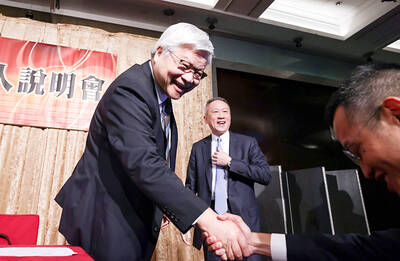
US CONSCULTANT: The US Department of Commerce’s Ursula Burns is a rarely seen US government consultant to be put forward to sit on the board, nominated as an independent director Taiwan Semiconductor Manufacturing Co (TSMC, 台積電), the world’s largest contract chipmaker, yesterday nominated 10 candidates for its new board of directors, including Ursula Burns from the US Department of Commerce. It is rare that TSMC has nominated a US government consultant to sit on its board. Burns was nominated as one of seven independent directors. She is vice chair of the department’s Advisory Council on Supply Chain Competitiveness. Burns is to stand for election at TSMC’s annual shareholders’ meeting on June 4 along with the rest of the candidates. TSMC chairman Mark Liu (劉德音) was not on the list after in December last


 RSS
RSS