


Facing a major test, the Federal Reserve pumped billions of dollars into the US financial system after a global credit crunch sent Wall Street into a dive and shriveled the nest eggs of investors large and small.
Will it be enough or will Fed Chairman Ben Bernanke and his central bank colleagues have to dig deeper into their arsenal?
The Fed's action may have eased some investors' anxieties. The Dow Jones industrial average was down again Friday, but only a little -- 31 points -- by the end of a seesaw day.
The Federal Reserve has a range of tools to keep financial institutions' problems from morphing into a broader economic crisis. It can also use the power of words to try to calm investors.
So far, the Fed has chosen a little of both.
It ordered extra cash to be plowed into the system, hoping to help banks and other institutions get over the hump and carry out their business more smoothly.
The Fed also sought to send a reassuring message to Wall Street and Main Street that it is on top of an unsettling situation, pledging to provide "reserves as necessary" to help the markets safely make their way.
Bernanke and his colleagues had to walk a fine line to acknowledge a problem, discuss some relief but not say anything that might spook investors further.
"If they were to say it is a really big crisis and they are really concerned it could translate into an economic crisis, it would have the reverse effect on investors and send them into a bigger panic," said Victor Li, economics professor Villanova School of Business.
The Fed cannot ignore the market's pain. At the same time, it must be mindful of doing what is best for the economy in the long run.
The Fed, in a meeting on Tuesday, acknowledged that Wall Street turbulence, credit problems and a nationwide housing slump pose increasing threats to the economy. But it refrained from cutting rates and stuck to a forecast that the economy will weather the financial storm and grow gradually in coming months.
"It seems like Bernanke might be more willing than [former chairman] Alan Greenspan to let financial stress play out to ensure investors don't feel emboldened in the future and take on more risk. There is a sense that Bernanke buys into that argument more than Greenspan did," said Mark Zandi, chief economist at Moody's Economy.com.
"We'll see if that is true in the next week or so. If markets remain unstable, it will be a test to see how closely the Bernanke Fed sticks to the Greenspan cookbook."
To make sure there's adequate money available, the Federal Reserve pushed US$38 billion in temporary reserves into the system on Friday -- the biggest injection since the days following the Sept. 11, 2001, terror attacks. On Thursday, the Fed had put US$24 billion into the system.
Banks were also told that the Fed's discount window -- where they can turn in an emergency for short-term loans -- is available as a source of funding. After the 2001 terror attacks, the Fed used the discount window to extend billions of dollars worth of emergency loans to keep the financial system functioning.
Besides injecting cash into the financial system as it did on Thursday and Friday, the Fed could lower the discount rate on loans to banks. That would encourage increased lending to people and businesses. The Fed has done this before in times of economic or financial crisis.
The central bank's most potent weapon, though, would be to lower the federal funds rate, now at 5.25 percent. That rate is the interest banks charge each other on overnight loans.
Cutting that rate would influence other important lending rates throughout the economy. Most notably, it would led to a corresponding reduction in commercial banks' prime interest rate -- now at 8.25 percent -- for certain credit cards, home equity lines of credit and other loans.
Bernanke, an economist and former academic, took the Federal Reserve helm in February last year. He succeeded Greenspan, who in his run of more than 18 years seemed to some to have a sixth sense about Wall Street's psyche.

Among the rows of vibrators, rubber torsos and leather harnesses at a Chinese sex toys exhibition in Shanghai this weekend, the beginnings of an artificial intelligence (AI)-driven shift in the industry quietly pulsed. China manufactures about 70 percent of the world’s sex toys, most of it the “hardware” on display at the fair — whether that be technicolor tentacled dildos or hyper-realistic personalized silicone dolls. Yet smart toys have been rising in popularity for some time. Many major European and US brands already offer tech-enhanced products that can enable long-distance love, monitor well-being and even bring people one step closer to

Malaysia’s leader yesterday announced plans to build a massive semiconductor design park, aiming to boost the Southeast Asian nation’s role in the global chip industry. A prominent player in the semiconductor industry for decades, Malaysia accounts for an estimated 13 percent of global back-end manufacturing, according to German tech giant Bosch. Now it wants to go beyond production and emerge as a chip design powerhouse too, Malaysian Prime Minister Anwar Ibrahim said. “I am pleased to announce the largest IC (integrated circuit) Design Park in Southeast Asia, that will house world-class anchor tenants and collaborate with global companies such as Arm [Holdings PLC],”

Sales in the retail, and food and beverage sectors last month continued to rise, increasing 0.7 percent and 13.6 percent respectively from a year earlier, setting record highs for the month of March, the Ministry of Economic Affairs said yesterday. Sales in the wholesale sector also grew last month by 4.6 annually, mainly due to the business opportunities for emerging applications related to artificial intelligence (AI) and high-performance computing technologies, the ministry said in a report. The ministry forecast that retail, and food and beverage sales this month would retain their growth momentum as the former would benefit from Tomb Sweeping Day
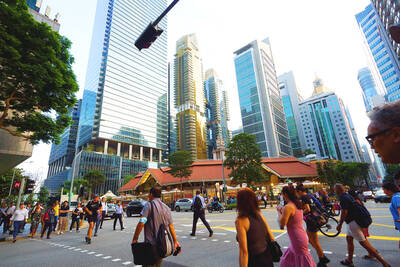
Thousands of parents in Singapore are furious after a Cordlife Group Ltd (康盛人生集團), a major operator of cord blood banks in Asia, irreparably damaged their children’s samples through improper handling, with some now pursuing legal action. The ongoing case, one of the worst to hit the largely untested industry, has renewed concerns over companies marketing themselves to anxious parents with mostly unproven assurances. This has implications across the region, given Cordlife’s operations in Hong Kong, Macau, Indonesia, the Philippines and India. The parents paid for years to have their infants’ cord blood stored, with the understanding that the stem cells they contained


 RSS
RSS