


There is no end in sight to the price war among local banks, which could reduce profits and trigger a downgrade of the fragmented banking industry, a ratings agency said yesterday.
"Unlike Singapore and Hong Kong, where leading banks have the power to set prices, Taiwan is an overcrowded market, where big lenders are not big enough to take the lead," Susan Chu (朱素徵), director of financial institution ratings at Taiwan Ratings Corp (中華信評), told the Taipei Times on the sidelines of a media briefing yesterday.
Poor market discipline could drag on for up to three years even though some banks have tried to turn things around, Chu said.
In its latest report on local banks, Taiwan Ratings, a local arm of Standard & Poor's Ratings Service, retained its stable outlook rating on the banking sector, that has moderate risk.
The report, Bank Industry Risk Analysis: Taiwan Banks' Operating Performance Remains Subdued in 2007, was released yesterday.
The sector's profitability remains constrained because of declining interest spreads, moderate corporate and consumer demand, and slow consolidation amid tight merger and acquisition (M&A) regulations, the firm said.
Taiwan is the second market in Asia after Japan to see the narrowest net interest margin (NIM). The nation's average NIM has dropped below 2 percent, compared with 3 percent in neighboring markets.
"Poor profitability will be the main trigger for a downgrade of Taiwan's banking sector if the price competition continues," Taiwan Ratings analyst Eunice Fan (范維華) said.
This makes banks vulnerable to economic cycles, especially amid the downtrend, Fan said.
Fitch Ratings raised similar concerns last month when it released its view of the banking industry, which has been plagued by bad debts since 2005.
Lingering interest margin contraction and cross-strait restrictions will continue to haunt Taiwanese banks in the coming year and "there is still a long way to get back to normal," Fitch said.
Large-scale consolidation would allow for the formation of dominating financial institutions with the power to set prices, which is what the fragmented banking sector needs most, Taiwan Ratings said.
Since last year, multinational banks have moved aggressively to buy local lenders to branch into the small-and-medium-enterprise segment. Standard Chartered Plc fired the first shot by acquiring Hsinchu International Bank (新竹國際商銀) last October, the first buyout deal in Taiwan's banking industry. Citibank was second, with its purchase of the Bank of Overseas Chinese (華僑銀行) in April, and ABN AMRO Bank NV was third with its acquisition of Taitung Business Bank (台東企銀) last month.
The first two foreign lenders combined command almost a 5 percent market share, but this is not expected to impact on local lenders in the short run, Chu said.
It may grow into an unavoidable threat to local lenders if they cannot find their niche or competitive edges within the next five years, she said.
The government's restrictions on Taiwanese banks operating in China will also hurt their competitiveness in this context, she said.
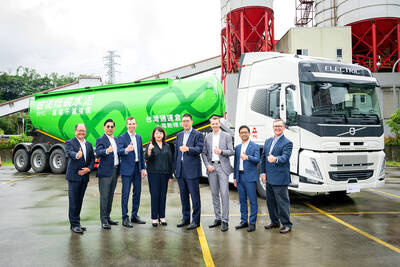
Taiwan Transport and Storage Corp (TTS, 台灣通運倉儲) yesterday unveiled its first electric tractor unit — manufactured by Volvo Trucks — in a ceremony in Taipei, and said the unit would soon be used to transport cement produced by Taiwan Cement Corp (TCC, 台灣水泥). Both TTS and TCC belong to TCC International Holdings Ltd (台泥國際集團). With the electric tractor unit, the Taipei-based cement firm would become the first in Taiwan to use electric vehicles to transport construction materials. TTS chairman Koo Kung-yi (辜公怡), Volvo Trucks vice president of sales and marketing Johan Selven, TCC president Roman Cheng (程耀輝) and Taikoo Motors Group

Among the rows of vibrators, rubber torsos and leather harnesses at a Chinese sex toys exhibition in Shanghai this weekend, the beginnings of an artificial intelligence (AI)-driven shift in the industry quietly pulsed. China manufactures about 70 percent of the world’s sex toys, most of it the “hardware” on display at the fair — whether that be technicolor tentacled dildos or hyper-realistic personalized silicone dolls. Yet smart toys have been rising in popularity for some time. Many major European and US brands already offer tech-enhanced products that can enable long-distance love, monitor well-being and even bring people one step closer to
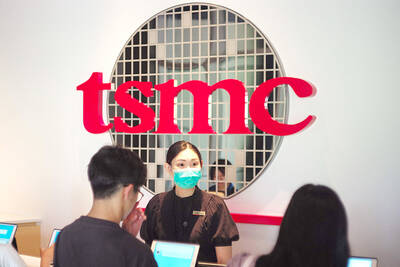
RECORD-BREAKING: TSMC’s net profit last quarter beat market expectations by expanding 8.9% and it was the best first-quarter profit in the chipmaker’s history Taiwan Semiconductor Manufacturing Co (TSMC, 台積電), which counts Nvidia Corp as a key customer, yesterday said that artificial intelligence (AI) server chip revenue is set to more than double this year from last year amid rising demand. The chipmaker expects the growth momentum to continue in the next five years with an annual compound growth rate of 50 percent, TSMC chief executive officer C.C. Wei (魏哲家) told investors yesterday. By 2028, AI chips’ contribution to revenue would climb to about 20 percent from a percentage in the low teens, Wei said. “Almost all the AI innovators are working with TSMC to address the

Malaysia’s leader yesterday announced plans to build a massive semiconductor design park, aiming to boost the Southeast Asian nation’s role in the global chip industry. A prominent player in the semiconductor industry for decades, Malaysia accounts for an estimated 13 percent of global back-end manufacturing, according to German tech giant Bosch. Now it wants to go beyond production and emerge as a chip design powerhouse too, Malaysian Prime Minister Anwar Ibrahim said. “I am pleased to announce the largest IC (integrated circuit) Design Park in Southeast Asia, that will house world-class anchor tenants and collaborate with global companies such as Arm [Holdings PLC],”


 RSS
RSS