


The PC market is slowing in mature markets and most future opportunities will be found in developing countries in the Asia-Pacific region and Latin America, while Microsoft's Vista operating system is not expected to have a big impact on the PC industry, an analyst said yesterday.
Vice president of International Data Corp (IDC) Bob O'Donnell said that last year PC sales in mature markets including North America and EMEA (Europe, the Middle East and Africa), totaled 46 million units more than those shipped to emerging markets.
But the gap will close to about 15 million units by 2011, O'Donnell said at an IDC forum.
Therefore, PC makers should think hard about grabbing the attention of consumers who have become picky about their choice of computer.
"Specifications for most notebook computer brands are similar and radical design changes will be the key differentiation," O'Donnell said, adding that buyers demand notebooks with better design, like the wide variety offered by cellphone makers.
Computer makers including Acer Inc have identified the trend.
Acer, the world's third-largest computer maker, this month unveiled a brand new "Gemstone" design for its "Aspire" range of consumer notebooks, following the launch of its previous "Folio" design three years earlier.
The Taiwanese maker is hoping its machines will stand out from others, boosting average selling prices and helping it gain better profits.
Meanwhile, the launch of Microsoft Corp's Vista operating system in January may not boost computer demand as expected, O'Donnell said.
"The reality is that people are not buying PCs because of Vista; they buy because they need one," he said.
However, hardware contract makers should be ready for a business boost with Vista, as it offers new hardware differentiations not possible with previous operating systems, he said.
These new distinctions include ReadyBoost, a disk caching technology making computers more responsive by using flash memory such as a USB drive; or SideShow, which supports a secondary screen on notebooks to view important information without turning on the computer.
Neither will sales of computer memory chips get a boost from the Vista factor, another IDC analyst said yesterday.
Memory chip makers had anticipated that the launch of Vista would boost chip demand, but overcapacity has pushed prices down below the cost of almost all suppliers, IDC analyst Kim Soo-kyoum said yesterday.
"Average selling prices have fallen by half in the first half of the year and are now below cost price," Kim said.
Kim did not expect rapid adoption of Microsoft's new system until the final quarter of this year, allowing computer memory chip suppliers to take a brief breather.
But, the slowdown may return next year for dynamic random access memory (DRAM) chips and the industry may experience a slow L-shaped recovery, Kim said.
Revenues of global DRAM suppliers for this year are expected to be almost flat at US$35 billion, Kim said without providing comparative figures.
O'Donnell, meanwhile, gave a conservative outlook on low-priced laptop computers -- such as the "one laptop per child" scheme proposed by Nicholas Negroponte, a cofounder of the Massachusetts Institute of Technology (MIT) Media Laboratory, and the Classmate PC developed by chipmaker Intel Corp.
"They are creating new opportunities," O'Donnell said. "But, we believe neither of them are going to be big sellers."
It would take time to sell these low-priced laptops on a large scale to developing countries such as India and Afghanistan as some major issues remain, including possible unstable power supplies and software and hardware support issues, he said.
Besides, it would also be a problem to get interest from those regions to purchase such notebook computers, he added.
Taiwan's Quanta Computer Inc (

Taiwan Transport and Storage Corp (TTS, 台灣通運倉儲) yesterday unveiled its first electric tractor unit — manufactured by Volvo Trucks — in a ceremony in Taipei, and said the unit would soon be used to transport cement produced by Taiwan Cement Corp (TCC, 台灣水泥). Both TTS and TCC belong to TCC International Holdings Ltd (台泥國際集團). With the electric tractor unit, the Taipei-based cement firm would become the first in Taiwan to use electric vehicles to transport construction materials. TTS chairman Koo Kung-yi (辜公怡), Volvo Trucks vice president of sales and marketing Johan Selven, TCC president Roman Cheng (程耀輝) and Taikoo Motors Group

Among the rows of vibrators, rubber torsos and leather harnesses at a Chinese sex toys exhibition in Shanghai this weekend, the beginnings of an artificial intelligence (AI)-driven shift in the industry quietly pulsed. China manufactures about 70 percent of the world’s sex toys, most of it the “hardware” on display at the fair — whether that be technicolor tentacled dildos or hyper-realistic personalized silicone dolls. Yet smart toys have been rising in popularity for some time. Many major European and US brands already offer tech-enhanced products that can enable long-distance love, monitor well-being and even bring people one step closer to
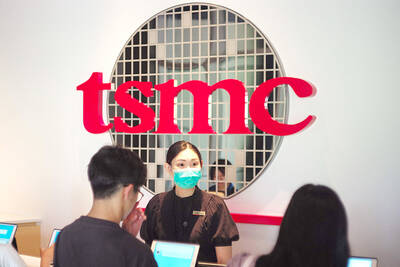
RECORD-BREAKING: TSMC’s net profit last quarter beat market expectations by expanding 8.9% and it was the best first-quarter profit in the chipmaker’s history Taiwan Semiconductor Manufacturing Co (TSMC, 台積電), which counts Nvidia Corp as a key customer, yesterday said that artificial intelligence (AI) server chip revenue is set to more than double this year from last year amid rising demand. The chipmaker expects the growth momentum to continue in the next five years with an annual compound growth rate of 50 percent, TSMC chief executive officer C.C. Wei (魏哲家) told investors yesterday. By 2028, AI chips’ contribution to revenue would climb to about 20 percent from a percentage in the low teens, Wei said. “Almost all the AI innovators are working with TSMC to address the

Malaysia’s leader yesterday announced plans to build a massive semiconductor design park, aiming to boost the Southeast Asian nation’s role in the global chip industry. A prominent player in the semiconductor industry for decades, Malaysia accounts for an estimated 13 percent of global back-end manufacturing, according to German tech giant Bosch. Now it wants to go beyond production and emerge as a chip design powerhouse too, Malaysian Prime Minister Anwar Ibrahim said. “I am pleased to announce the largest IC (integrated circuit) Design Park in Southeast Asia, that will house world-class anchor tenants and collaborate with global companies such as Arm [Holdings PLC],”


 RSS
RSS