


China Airlines Ltd (華航), Taiwan's largest carrier, has reduced fuel hedging by about 67 percent because "volatile" prices have made the cost of the contracts riskier than buying jet kerosene on the spot market.
"It's too dangerous to do any kind of hedging now," China Airlines chairman Philip Wei (
"Since last October until now, we did two or three transactions, no more," Wei said.
"We don't do any hedging now," he said.
The company joins Cathay Pacific Airways Ltd in reducing its use of hedging as forecasters differ on the outlook for oil prices. The US government predicts benchmark crude in New York will fall to an average of US$62.23 a barrel last year, 5.7 percent lower from last year.
"Less hedging may make the stock more attractive, as it means earnings will be more predictable," said Hank Chen, who manages US$21 million worth of assets for National Investment Trust Co in Taipei and doesn't own China Airlines shares.
"Excessive or inadequate hedging may lead to losses," he said.
In the interview, Wei also said China Airlines would pick either Boeing Co or Airbus SAS before the end of the year for an order for more than 10 planes.
This will be the airline's biggest deal since agreeing to buy a total of 22 aircraft worth as much as US$3.7 billion from the two plane makers in December 2002.
China Airlines' proportion of hedging has fallen to 20 percent from 60 percent a year ago, Wei said.
Company spokesman Johnson Sun (孫鴻文) declined to comment on whether the carrier has made or lost money from hedging in the past.
Cathay Pacific, Hong Kong's largest carrier, has hedged 9 percent of its fuel requirements for next year, spokeswoman Carolyn Leung said yesterday, compared with 40 percent of future needs at the same point a year ago.
The price of oil "is still higher than we want," Wei said.
Fuel accounts for about 40 percent of the carrier's costs, he said.
Shares of China Airlines fell 0.7 percent to close at NT$14.55 in Taipei. The stock has declined 4.3 percent this year, compared to a 2.7 percent gain in the benchmark TAIEX index.
Wei, 65, has reduced the number of aircraft types operated by China Airlines and is buying more fuel-efficient planes to cut the carrier's maintenance and fuel costs.
The airline will order Airbus A380s or Boeing 747-8s for services to the US and Europe, Wei said.
It will also buy smaller planes, either A350s or Boeing 787s, he added.
"It'll make more sense if they buy from Boeing, as it'll be easier for maintenance to have airplanes from the same company," said Peter Tzeng (
The airline's fleet of 69 aircraft includes 36 Boeing 747-400 passenger planes and freighters. The company also has 12 Boeing 737-800s, 14 Airbus 330-300s and seven Airbus 340-300s. The average age of the planes is 5.1 years.
Carriers such as Malaysian Airline System Bhd are expanding their fleets as travel in the Asia-Pacific region increases. Wei is adding new planes also to maintain the airline's advantage of owning one of the youngest fleets in the region.
New planes "help the company become more competitive," said Francis Hsiao (
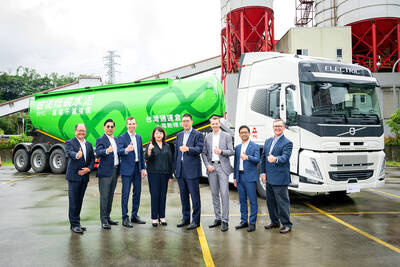
Taiwan Transport and Storage Corp (TTS, 台灣通運倉儲) yesterday unveiled its first electric tractor unit — manufactured by Volvo Trucks — in a ceremony in Taipei, and said the unit would soon be used to transport cement produced by Taiwan Cement Corp (TCC, 台灣水泥). Both TTS and TCC belong to TCC International Holdings Ltd (台泥國際集團). With the electric tractor unit, the Taipei-based cement firm would become the first in Taiwan to use electric vehicles to transport construction materials. TTS chairman Koo Kung-yi (辜公怡), Volvo Trucks vice president of sales and marketing Johan Selven, TCC president Roman Cheng (程耀輝) and Taikoo Motors Group

Among the rows of vibrators, rubber torsos and leather harnesses at a Chinese sex toys exhibition in Shanghai this weekend, the beginnings of an artificial intelligence (AI)-driven shift in the industry quietly pulsed. China manufactures about 70 percent of the world’s sex toys, most of it the “hardware” on display at the fair — whether that be technicolor tentacled dildos or hyper-realistic personalized silicone dolls. Yet smart toys have been rising in popularity for some time. Many major European and US brands already offer tech-enhanced products that can enable long-distance love, monitor well-being and even bring people one step closer to
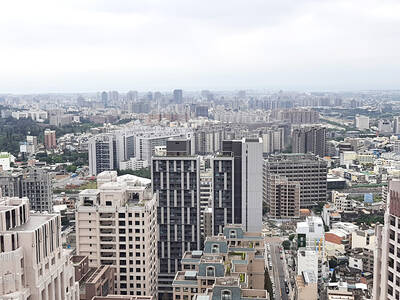
New apartments in Taiwan’s major cities are getting smaller, while old apartments are increasingly occupied by older people, many of whom live alone, government data showed. The phenomenon has to do with sharpening unaffordable property prices and an aging population, property brokers said. Apartments with one bedroom that are two years old or older have gained a noticeable presence in the nation’s six special municipalities as well as Hsinchu county and city in the past five years, Evertrust Rehouse Co (永慶房產集團) found, citing data from the government’s real-price transaction platform. In Taipei, apartments with one bedroom accounted for 19 percent of deals last

RECORD-BREAKING: TSMC’s net profit last quarter beat market expectations by expanding 8.9% and it was the best first-quarter profit in the chipmaker’s history Taiwan Semiconductor Manufacturing Co (TSMC, 台積電), which counts Nvidia Corp as a key customer, yesterday said that artificial intelligence (AI) server chip revenue is set to more than double this year from last year amid rising demand. The chipmaker expects the growth momentum to continue in the next five years with an annual compound growth rate of 50 percent, TSMC chief executive officer C.C. Wei (魏哲家) told investors yesterday. By 2028, AI chips’ contribution to revenue would climb to about 20 percent from a percentage in the low teens, Wei said. “Almost all the AI innovators are working with TSMC to address the


 RSS
RSS