


Susan Cischke admits that her vision is a little fuzzy when she looks more than two decades into the future, but she still sees an internal combustion engine -- albeit one smaller, lighter and more fuel-efficient than the engines of today.
And although the future is a bit cloudy to her and everyone else in the auto business, what Cischke sees could largely determine the future of her struggling employer, Ford Motor Co.
Cischke, 53, last week was appointed senior vice president for sustainability, environment and safety engineering at Ford and was given the almost impossible task of correctly predicting consumer wants, the price of gasoline and the development of fuel-efficient technologies for decades into the future.
"It is a little overwhelming in some ways," she said of her new post, which is part of Ford chief executive Alan Mulally's senior management team.
The biggest challenge, she said, is figuring out what people want to drive while at the same time making sure Ford is a good steward of the environment.
Ford has been good at making five-year plans but has not been so good at looking beyond that, she said.
Her job, while still being defined, will be to peer just beyond the five years and as far out as 2030 to help shape Ford's products, factories and behavior.
Cischke, formerly Ford's vice president of environmental and safety engineering, said that her elevation to the company's operating committee shows that under Mulally -- a former Boeing Co executive hired last year to rescue Ford -- global warming, greenhouse gasses and fuel economy will be at the forefront of the company's decision-making.
"What we're trying to do is integrate this into the business," she said in an interview at Ford's Dearborn headquarters. "What we're saying is it's not just a sideline."
With US$0.79-per-liter gasoline and growing public awareness of environmental concerns, Cischke said her job is easier than it would have been a decade ago.
Research, Cischke said, shows Americans want more fuel-efficient cars, yet they don't want to drive smaller vehicles.
And they still have a need to move people, haul things and tow boats and other loads, she said.
"They'll say: `I want what I have today, but I want double the fuel economy of what I have today.' So we're saying, how do you really do that? It's going to be a challenge along that line," Cischke said.
After 2012, Cischke expects to see more efficient gasoline engines still being the big player in powering cars and trucks, and she also sees more clean diesels and biofuels.
If there is a battery technology breakthrough, however, she sees more plug-in gas-electric hybrids.
"A lot of work can be done in terms of just lightweight materials to then make the engines more efficient, downsizing the engines," she said.
"It's always hard to predict invention in terms of battery technology, but we're seeing some very promising things out there," Cischke said.
The same array of vehicles will exist in 2030, she predicted, but hydrogen fuel cells will play a role.
"I think what it's going to look like is a lot of the components we have today," she said.
"You'll still see gas engines, you're going to see diesel, but you might see a totally different type of vehicle," she said.
"I think the vehicles are going to be smaller, and we're going to have to figure out how with lightweight materials and different concepts that we can still give people the attributes they're looking for," Cischke said.
Some environmentalists say that Ford hasn not been a good steward and that Cischke's appointment doesn't do a lot to convince them that the company is changing.
"She has spent a lot of time in Washington opposing environmental solutions like cleaner, more fuel-efficient cars," said Dan Becker, director of the Sierra Club's global warming campaign.
Becker said that Ford should spend more money marketing fuel-efficient vehicles, adding it instead spends its advertising dollars promoting sport utility vehicles and pickup trucks that make it the most profit.
"They market pickup trucks to people who want to haul lattes home from Starbucks, not just to farmers," he said.
Ford will fall further behind Toyota Motor Corp and Honda Motor Co if it doesn't come up with more fuel-efficient vehicles quickly, Becker said.
David Cole, chairman of the Center for Automotive Research in Ann Arbor, Michigan, said that Ford is fully aware that it is good business to pay attention to fuel efficiency and the environment.
"But if you're in business and you want to be profitable, you've got to provide a range of products that people need," he said.
"If you can provide significant improvement in fuel efficiency without compromising utility, that's where everybody wants to go," Cole said.
"Unfortunately, the cost of doing that isn't zero," he said.
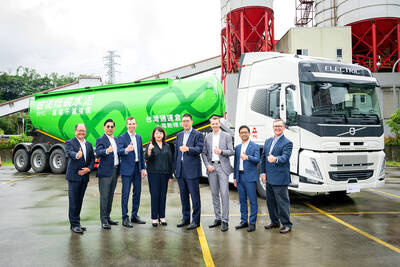
Taiwan Transport and Storage Corp (TTS, 台灣通運倉儲) yesterday unveiled its first electric tractor unit — manufactured by Volvo Trucks — in a ceremony in Taipei, and said the unit would soon be used to transport cement produced by Taiwan Cement Corp (TCC, 台灣水泥). Both TTS and TCC belong to TCC International Holdings Ltd (台泥國際集團). With the electric tractor unit, the Taipei-based cement firm would become the first in Taiwan to use electric vehicles to transport construction materials. TTS chairman Koo Kung-yi (辜公怡), Volvo Trucks vice president of sales and marketing Johan Selven, TCC president Roman Cheng (程耀輝) and Taikoo Motors Group

Among the rows of vibrators, rubber torsos and leather harnesses at a Chinese sex toys exhibition in Shanghai this weekend, the beginnings of an artificial intelligence (AI)-driven shift in the industry quietly pulsed. China manufactures about 70 percent of the world’s sex toys, most of it the “hardware” on display at the fair — whether that be technicolor tentacled dildos or hyper-realistic personalized silicone dolls. Yet smart toys have been rising in popularity for some time. Many major European and US brands already offer tech-enhanced products that can enable long-distance love, monitor well-being and even bring people one step closer to

RECORD-BREAKING: TSMC’s net profit last quarter beat market expectations by expanding 8.9% and it was the best first-quarter profit in the chipmaker’s history Taiwan Semiconductor Manufacturing Co (TSMC, 台積電), which counts Nvidia Corp as a key customer, yesterday said that artificial intelligence (AI) server chip revenue is set to more than double this year from last year amid rising demand. The chipmaker expects the growth momentum to continue in the next five years with an annual compound growth rate of 50 percent, TSMC chief executive officer C.C. Wei (魏哲家) told investors yesterday. By 2028, AI chips’ contribution to revenue would climb to about 20 percent from a percentage in the low teens, Wei said. “Almost all the AI innovators are working with TSMC to address the

Malaysia’s leader yesterday announced plans to build a massive semiconductor design park, aiming to boost the Southeast Asian nation’s role in the global chip industry. A prominent player in the semiconductor industry for decades, Malaysia accounts for an estimated 13 percent of global back-end manufacturing, according to German tech giant Bosch. Now it wants to go beyond production and emerge as a chip design powerhouse too, Malaysian Prime Minister Anwar Ibrahim said. “I am pleased to announce the largest IC (integrated circuit) Design Park in Southeast Asia, that will house world-class anchor tenants and collaborate with global companies such as Arm [Holdings PLC],”


 RSS
RSS