


Despite efforts to take the market by storm with competitively priced notebook computers, Acer Inc, the world's fourth-largest personal computer maker, is expected to face obstacles this year in its quest to become one of the market's top three players, industry watchers said.
Last Tuesday, market leader Hewlett-Packard Co (HP) filed a lawsuit with the US District Court in Texas accusing Acer of infringing on five of its patents related to processors, power systems and optical data storage.
The lawsuit seeks to stop Acer from selling some of its products in the US, including desktops, notebook computers, media centers and related products.
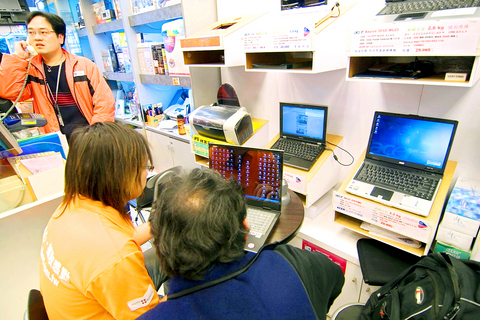
PHOTO: AP
"This is more a competitive tactic," said Kirk Yang (
Acer currently does not manufacture any products on its own, as it has outsourced 100 percent of its notebook computer production line.
Any potential liability will most likely apply to the suppliers, not Acer, he said.
Daniel Chang (
"We think this is the first step HP is taking to fight a significant rival, by trying to slow down Acer's growth," Chang said.
It would be a blow to Acer in the US, which is its second-largest market.
Acer's US distributors may not want to assume the risk of selling Acer's products if the case proceeds or the court imposes an injunction that could take time to resolve, he said.
Acer reentered the US market in 2003 after years of losses while inventory piled up, because of failure to offer proper after-sale services.
The US accounts for roughly 20 percent of Acer's total sales. It shipped a total of 1.1 million notebook computers and 311,000 desktops last year, market researcher International Data Corp (IDC) said.
Acer expects its US sales to expand to 25 percent this year, with year-on-year shipment growth of as much as 40 percent.
It shipped a total of 4.6 million PCs in the fourth quarter last year, demonstrating a stunning 37.8 percent growth over the same period the earlier year -- the highest growth among the top five makers, IDC said.
Acer was ranked No. 229 in terms of the world's most valuable brands, the Brand Finance 250 list released in late January showed.
The maker enjoys a brand value of US$2.3 billion, making it the only Taiwanese firm to place on the top 250 list, compiled by the London-based consultancy firm Brand Finance.
HP, on the other hand, was the ninth-most valuable brand, with brand value hitting US$29.5 billion.
HP is not the only company feeling the heat from Acer, which has repeatedly vowed to overtake Lenovo Group Ltd (
Market watchers said the goal would likely be achieved in the last two quarters of this year because of strong traditional demand generated by the European market, which contributes over 50 percent of Acer's total revenues.
But analysts warned that Dell Inc, the world's No. 2 maker, was also a serious competitor.
Chief executive officer Michael Dell visited Taipei on March 19, meeting Taiwanese suppliers for the first time since reclaiming his job in February.
His visit spurred speculation that Dell was set to order more fully assembled notebook products from local companies as part of its efforts to bolster its dwindling market share.
The US computer maker used to only purchase "barebone" -- or half-assembled -- systems and assemble them into a complete laptop, adding components such as processors and flat panels.
"Our checks suggest that Dell may start using full-system assembly in the second half of the year, which means it could soon change its strategy from direct distribution to channel distribution," Chang said.
Such a move would be negative for Acer -- which relies 100 percent on distributors to sell its computers, while Dell uses a direct sales model -- as distributors would be less dependent on the company, he said.
Even though Acer could choose to acquire a smaller maker to augment its scale, some watchers were not convinced this was the best solution.
"Acer is weak in the US and Japanese markets. Chances are high that it will merge with Gateway or Fujitsu, which are both top 10 brands," said Molly Lin (
This merger is complementary to Acer's overall strategy, she said.
But Chang said that Acer should consider using its cash wisely, as the acquisition of a PC company is not a smart move.
"For now, Acer should focus more on profitability than on its global ranking," he said.
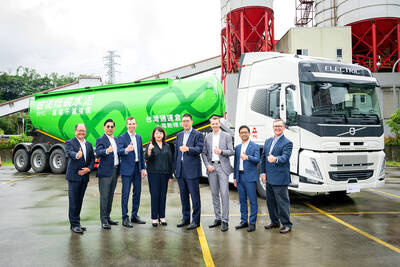
Taiwan Transport and Storage Corp (TTS, 台灣通運倉儲) yesterday unveiled its first electric tractor unit — manufactured by Volvo Trucks — in a ceremony in Taipei, and said the unit would soon be used to transport cement produced by Taiwan Cement Corp (TCC, 台灣水泥). Both TTS and TCC belong to TCC International Holdings Ltd (台泥國際集團). With the electric tractor unit, the Taipei-based cement firm would become the first in Taiwan to use electric vehicles to transport construction materials. TTS chairman Koo Kung-yi (辜公怡), Volvo Trucks vice president of sales and marketing Johan Selven, TCC president Roman Cheng (程耀輝) and Taikoo Motors Group

Among the rows of vibrators, rubber torsos and leather harnesses at a Chinese sex toys exhibition in Shanghai this weekend, the beginnings of an artificial intelligence (AI)-driven shift in the industry quietly pulsed. China manufactures about 70 percent of the world’s sex toys, most of it the “hardware” on display at the fair — whether that be technicolor tentacled dildos or hyper-realistic personalized silicone dolls. Yet smart toys have been rising in popularity for some time. Many major European and US brands already offer tech-enhanced products that can enable long-distance love, monitor well-being and even bring people one step closer to
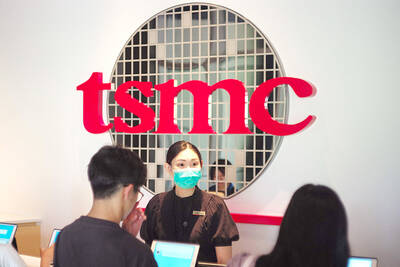
RECORD-BREAKING: TSMC’s net profit last quarter beat market expectations by expanding 8.9% and it was the best first-quarter profit in the chipmaker’s history Taiwan Semiconductor Manufacturing Co (TSMC, 台積電), which counts Nvidia Corp as a key customer, yesterday said that artificial intelligence (AI) server chip revenue is set to more than double this year from last year amid rising demand. The chipmaker expects the growth momentum to continue in the next five years with an annual compound growth rate of 50 percent, TSMC chief executive officer C.C. Wei (魏哲家) told investors yesterday. By 2028, AI chips’ contribution to revenue would climb to about 20 percent from a percentage in the low teens, Wei said. “Almost all the AI innovators are working with TSMC to address the

Malaysia’s leader yesterday announced plans to build a massive semiconductor design park, aiming to boost the Southeast Asian nation’s role in the global chip industry. A prominent player in the semiconductor industry for decades, Malaysia accounts for an estimated 13 percent of global back-end manufacturing, according to German tech giant Bosch. Now it wants to go beyond production and emerge as a chip design powerhouse too, Malaysian Prime Minister Anwar Ibrahim said. “I am pleased to announce the largest IC (integrated circuit) Design Park in Southeast Asia, that will house world-class anchor tenants and collaborate with global companies such as Arm [Holdings PLC],”


 RSS
RSS