


Two years ago, nobody would have noticed if China's stock markets had suddenly plummeted nearly 9 percent in one day.
But the global sell-off last Tuesday, sparked by concerns over China's economic growth, reverberated around the world, pitching other Asian markets lower and taking bourses across Europe and the Americas with it.
Many were quick to dismiss the impact of the drop on China's fledgling exchanges -- the steepest one-day decline in Shanghai in 10 years -- but the global knock-on effect was also an indication of how investors' perceptions about the Chinese economy have changed.
"Greater global attention is on the Chinese economy today, so this kind of huge volatility makes overseas investors far more sensitive," said Yan Li (
The sharp declines worldwide were prompted in part by anxiety that China's roaring economy -- bounding ahead at annual growth rates of about 10 percent -- may be in for a bumpier ride, especially if the US economy were to slow down.
Compounding these worries were reports that former US Federal Reserve chairman Alan Greenspan had suggested the US economy could be fighting off a potential recession by the end of the year.
"Overseas investors have interpreted the market's fall as a warning that China's economy is overheated," said Cheng Weiqing, an analyst at Citic Securities (
"Western investors believe that there are some problems showing up in emerging markets [like China]," Cheng said.
Driven by cheap labor, copious investment and waves of exports, China has been a major driver of global economic growth since it joined the WTO in late 2001.
The meteoric rise of the world's fourth-largest economy has stoked global growth, but also heightened fears that China teeters on the brink of the kind of overheating that could provoke an inflationary crisis.
Asian countries capitalizing on China's boom especially worry that a slowdown in the regional giant's economy could lead to unwelcome consequences at home.
Most markets in Asia had a tough time shaking off the effects of the volatility that dropped the key Shanghai index 5.5 percent lower on the week.
But analysts also cautioned against linking too closely China's economy and its bourses with declines in other markets.
"Global markets, already on edge from Iran and Alan Greenspan mentioning the `recession' word at the weekend, and highly leveraged, were looking for an excuse to sell off, and China provided that," said Stephen Green, an economist at Standard Chartered in Shanghai.
China's restricted share markets, with total capitalization of about US$1.5 trillion, were not an accurate barometer of the national economy like in other countries, analysts said.
"Although China stock markets have become more important to the Chinese economy, they are not as important as people imagine," Yan said.
Central to that argument was that the declines in China on Tuesday were blamed on a rumored capital gains tax on stocks investments, testament that the country's bourses are still driven more by policy than economic fundamentals.
"The Chinese market has a psychological tradition in that investors believe government policy is the key element that influences the market," Yan said.
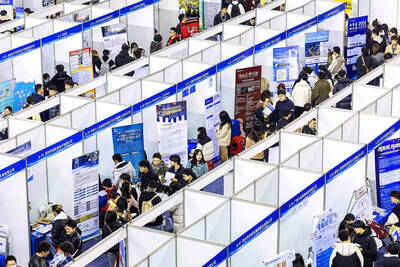
Stephen Garrett, a 27-year-old graduate student, always thought he would study in China, but first the country’s restrictive COVID-19 policies made it nearly impossible and now he has other concerns. The cost is one deterrent, but Garrett is more worried about restrictions on academic freedom and the personal risk of being stranded in China. He is not alone. Only about 700 American students are studying at Chinese universities, down from a peak of nearly 25,000 a decade ago, while there are nearly 300,000 Chinese students at US schools. Some young Americans are discouraged from investing their time in China by what they see

Taiwan Transport and Storage Corp (TTS, 台灣通運倉儲) yesterday unveiled its first electric tractor unit — manufactured by Volvo Trucks — in a ceremony in Taipei, and said the unit would soon be used to transport cement produced by Taiwan Cement Corp (TCC, 台灣水泥). Both TTS and TCC belong to TCC International Holdings Ltd (台泥國際集團). With the electric tractor unit, the Taipei-based cement firm would become the first in Taiwan to use electric vehicles to transport construction materials. TTS chairman Koo Kung-yi (辜公怡), Volvo Trucks vice president of sales and marketing Johan Selven, TCC president Roman Cheng (程耀輝) and Taikoo Motors Group

MAJOR DROP: CEO Tim Cook, who is visiting Hanoi, pledged the firm was committed to Vietnam after its smartphone shipments declined 9.6% annually in the first quarter Apple Inc yesterday said it would increase spending on suppliers in Vietnam, a key production hub, as CEO Tim Cook arrived in the country for a two-day visit. The iPhone maker announced the news in a statement on its Web site, but gave no details of how much it would spend or where the money would go. Cook is expected to meet programmers, content creators and students during his visit, online newspaper VnExpress reported. The visit comes as US President Joe Biden’s administration seeks to ramp up Vietnam’s role in the global tech supply chain to reduce the US’ dependence on China. Images on
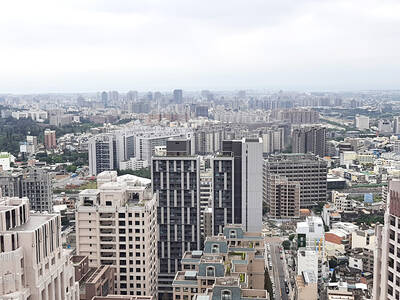
New apartments in Taiwan’s major cities are getting smaller, while old apartments are increasingly occupied by older people, many of whom live alone, government data showed. The phenomenon has to do with sharpening unaffordable property prices and an aging population, property brokers said. Apartments with one bedroom that are two years old or older have gained a noticeable presence in the nation’s six special municipalities as well as Hsinchu county and city in the past five years, Evertrust Rehouse Co (永慶房產集團) found, citing data from the government’s real-price transaction platform. In Taipei, apartments with one bedroom accounted for 19 percent of deals last


 RSS
RSS