


The tax honeymoon for foreign investors in China is ending.
For two decades, China has rewarded new investors with hefty tax breaks, helping to lure the nearly US$700 billion in investment that has helped make this the world's fourth-largest economy, but fueling growing complaints by Chinese companies about unfair treatment.
Now, China's legislature is expected to end this special status after it opens its annual session tomorrow. A law that state media say is expected to be enacted would equalize tax rates, raising foreign companies' tax bills and cutting those for many Chinese entities.
"This special treatment could not continue forever," said Winston Zhao, a lawyer in Shanghai for the US law firm Jones Day who is advising companies on the change. "Foreign investors have to be prepared mentally, though nobody wants this to happen."
The change is part of sweeping efforts to modernize China's laws to keep pace with explosive economic change and meet WTO commitments to treat companies equally.
It is too early to know what the financial impact will be on foreign companies, say business groups and consultants. But they say that major changes in business plans are unlikely, because companies are still attracted by China's low labor costs and 1.3 billion potential consumers.
"Companies are largely profitable, in it for the long term here and willing to put up with a change in the tax system that is more clear and more fair," said Robert Poole, vice president of the US-China Business Council, which represents 250 US companies.
Until now, new foreign investors have been exempt from income tax for two years and got a 50 percent cut for another three. After that, other breaks such as for investing in special economic zones could keep taxes as low as 10 percent.
By contrast, Chinese companies pay 33 percent of their profits in taxes.
The new law would set taxes for all companies at 25 percent, with lower rates for companies in technology development, according to a draft that was given to foreign companies. It says tax breaks already granted to foreign investors would continue for up to five years.
"A unified tax code will create a taxation environment that favors fair competition among all ventures registered in China," Finance Minister Jin Renqing (
It is not clear when exactly the new regulations would kick in. China's next tax year starts on Jan. 1, 2008.
The proposed new tax code is part of efforts to impose uniform business conditions nationwide. But it isn't clear whether Beijing can enforce the changes in a system where tax collection is run by local authorities who are hungry for investment. They often offer huge incentives of their own, and tax collecting, especially for Chinese companies, is uneven.
"I doubt that it will travel so fast, especially to the remote western region," Zhao said. "So one can expect that there still will be arrangements made by local authorities in order to attract or retain investors."
Chinese companies ranging from manufacturers to life insurers loudly criticize tax breaks for their foreign competitors, especially after Beijing's WTO entry required it to let more of them into its domestic market.
"We want equal tax rates with foreign companies so that domestic enterprises in our fields can better compete with overseas counterparts," said a spokesman for the China Light Industry Federation who refused to give his name. The group represents companies in manufacturing, publishing and other industries.
China attracted some US$60 billion in foreign investment last year, raising the total over the past two decades to US$659 billion, the government has said.
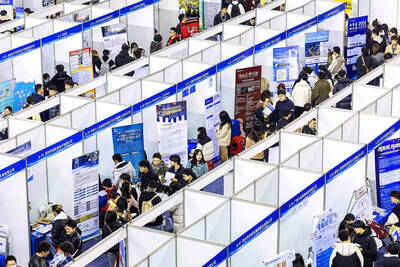
Stephen Garrett, a 27-year-old graduate student, always thought he would study in China, but first the country’s restrictive COVID-19 policies made it nearly impossible and now he has other concerns. The cost is one deterrent, but Garrett is more worried about restrictions on academic freedom and the personal risk of being stranded in China. He is not alone. Only about 700 American students are studying at Chinese universities, down from a peak of nearly 25,000 a decade ago, while there are nearly 300,000 Chinese students at US schools. Some young Americans are discouraged from investing their time in China by what they see

MAJOR DROP: CEO Tim Cook, who is visiting Hanoi, pledged the firm was committed to Vietnam after its smartphone shipments declined 9.6% annually in the first quarter Apple Inc yesterday said it would increase spending on suppliers in Vietnam, a key production hub, as CEO Tim Cook arrived in the country for a two-day visit. The iPhone maker announced the news in a statement on its Web site, but gave no details of how much it would spend or where the money would go. Cook is expected to meet programmers, content creators and students during his visit, online newspaper VnExpress reported. The visit comes as US President Joe Biden’s administration seeks to ramp up Vietnam’s role in the global tech supply chain to reduce the US’ dependence on China. Images on

Taiwan Transport and Storage Corp (TTS, 台灣通運倉儲) yesterday unveiled its first electric tractor unit — manufactured by Volvo Trucks — in a ceremony in Taipei, and said the unit would soon be used to transport cement produced by Taiwan Cement Corp (TCC, 台灣水泥). Both TTS and TCC belong to TCC International Holdings Ltd (台泥國際集團). With the electric tractor unit, the Taipei-based cement firm would become the first in Taiwan to use electric vehicles to transport construction materials. TTS chairman Koo Kung-yi (辜公怡), Volvo Trucks vice president of sales and marketing Johan Selven, TCC president Roman Cheng (程耀輝) and Taikoo Motors Group
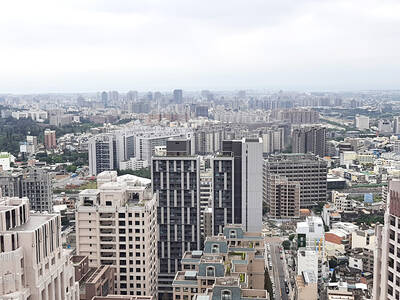
New apartments in Taiwan’s major cities are getting smaller, while old apartments are increasingly occupied by older people, many of whom live alone, government data showed. The phenomenon has to do with sharpening unaffordable property prices and an aging population, property brokers said. Apartments with one bedroom that are two years old or older have gained a noticeable presence in the nation’s six special municipalities as well as Hsinchu county and city in the past five years, Evertrust Rehouse Co (永慶房產集團) found, citing data from the government’s real-price transaction platform. In Taipei, apartments with one bedroom accounted for 19 percent of deals last


 RSS
RSS