


A 46-year-old salaried man bought canned essence of clam to drink in the hope of strengthening his liver, which he believed had been weakened by frequent overtime at work.
Unexpectedly, things turned out much worse after he took the concentrated drink every day for a week. His gout deteriorated, making his toes and ankles painful and swollen. He suspected the drink was the source of his troubles.
When this news broke last month, it sent shock waves through the burgeoning essence of clam market and triggered public concern about whether the product was really as safe as the producers had claimed.
On the Web site of the state-run Taiwan Sugar Corp (Taisugar,
"Whether it's suitable or not suitable [for certain people] is not a question," it said, meaning the company believes that everyone, regardless of age and health, can benefit from it.
The statement, however, is not entirely correct.
Chen Shih-yang (陳峙仰), chief of the gout center at Taipei's Country Hospital, advised gout sufferers to stay away from this kind of concentrated drink as the volume of purine in essence of clam is more than 100 times that contained in normal food and beverages.
"For healthy people who metabolize purine normally to form uric acid, it's OK to drink clam essence following the manufacturers' recommendations. But gout patients should stay away from these products," Chen said.
The Taiwan branch of Cerebos International Health Ltd, which distributes essence of chicken in the local market, also introduced its essence of clam to local consumers in June last year.
The company were more cautious than Taisugar in regard to health warnings, and had added a statement to the product packaging saying: "People allergic to seafood, pregnant women and those about to have surgery or with fresh wounds should consult professionals."
Some have criticized the manufacturers' failings in exposing possible hazards, saying they are only interested in making a profit. The businesses, however, reiterated that they have done their best to provide detailed nutritional information on their packaging, and that printing a warning for gout sufferers or people with liver complaints is not practicable until scientific proof is made available.
"What we don't know is whether the man who complained about deteriorating gout last month had an excess of essence of clam or whether his eating habits were to blame, as people with his condition naturally would have to pay more attention to the intake of protein and calorific capacity," said Charlene Chou (周湘琳), public relations supervisor at Cerebos.
She said the firm's products clearly show the ingredients for consumers' reference. For instance, a 60ml can of essence of clam contains 0.33g of protein, far lower than the maximum amount of 40g a seriously ill patient should take, she said.
"By following our recommendations, drinking one to two cans a day is OK. But some people might drink five cans a day thinking it will help them regain physical strength, which is beyond our recommendation," Chou said.
Since its essence of clam was launched last year, Cerebos has secured sales of over NT$100 million (US$3.03 million) as of last month, taking a 15 percent to 20 percent share of the market.
The fresh competition cut into Taisugar's previous domination of the market, and also enlarged the overall market, said Andy Feng (
There is no solid scientific proof currently available that would enable the government to demand that manufacturers print a warning regarding gout sufferers and there are various causes of gout, including a person's eating habits, said Hsieh Ting-hung (謝定宏), deputy director of the Food Safety Bureau at the Department of Health.
However, if food producers are aware that certain ingredients in one of their products might be a potential threat to certain people, they should consider offering appropriate, if not explicit, warnings in accordance with the regulations stipulated in the Consumer Protection Law (消費者保護法), Hsieh said.
Seeking scientific endorsement, Taisugar has hired a research institute to examine whether its clam product could pose a potential health risk to certain groups of people, according to Alex Chen (陳啟祥), vice chief executive officer of Taisugar's marketing business.
The result would be known by early April, he added.
Before any scientific results are produced, those with gout, high blood pressure and heart disease should be extremely cautious about what they eat and drink, said Lee Cherh-yu (李哲瑜), an associate professor of restaurant management at the Technology and Science Institute of Northern Taiwan.
Health drinks themselves are not harmful, but problems can be caused when they are combined with people's existing bad eating habits, she said.
"I don't think it's necessary to include a warning statement because of one or two isolated cases, as that would instead distort the message on correct eating habits and scare away possible buyers. Demanding that these products carry clear nutritional facts for customers' reference would be the best way to go," she suggested.
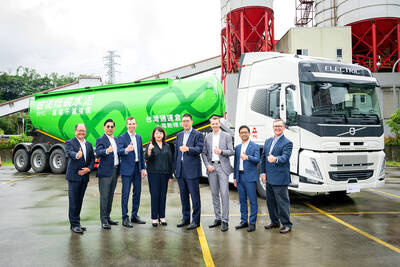
Taiwan Transport and Storage Corp (TTS, 台灣通運倉儲) yesterday unveiled its first electric tractor unit — manufactured by Volvo Trucks — in a ceremony in Taipei, and said the unit would soon be used to transport cement produced by Taiwan Cement Corp (TCC, 台灣水泥). Both TTS and TCC belong to TCC International Holdings Ltd (台泥國際集團). With the electric tractor unit, the Taipei-based cement firm would become the first in Taiwan to use electric vehicles to transport construction materials. TTS chairman Koo Kung-yi (辜公怡), Volvo Trucks vice president of sales and marketing Johan Selven, TCC president Roman Cheng (程耀輝) and Taikoo Motors Group

Among the rows of vibrators, rubber torsos and leather harnesses at a Chinese sex toys exhibition in Shanghai this weekend, the beginnings of an artificial intelligence (AI)-driven shift in the industry quietly pulsed. China manufactures about 70 percent of the world’s sex toys, most of it the “hardware” on display at the fair — whether that be technicolor tentacled dildos or hyper-realistic personalized silicone dolls. Yet smart toys have been rising in popularity for some time. Many major European and US brands already offer tech-enhanced products that can enable long-distance love, monitor well-being and even bring people one step closer to
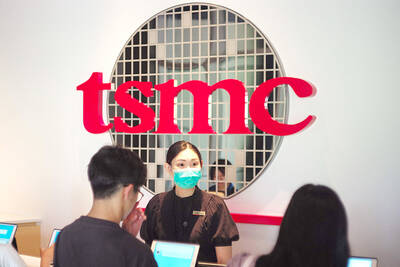
RECORD-BREAKING: TSMC’s net profit last quarter beat market expectations by expanding 8.9% and it was the best first-quarter profit in the chipmaker’s history Taiwan Semiconductor Manufacturing Co (TSMC, 台積電), which counts Nvidia Corp as a key customer, yesterday said that artificial intelligence (AI) server chip revenue is set to more than double this year from last year amid rising demand. The chipmaker expects the growth momentum to continue in the next five years with an annual compound growth rate of 50 percent, TSMC chief executive officer C.C. Wei (魏哲家) told investors yesterday. By 2028, AI chips’ contribution to revenue would climb to about 20 percent from a percentage in the low teens, Wei said. “Almost all the AI innovators are working with TSMC to address the

Malaysia’s leader yesterday announced plans to build a massive semiconductor design park, aiming to boost the Southeast Asian nation’s role in the global chip industry. A prominent player in the semiconductor industry for decades, Malaysia accounts for an estimated 13 percent of global back-end manufacturing, according to German tech giant Bosch. Now it wants to go beyond production and emerge as a chip design powerhouse too, Malaysian Prime Minister Anwar Ibrahim said. “I am pleased to announce the largest IC (integrated circuit) Design Park in Southeast Asia, that will house world-class anchor tenants and collaborate with global companies such as Arm [Holdings PLC],”


 RSS
RSS