


Working mother Kumari Ranasinghe looks forward every day to a telephone call from someone who hangs up on her immediately -- her 12-year-old son who is making the call to let her know he has left school.
It's a supremely cost-effective method of keeping in touch that has swept Sri Lanka where daily bloodshed, despite a truce in the civil war, has many people living in fear for their lives and those of loved ones.
"Two beeps [rings] on my mobile after an hour, I know he has got home safely," said Ranasinghe, 37, who works as a secretary in the jittery capital where security is tight amid fears of Tamil rebel bomb attacks.
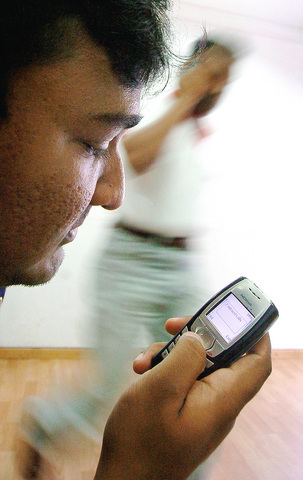
PHOTO: AFP
Mother and son are part of the new "ring cut" generation that has spread across Sri Lanka and other Asian countries.
A growing number of mobile phone owners use "missed calls" to communicate without answering incoming calls, telecom researchers said.
The country of 19 million has more than 5 million mobile phone subscribers with the majority using pre-paid subscriptions.
Call rates of 5 rupees (US$0.05) per minute are too expensive for the many people in this country who earn less than US$100 a month, so they pre-pay as little as 20 rupees for a SIM card that will then last months as they mostly use their phones to "ring cut" on the missed calls function.
The system has already found favor with about 15 percent of the mobile phone users in Sri Lanka who buy phones for around US$30, cellular operators said.
"It's a secret language of saying `I'm thinking about you' or `Call me back,'" said Ayesha Zainudeen, researcher at LIRNEasia, a regional telecoms think tank that studied mobile phone usage patterns in Sri Lanka, India, Pakistan, the Philippines and Thailand.
"It's a segment that is fast catching on among young and rural people who see it as a form of affordable communication," Zainudeen said.
Use of the missed calls function -- or beeping, as it is also known -- involves dialling a number and hanging up before the call is answered; the phone's internal log records the number the call came from and at what time.
Most beeps are requests to the mobile owner to call back immediately, but beeps can also send pre-set messages such as "answer now" or "I miss you."
"I would often hear someone say: `I'll give you a ring cut when I get there,'" said undergraduate Roshan de Silva, who uses missed calls for pre-arranged messages among his friends.
Mobile phone companies offer incoming calls for free and make money when a connection is completed. The companies declined to comment on the practice, but another analyst said it impacts the bottom line and network quality.
"Missed calls are not good for the networks -- less revenue; not good for the state -- less taxes; and not necessarily good for the user -- networks get blocked and we can't talk," LIRNEasia's lead economist Harsha de Silva said.
Of the five countries, only the Philippines beat Sri Lanka in the "ring cut" race, the LIRNEasia study that surveyed around 9,000 low income earners aged between 18 and 80 years old showed.
In the Philippines, 65 percent of mobile phone owners use missed calls, compared with Thailand's 40 percent, India's 36 percent and Pakistan's 39 percent, Zainudeen said.
In addition, many people used telephones at their workplace, or landlines, to return a "ring cut," further avoiding payment on mobile networks.
Rohith Perera, 28, who on average receives 10 to 15 missed calls during office hours daily, notes that some of his colleagues also used it as a ruse to skip long meetings, as executives will excuse themselves to answer calls outside the meeting room.
"Sometimes outsiders want you to call back from workplaces, because it's the office that picks up the cost of the call," Perera said.
But "ring cut" signals can also backfire.
Roshan de Silva says he has "missed" meeting his girlfriend when his phone was on silent mode.
"It's also a disaster when the networks are busy and you can't get through to leave a missed call," he said.

Stephen Garrett, a 27-year-old graduate student, always thought he would study in China, but first the country’s restrictive COVID-19 policies made it nearly impossible and now he has other concerns. The cost is one deterrent, but Garrett is more worried about restrictions on academic freedom and the personal risk of being stranded in China. He is not alone. Only about 700 American students are studying at Chinese universities, down from a peak of nearly 25,000 a decade ago, while there are nearly 300,000 Chinese students at US schools. Some young Americans are discouraged from investing their time in China by what they see

MAJOR DROP: CEO Tim Cook, who is visiting Hanoi, pledged the firm was committed to Vietnam after its smartphone shipments declined 9.6% annually in the first quarter Apple Inc yesterday said it would increase spending on suppliers in Vietnam, a key production hub, as CEO Tim Cook arrived in the country for a two-day visit. The iPhone maker announced the news in a statement on its Web site, but gave no details of how much it would spend or where the money would go. Cook is expected to meet programmers, content creators and students during his visit, online newspaper VnExpress reported. The visit comes as US President Joe Biden’s administration seeks to ramp up Vietnam’s role in the global tech supply chain to reduce the US’ dependence on China. Images on

Taiwan Transport and Storage Corp (TTS, 台灣通運倉儲) yesterday unveiled its first electric tractor unit — manufactured by Volvo Trucks — in a ceremony in Taipei, and said the unit would soon be used to transport cement produced by Taiwan Cement Corp (TCC, 台灣水泥). Both TTS and TCC belong to TCC International Holdings Ltd (台泥國際集團). With the electric tractor unit, the Taipei-based cement firm would become the first in Taiwan to use electric vehicles to transport construction materials. TTS chairman Koo Kung-yi (辜公怡), Volvo Trucks vice president of sales and marketing Johan Selven, TCC president Roman Cheng (程耀輝) and Taikoo Motors Group

New apartments in Taiwan’s major cities are getting smaller, while old apartments are increasingly occupied by older people, many of whom live alone, government data showed. The phenomenon has to do with sharpening unaffordable property prices and an aging population, property brokers said. Apartments with one bedroom that are two years old or older have gained a noticeable presence in the nation’s six special municipalities as well as Hsinchu county and city in the past five years, Evertrust Rehouse Co (永慶房產集團) found, citing data from the government’s real-price transaction platform. In Taipei, apartments with one bedroom accounted for 19 percent of deals last


 RSS
RSS