


German Chancellor Angela Merkel and French President Jacques Chirac on Friday urged a "fair division" of the burden in restructuring Airbus amid cross-border strain over the European jet maker.
Chirac said after informal talks in Germany that he and Merkel were confident that the management of Airbus would take equitable decisions on job cuts and plant closures in France and Germany and cushion the blow to affected communities.
"There must be no forced redundancies," he said, implying that job cuts would come through attrition or similar measures.

PHOTO: EPA
Merkel said that while the human impact of any restructuring must be minimized, Airbus must be whipped into shape so it can hold its own against international competitors such as Boeing.
"Airbus' competitiveness is the highest priority," she told a joint press conference.
Merkel also tried to play down the bilateral tensions the plans have triggered.
"That is normal in such a difficult situation for a company. And this normal approach must in no way be abused to stoke a conflict in any way between two countries -- that is our political message," she said. "We are politically in complete agreement that that would be the worst thing for this company and its employees in both countries. Germany and France will see Airbus through this difficult time together."
She said there must be "a fair redivision of opportunities and risks" between the neighbors on "the future of new technologies" to be used in future aircraft.
Tensions rose between Paris and Berlin this week over the crucial "Power8" restructuring program of Airbus, a unit of the European Aeronautic Defence and Space Company (EADS).
The scheme is to be unveiled when the aerospace giant publishes its annual earnings on March 9.
Merkel said it was now up to EADS to take the necessary decisions "so we do not find ourselves faced with similar problems in a year or two."
The rescue plan, arising from problems in the A380 superjumbo airliner program, has already been stalled for four months due to wrangling between German and French interests over where cuts will fall.
The company faced more bad news on Friday when US courier company United Parcel Service Inc (UPS) suggested it could cancel its order for 10 Airbus superjumbo freighters in case of further delivery delays.
Any withdrawal by UPS would sound the effective death knell for the European company's plans to build a cargo version of its enormous A380 plane. UPS is the only remaining customer after FedEx pulled out last year.
On Monday, Airbus was forced to suddenly delay an announcement due the following day on how the restructuring scheme would work, citing conflicting national interests in the development and building of Airbus' next generation of big jets, the A350.
Chief executive Louis Gallois stressed that Airbus "cannot delay any longer" over the plan to save 5 billion euros (US$6.6 billion) by 2010 and 2 billion euros per year thereafter.
Germany openly expressed its irritation on Tuesday after French Prime Minister Dominique de Villepin announced that 10,000 jobs would be axed at the plane maker.
German government spokesman Thomas Steg insisted that no such decision had been taken.
With France heading for presidential elections in April and May, its government is likely to be highly sensitive to big job cuts.
Airbus employs about 21,000 people at seven sites in Germany and officials there are concerned that those sites will bear the brunt of the austerity moves.
An EADS spokesman reiterated on Thursday that no decision had been taken, dismissing as "speculation" repeated reports of layoffs.
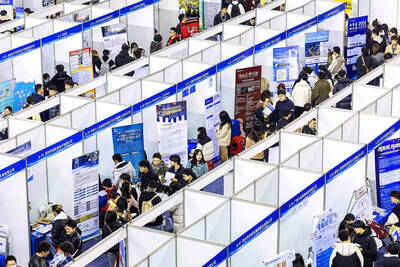
Stephen Garrett, a 27-year-old graduate student, always thought he would study in China, but first the country’s restrictive COVID-19 policies made it nearly impossible and now he has other concerns. The cost is one deterrent, but Garrett is more worried about restrictions on academic freedom and the personal risk of being stranded in China. He is not alone. Only about 700 American students are studying at Chinese universities, down from a peak of nearly 25,000 a decade ago, while there are nearly 300,000 Chinese students at US schools. Some young Americans are discouraged from investing their time in China by what they see

MAJOR DROP: CEO Tim Cook, who is visiting Hanoi, pledged the firm was committed to Vietnam after its smartphone shipments declined 9.6% annually in the first quarter Apple Inc yesterday said it would increase spending on suppliers in Vietnam, a key production hub, as CEO Tim Cook arrived in the country for a two-day visit. The iPhone maker announced the news in a statement on its Web site, but gave no details of how much it would spend or where the money would go. Cook is expected to meet programmers, content creators and students during his visit, online newspaper VnExpress reported. The visit comes as US President Joe Biden’s administration seeks to ramp up Vietnam’s role in the global tech supply chain to reduce the US’ dependence on China. Images on

New apartments in Taiwan’s major cities are getting smaller, while old apartments are increasingly occupied by older people, many of whom live alone, government data showed. The phenomenon has to do with sharpening unaffordable property prices and an aging population, property brokers said. Apartments with one bedroom that are two years old or older have gained a noticeable presence in the nation’s six special municipalities as well as Hsinchu county and city in the past five years, Evertrust Rehouse Co (永慶房產集團) found, citing data from the government’s real-price transaction platform. In Taipei, apartments with one bedroom accounted for 19 percent of deals last
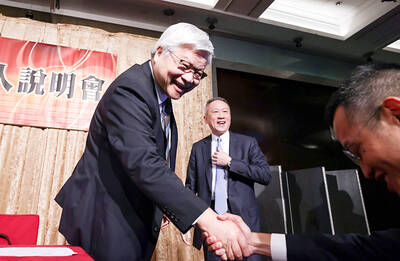
US CONSCULTANT: The US Department of Commerce’s Ursula Burns is a rarely seen US government consultant to be put forward to sit on the board, nominated as an independent director Taiwan Semiconductor Manufacturing Co (TSMC, 台積電), the world’s largest contract chipmaker, yesterday nominated 10 candidates for its new board of directors, including Ursula Burns from the US Department of Commerce. It is rare that TSMC has nominated a US government consultant to sit on its board. Burns was nominated as one of seven independent directors. She is vice chair of the department’s Advisory Council on Supply Chain Competitiveness. Burns is to stand for election at TSMC’s annual shareholders’ meeting on June 4 along with the rest of the candidates. TSMC chairman Mark Liu (劉德音) was not on the list after in December last


 RSS
RSS