


Although the Taiwanese economy is expected to steadily improve next year, the key to catching up with other Asian competitors -- which are growing at a much faster pace -- is to ease cross-strait business restrictions, market watchers said in a forum yesterday.
"Many analysts and even the president have said that Taiwan's stock market will surge past 10,000 points [from the current 7,500], but it will not happen without a relaxation of cross-strait rules," said Hsieh Chin-ho (
Hsieh made the remark one day after the Investment Commission announced revision of rules that further restricted major China-bound investments.
On Thursday, President Chen Shui-bian (
Faced with China's growing economic power, many Asian countries have chosen to grow with China or loosen related regulations to sustain their economies, Hsieh said, citing the three other four little dragons, i.e., Singapore, Hong Kong and South Korea, as an example.
Singapore is trying to lure Chinese visitors and boost regional tourism by approving the opening of two casinos in the city state, Hsieh said.
Singapore's Temasek Holdings Pte has also become one of the most active investors in the initial public offerings of Chinese companies, he said.
Hong Kong's real estate, retail, banking and other sectors have benefited from its Closer Economic Partnership Arrangement with China, and its capital market has largely benefited from the listing of major Chinese companies, Hsieh said.
South Korea is trying to grab a share of China's lucrative market, and now is China's second largest source of imports, he said.
While Taiwan's GDP is forecast to hover around 4 percent this year, Singapore's economy is expected to grow by 8 percent, Hong Kong's by more than 6 percent and South Korea by about 5 percent, he said.
Meanwhile, a survey of the members of the banking and securities association showed that they believed improving cross-strait relations should top the government's agenda, said Wu Chung-shu (吳中書), a research fellow at the Academia Sinica who conducted the poll.
"The result shows that cross-strait relations are considered the most important factor that could influence the nation's economy," Wu said at the forum yesterday.
However, Citigroup Taiwan's country officer Morris Li (
Net exports are expected to account for 3.2 percent of the nation's GDP growth, but the percentage will go down to 1.6 percent as local industries' migration to China continues, he said.
Rising production overseas will inevitably cut into Taiwan's exports, he added.
Aside from cross-strait issues, Sophia Cheng (
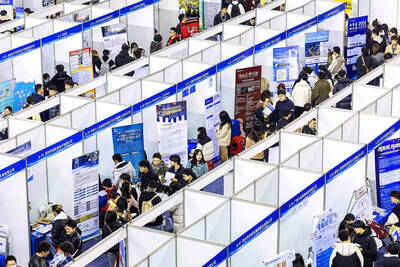
Stephen Garrett, a 27-year-old graduate student, always thought he would study in China, but first the country’s restrictive COVID-19 policies made it nearly impossible and now he has other concerns. The cost is one deterrent, but Garrett is more worried about restrictions on academic freedom and the personal risk of being stranded in China. He is not alone. Only about 700 American students are studying at Chinese universities, down from a peak of nearly 25,000 a decade ago, while there are nearly 300,000 Chinese students at US schools. Some young Americans are discouraged from investing their time in China by what they see

Taiwan Transport and Storage Corp (TTS, 台灣通運倉儲) yesterday unveiled its first electric tractor unit — manufactured by Volvo Trucks — in a ceremony in Taipei, and said the unit would soon be used to transport cement produced by Taiwan Cement Corp (TCC, 台灣水泥). Both TTS and TCC belong to TCC International Holdings Ltd (台泥國際集團). With the electric tractor unit, the Taipei-based cement firm would become the first in Taiwan to use electric vehicles to transport construction materials. TTS chairman Koo Kung-yi (辜公怡), Volvo Trucks vice president of sales and marketing Johan Selven, TCC president Roman Cheng (程耀輝) and Taikoo Motors Group

MAJOR DROP: CEO Tim Cook, who is visiting Hanoi, pledged the firm was committed to Vietnam after its smartphone shipments declined 9.6% annually in the first quarter Apple Inc yesterday said it would increase spending on suppliers in Vietnam, a key production hub, as CEO Tim Cook arrived in the country for a two-day visit. The iPhone maker announced the news in a statement on its Web site, but gave no details of how much it would spend or where the money would go. Cook is expected to meet programmers, content creators and students during his visit, online newspaper VnExpress reported. The visit comes as US President Joe Biden’s administration seeks to ramp up Vietnam’s role in the global tech supply chain to reduce the US’ dependence on China. Images on
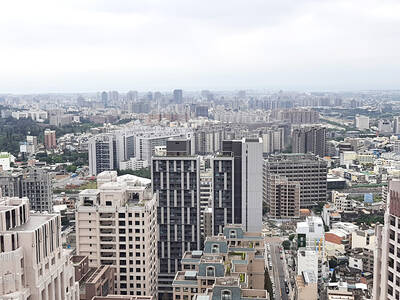
New apartments in Taiwan’s major cities are getting smaller, while old apartments are increasingly occupied by older people, many of whom live alone, government data showed. The phenomenon has to do with sharpening unaffordable property prices and an aging population, property brokers said. Apartments with one bedroom that are two years old or older have gained a noticeable presence in the nation’s six special municipalities as well as Hsinchu county and city in the past five years, Evertrust Rehouse Co (永慶房產集團) found, citing data from the government’s real-price transaction platform. In Taipei, apartments with one bedroom accounted for 19 percent of deals last


 RSS
RSS