


This year's APEC leaders meeting -- with representatives from 21 member economies, along with businesspeople, government officials and reporters -- has thrust quiet Hanoi, the capital of Vietnam, into the world spotlight.
But irrespective of the number and rank of people who turned up, the fact is that the importance of APEC is diminishing.
According to a survey of 370 regional opinion leaders released this week by the Pacific Economic Cooperation Council (PECC), an advisory group to APEC, concern about the viability of APEC is widespread.
Only 42 percent of respondents agreed with the statement "APEC is as important today as it was in 1989," while a majority of respondents identified "weak commitment from member economies" and "lack of focus" as key challenges facing the regional forum.
The result could be a problem for Taiwan, as APEC is a vital means for the nation to engage with the international community, both politically and economically.
"Taiwan should be alert to the situation," Wu Lin-jun (
The increase in the number of issues discussed at APEC meetings -- everything from from bird flu to the North Korean nuclear crisis -- have distracted meetings from the main focus of APEC, which originally was trade liberalization and facilitation, Wu said.
Because it operates as a nonbinding forum, APEC has trouble delivering substantial results, which is another frustration among member states, Wu said.
The rise of several other regional organizations in Asia may eclipse APEC, especially ASEAN, with China in tow, or Japan's new East Asia Summit, Wu said.
In theory, integrated trade partners are more likely to be political allies, and both ASEAN and the East Asia Summit, which exclude Taiwan, are the focus of a push to establish a regional common market, Wu said.
The US will not sit on its hands while this happens. The US pushed its own regional agenda during this year's APEC meeting -- a new APEC-wide free trade zone or Free-Trade Area of the Asia Pacific (FTAAP).
The US-led initiative was originally suggested by the APEC Business Advisory Council and PECC two years ago, but was only listed as a long-term goal this year.
Despite the fact that the US said it was promoting the idea to resolve the current WTO impasse, there has been speculation that China was behind the recent move to reintroduce the plan.
Aside from the political tussles that surround its operation, APEC's well-developed committee system and working groups still make it an important organization that Taiwan should find a way to make better use of, Wu said.
One major initiative the nation has contributed to APEC is the APEC Digital Opportunity Center (ADOC). Established in 2003, ADOC aims to help eliminate the digital divide among member economies by setting up IT centers in Vietnam, Chile, Peru, the Philippines, Indonesia and Papua New Guinea.
ADOC was extended to the "ADOC Plus" program last year to help remote townships in participating countries sell local produce on the Internet. This year, ADOC will incorporate the APEC Cultural Digital Archives Sharing initiative to promote cultural artifacts.
The series of digital projects is certainly welcomed among member economies, but a macro initiative involving the participation of all members is needed for the nation to drive the agenda and increase its presence in APEC, said Chyungly Lee (
The government should also highlight the role of the APEC Business Advisory Council (ABAC), a non-governmental organization that has an official role in the APEC Economic Leaders Summit through a formal dialogue with business representatives, Lee said.
The participation of private business groups will help to bring the focus back to trade
issues, as well as inject more creativity in mapping out strategies, she said.
Taiwan Institute of Economic Research Division of International Affairs Deputy
Director Wu Fu-cheng (吳福成) suggested that the nation should adopt a flexible
strategy while participating in APEC and other international organizations to avoid
conflict with China.
Taiwanese leaders are not able to join the APEC Summits and the nation is also
excluded from APEC's foreign policy meetings — the result of pressure from China.
But the nation should not be frustrated with this treatment, Wu said.
Taiwan should
still use APEC as a platform to build contacts with member countries by organizing
APEC events, he said. The nation is not permitted to host meetings involving senior
officials.
Becoming familiar with the operation of APEC will help the nation find a niche within
the organization, which it can use to leverage its international relationships. This will
be more effective than remaining locked in disputes over the nation's sovereignty, Wu
said.

Stephen Garrett, a 27-year-old graduate student, always thought he would study in China, but first the country’s restrictive COVID-19 policies made it nearly impossible and now he has other concerns. The cost is one deterrent, but Garrett is more worried about restrictions on academic freedom and the personal risk of being stranded in China. He is not alone. Only about 700 American students are studying at Chinese universities, down from a peak of nearly 25,000 a decade ago, while there are nearly 300,000 Chinese students at US schools. Some young Americans are discouraged from investing their time in China by what they see

MAJOR DROP: CEO Tim Cook, who is visiting Hanoi, pledged the firm was committed to Vietnam after its smartphone shipments declined 9.6% annually in the first quarter Apple Inc yesterday said it would increase spending on suppliers in Vietnam, a key production hub, as CEO Tim Cook arrived in the country for a two-day visit. The iPhone maker announced the news in a statement on its Web site, but gave no details of how much it would spend or where the money would go. Cook is expected to meet programmers, content creators and students during his visit, online newspaper VnExpress reported. The visit comes as US President Joe Biden’s administration seeks to ramp up Vietnam’s role in the global tech supply chain to reduce the US’ dependence on China. Images on

New apartments in Taiwan’s major cities are getting smaller, while old apartments are increasingly occupied by older people, many of whom live alone, government data showed. The phenomenon has to do with sharpening unaffordable property prices and an aging population, property brokers said. Apartments with one bedroom that are two years old or older have gained a noticeable presence in the nation’s six special municipalities as well as Hsinchu county and city in the past five years, Evertrust Rehouse Co (永慶房產集團) found, citing data from the government’s real-price transaction platform. In Taipei, apartments with one bedroom accounted for 19 percent of deals last
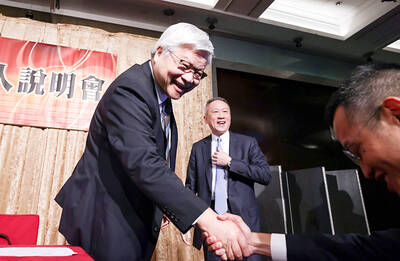
US CONSCULTANT: The US Department of Commerce’s Ursula Burns is a rarely seen US government consultant to be put forward to sit on the board, nominated as an independent director Taiwan Semiconductor Manufacturing Co (TSMC, 台積電), the world’s largest contract chipmaker, yesterday nominated 10 candidates for its new board of directors, including Ursula Burns from the US Department of Commerce. It is rare that TSMC has nominated a US government consultant to sit on its board. Burns was nominated as one of seven independent directors. She is vice chair of the department’s Advisory Council on Supply Chain Competitiveness. Burns is to stand for election at TSMC’s annual shareholders’ meeting on June 4 along with the rest of the candidates. TSMC chairman Mark Liu (劉德音) was not on the list after in December last


 RSS
RSS