


In early July, Pete Bethune, an amateur sailor from New Zealand and a recent convert to environmentalism, stepped aboard his new US$2.4 million speedboat, filled up the tank with a fuel made from animal fat and headed east from Auckland.
His goal was simple: to complete the fastest circumnavigation of the globe in a motorboat while using nothing but biodiesel, which can be salvaged from french fry grease, refined soybean oil and other organic and recycled oils.
The record attempt is due to start in March, from Barbados, after a North American tour this fall meant to test and publicize the boat -- called the Earthrace -- and raise money.
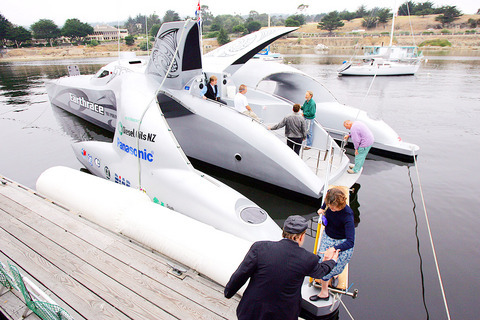
PHOTO: NY TIMES NEWS SERVICE
"I thought I'd have a sponsor give me US$4 million and bankroll the whole thing," Bethune, 41, said. "And I still believe that."
But somewhere between Hawaii (where the boat refueled on biodiesel made from the drippings of cruise liners' deep fryers) and Vancouver (where it loaded up with fuel made from tallow, drawn from the hard fat of sheep and cattle), the Earthrace almost ran out of gas -- at least financially.
For the last month, Bethune, a former oil exploration engineer, has been bobbing up and down the California coast, asking for contributions ranging from US$5 to tour the boat to US$50,000 to plaster a corporate logo on the side.
"My wife sent an e-mail saying they're going to turn the lights out" at home, said Bethune, who has two children. "When you're stressing your partner out like this, it's hard."
The project has only about US$10,000 remaining in the bank and is hundreds of thousands of dollars in debt. Bethune says he has put US$650,000 of his own cash into the Earthrace and spent another US$650,000 that was borrowed from banks, friends and family.
He sold a business he founded, sold his part in a plantation and mortgaged his home -- three times.
"I thought it would just fall into place," he said. "But we're just keeping our heads above water."
John Allen, the project's one-man ground crew, has also been trying to find money.
"There's lots of irons in the fire but no one with a checkbook and pen poised," said Allen, who is also a New Zealander. "But with a negligible budget, it's been difficult to go full bore with this."
Hotel rooms and fuel have been donated along the way, but things like rental cars have been a luxury.
"I've been wearing the same shorts for three months," Allen said. "It might be nice to get a new pair."
While the lack of money has done little to dampen Bethune's ambitions, he says he understands why nautical sponsors can be hard to find: "The sight of a boat sinking with someone's name on the side can be disconcerting."
Bethune said he first became interested in biodiesel several years ago while writing a paper on renewable fuels while studying for a master's degree in Australia.
He gained a passing knowledge of biodiesel while working on oil rigs in the North Sea and near Libya, but as he learned more, he said, he "became a real convert."
Around the same time, Bethune also happened across a little-known fact: The world record for circumnavigation of the globe by a powerboat is 75 days, set in 1998 by a British boat called the Cable & Wireless Adventurer. Bethune figured he could do it faster and, at the same time, raise awareness for his newfound cause.
His passion won over some early sponsors, including Cummins MerCruiser Diesel, which donated the engines; ZF Marine, which donated the boat's gearboxes, propellers and engine controls; and Biodiesel Oils NZ, which gave Earthrace 56,780 liters of fuel (about five tanks' worth) and US$30,000 for expenses. Panasonic donated US$150,000 worth of video equipment, and Caliber Boats built the boat at cost, fusing it together using Kevlar and carbon.
The Earthrace project has also relied heavily on the kindness of strangers, including a rotating, all-volunteer crew. Because Bethune had never taken a boat out of the sight of land, the Earthrace has two experienced sailors helping with the open-ocean sailing, where waves the size of houses can challenge the most able mariner.
With three hulls and a pair of state-of-the-art engines, the Earthrace, which looks a bit like a large metallic swan, is designed to cut through waves up to 15m high without slowing and can reach speeds of 74kph, which boating experts say could help in its record attempt.
"The fact that it's a wave cutter and a tri-hull, you're talking about high speeds here," said Stuart Reininger, a writer for Motor Boating magazine and an expert on power boats.
"I'm sure they could do it," he said.
But running on biodiesel, which is harder to find, would complicate things, Reininger said.
"You're talking about a fuel that doesn't have supply stations located everywhere," he said.
The Earthrace is 24m long, but the living space is cramped with just a closet-size room with four bunks. The galley is similarly basic, with only a kettle, a microwave and a toaster. There is no shower, a fact that Bethune said added a certain musk to the journey.
"You kind of lose your sense of smell," he said. "But then when you get off, people are like, `Oy, mate, this boat stinks."'
Then there are the curious smells that follow biodiesel vehicles in general, often reflecting the fuel's origins.
"You may smell doughnuts, you may smell french fries," said Josh Tickell of the advocacy group Biodiesel America. "People say they smell fried catfish, but that might be a stretch."
Biodiesel gives off fewer emissions than regular oil-based diesel. It is also nontoxic and biodegradable, making it an ideal fuel for boats, Tickell said.
"It biodegrades in water as fast as sugar," he said.

Stephen Garrett, a 27-year-old graduate student, always thought he would study in China, but first the country’s restrictive COVID-19 policies made it nearly impossible and now he has other concerns. The cost is one deterrent, but Garrett is more worried about restrictions on academic freedom and the personal risk of being stranded in China. He is not alone. Only about 700 American students are studying at Chinese universities, down from a peak of nearly 25,000 a decade ago, while there are nearly 300,000 Chinese students at US schools. Some young Americans are discouraged from investing their time in China by what they see

MAJOR DROP: CEO Tim Cook, who is visiting Hanoi, pledged the firm was committed to Vietnam after its smartphone shipments declined 9.6% annually in the first quarter Apple Inc yesterday said it would increase spending on suppliers in Vietnam, a key production hub, as CEO Tim Cook arrived in the country for a two-day visit. The iPhone maker announced the news in a statement on its Web site, but gave no details of how much it would spend or where the money would go. Cook is expected to meet programmers, content creators and students during his visit, online newspaper VnExpress reported. The visit comes as US President Joe Biden’s administration seeks to ramp up Vietnam’s role in the global tech supply chain to reduce the US’ dependence on China. Images on

New apartments in Taiwan’s major cities are getting smaller, while old apartments are increasingly occupied by older people, many of whom live alone, government data showed. The phenomenon has to do with sharpening unaffordable property prices and an aging population, property brokers said. Apartments with one bedroom that are two years old or older have gained a noticeable presence in the nation’s six special municipalities as well as Hsinchu county and city in the past five years, Evertrust Rehouse Co (永慶房產集團) found, citing data from the government’s real-price transaction platform. In Taipei, apartments with one bedroom accounted for 19 percent of deals last

US CONSCULTANT: The US Department of Commerce’s Ursula Burns is a rarely seen US government consultant to be put forward to sit on the board, nominated as an independent director Taiwan Semiconductor Manufacturing Co (TSMC, 台積電), the world’s largest contract chipmaker, yesterday nominated 10 candidates for its new board of directors, including Ursula Burns from the US Department of Commerce. It is rare that TSMC has nominated a US government consultant to sit on its board. Burns was nominated as one of seven independent directors. She is vice chair of the department’s Advisory Council on Supply Chain Competitiveness. Burns is to stand for election at TSMC’s annual shareholders’ meeting on June 4 along with the rest of the candidates. TSMC chairman Mark Liu (劉德音) was not on the list after in December last


 RSS
RSS