


Asian currencies weakened, led by the Singapore dollar, after the G-7 industrialized nations diluted demands on the region to strengthen currencies.
Finance ministers and central bankers from the G-7 in a statement issued over the weekend omitted an April call for Asian currencies to rise. Export-oriented economies in the region benefit from a weaker currency as it makes their goods cheaper overseas, helping trade surpluses.
"They didn't mention anything more specific at the G-7 about currency appreciation," said Ko Yun-jin, assistant manager of foreign-exchange trading at Kookmin Bank in Seoul. "So people are selling back Asian currencies."
The Singapore dollar dropped 0.5 percent to S$1.5879 against its US counterpart at 4.28pm. local time, the biggest decline in seven weeks, and the Malaysian ringgit fell 0.3 percent to 3.6797. The Korean won traded at 956.50, snapping three days of gains, according to Seoul Money Brokerage Services Ltd.
"Greater flexibility in the exchange rate is desirable in emerging economies that have large current-account surpluses," the G-7 said in a statement after their meeting in Singapore. The April call for stronger currencies in Asia, especially China, was left out.
A rising yuan may reduce export competitiveness, while increasing China's buying power for Asian goods, making it easier for regional central banks to let their currencies rise.
The current account is a broader measure of trade because it includes services income. China's trade surplus was a record for a fourth month last month as exports reached an all-time high, with the gap widening to US$18.8 billion from US$14.6 billion in July, the Beijing-based customs bureau said last week.
By backtracking, G-7 officials may be seeking to avoid a repeat of the dollar's slump triggered by the statement in April.
Government officials in the US, Europe and Japan want stronger currencies in Asia to help address global imbalances in trade.
The South Korean won on April 24, the first trading day after that month's G-7 statement, climbed the most since Jan. 12.
The Singapore dollar had the biggest increase since Feb. 23 and the Taiwan dollar and Malaysian ringgit posted the largest gains since Jan. 5.
More yuan flexibility will be introduced in a "progressive manner," People's Bank of China Governor Zhou Xiaochuan (
The Philippine peso, the world's best performer this month, gained for a fifth day to a four-year high after the government reported a budget surplus last month. The excess was 14 billion pesos (US$279 million), Finance Assistant Secretary Gil Beltran said in Manila.
"The peso has done quite well amongst the regional currencies," said Thio Chin Loo, senior currency strategist at BNP Paribas SA in Singapore. "One reason is the fiscal improvement we've seen."
The peso advanced 0.1 percent to 50.20 against the dollar, the strongest close since June 18, 2002, and taking gains this month to 1.2 percent, according to the Bankers Association of the Philippines. It will rise to 50 by the end of this year, Thio said.
Thailand's baht dropped 0.2 percent to 37.31 against the dollar. It is the best performer this year among the 15 Asia-Pacific currencies, gaining 10 percent.
The baht is "at par" with regional currencies and may end the year at about 37.50, Finance Minister Thanong Bidaya said.
"We look at it in such a way that as long as we have a current-account surplus, that's where the baht's level is appropriate," Thanong said in an interview in Singapore on Sunday. "The baht was quite weak in the previous two years, so it's a readjustment with trading partners."
Rising exports and tourism revenue helped caretaker Thai Prime Minister Thaksin Shinawatra's government post a current-account surplus for a second month in July and has contributed to a strengthening of the nation's currency.
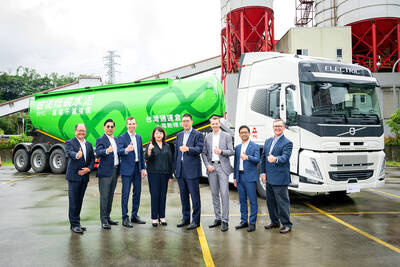
Taiwan Transport and Storage Corp (TTS, 台灣通運倉儲) yesterday unveiled its first electric tractor unit — manufactured by Volvo Trucks — in a ceremony in Taipei, and said the unit would soon be used to transport cement produced by Taiwan Cement Corp (TCC, 台灣水泥). Both TTS and TCC belong to TCC International Holdings Ltd (台泥國際集團). With the electric tractor unit, the Taipei-based cement firm would become the first in Taiwan to use electric vehicles to transport construction materials. TTS chairman Koo Kung-yi (辜公怡), Volvo Trucks vice president of sales and marketing Johan Selven, TCC president Roman Cheng (程耀輝) and Taikoo Motors Group

Among the rows of vibrators, rubber torsos and leather harnesses at a Chinese sex toys exhibition in Shanghai this weekend, the beginnings of an artificial intelligence (AI)-driven shift in the industry quietly pulsed. China manufactures about 70 percent of the world’s sex toys, most of it the “hardware” on display at the fair — whether that be technicolor tentacled dildos or hyper-realistic personalized silicone dolls. Yet smart toys have been rising in popularity for some time. Many major European and US brands already offer tech-enhanced products that can enable long-distance love, monitor well-being and even bring people one step closer to
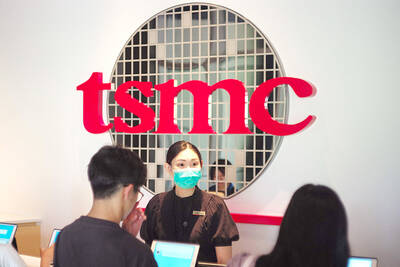
RECORD-BREAKING: TSMC’s net profit last quarter beat market expectations by expanding 8.9% and it was the best first-quarter profit in the chipmaker’s history Taiwan Semiconductor Manufacturing Co (TSMC, 台積電), which counts Nvidia Corp as a key customer, yesterday said that artificial intelligence (AI) server chip revenue is set to more than double this year from last year amid rising demand. The chipmaker expects the growth momentum to continue in the next five years with an annual compound growth rate of 50 percent, TSMC chief executive officer C.C. Wei (魏哲家) told investors yesterday. By 2028, AI chips’ contribution to revenue would climb to about 20 percent from a percentage in the low teens, Wei said. “Almost all the AI innovators are working with TSMC to address the

Malaysia’s leader yesterday announced plans to build a massive semiconductor design park, aiming to boost the Southeast Asian nation’s role in the global chip industry. A prominent player in the semiconductor industry for decades, Malaysia accounts for an estimated 13 percent of global back-end manufacturing, according to German tech giant Bosch. Now it wants to go beyond production and emerge as a chip design powerhouse too, Malaysian Prime Minister Anwar Ibrahim said. “I am pleased to announce the largest IC (integrated circuit) Design Park in Southeast Asia, that will house world-class anchor tenants and collaborate with global companies such as Arm [Holdings PLC],”


 RSS
RSS