


Toyota Motor Corp is quickening its quest to unseat ailing rival General Motors Corp as the world's biggest automaker and widen its lead over Ford Motor Co with reported plans to boost overseas production by 40 percent to 5 million vehicles by 2008.
The news comes just days after Ford announced drastic steps to remake itself into a smaller, more competitive company, slashing thousands of jobs and shuttering two plants to cut costs. Ford's overhaul was announced just as DaimlerChrysler said it would cut US production through the rest of this year. GM announced its own large cutbacks earlier this year.
Toyota, by contrast, is planning to increase overseas production by 40 percent over last year's level to 5 million vehicles by 2008, Japan's Nihon Keizai Shimbun reported yesterday, without saying how it got the information.

PHOTO: AP
In North America, the world's largest auto market, the Japanese company intends to raise production by 20 percent to 1.84 million vehicles in that period, the business newspaper reported. Toyota aims to meet the target with the help of new plants previously planned for Texas and Canada, it said.
different outlooks
The vastly different outlooks underline the diverging fates of automakers in Japan and the US. While US companies are closing plants, letting workers go and trimming production amid weak sales, Japanese manufacturers -- including Toyota and Honda Motor Co -- are posting record earnings and increasing output to keep up with demand.
In May, profit-rich Honda announced sweeping plans to spend US$1.18 billion on new plants in the US, Canada and Japan and boost production to meet soaring sales of its fuel-efficient models.
Meanwhile, Nissan Motor Co is in talks with Renault SA over a possible alliance with GM to help bail out their Detroit rival.
Under the plans it reported yesterday, Toyota also expects to raise production above 1 million vehicles for the first time in Asia, excluding Japan and China. That goal will be achieved by bringing its third factory in Thailand online, the Nihon Keizai reported.
In China, the automaker aims to quadruple production from last year's levels to 600,000, it said.
Production in Japan is seen rising to 4.15 million vehicles by 2008, bringing Toyota's global output to 9.1 million.
Toyota officials were not available for comment yesterday, but the company's robust earnings and sales have put it on track to surpass GM as the world's No. 1 automaker, analysts say.
General Motors, which lost US$10.6 billion last year, launched a major restructuring last November, calling for the closure of 12 plants by 2008, slashing a portion of its work force, reducing capacity and cutting costs. About 34,000 hourly workers have accepted buyouts or early retirement offers that were extended earlier this year and the company has cut 2,000 salaried workers.
According to figures released by GM earlier this month, the US automaker produced 9.05 million autos worldwide last year while Toyota produced 8.23 million worldwide.
further behind
Since being overtaken by Toyota in 2003, Ford has been falling farther behind.
Friday's cuts by Ford bring its total plant closures to 16, adding to 14 plants announced in a previous restructuring. Ford also said it would complete cuts of about 30,000 hourly jobs by the end of the 2008, four years ahead of its previous target.
That announcement coincided with more bad news from DaimlerChrysler, which said on Friday its Chrysler division will make additional production cuts in the third and fourth quarters to reduce dealer inventories.
The Big Three, which rely more on light trucks for profits than their foreign competitors, have been hurt by declining sales of pickups as customers switch to more fuel-efficient vehicles. They are also struggling with the need to reduce so-called "legacy costs" of big pay and benefits packages for workers and retirees.
Despite its ambitious outlook, however, even Toyota recognizes no automaker is invincible.
Last month, Toyota president Katsuaki Watanabe warned that his company could delay the introduction of some new models as it tries to improve its quality control amid a spate of recalls. The glitches were partly due to efforts to cut costs by using the same parts across different models, but they could do lasting damage to Toyota's reputation for reliability.
investigations
Japanese authorities have launched an investigation into three Toyota officials suspected of failing to take action about a faulty steering part, which may have played a factor in causing a 2004 accident that injured five people.
The US government has also opened an investigation into Toyota Sienna minivans that were made from 2004 until last year after receiving complaints that their lift gates had failed, causing the hatchback to close on motorists' heads.
In China, authorities recently said Toyota will launch a recall of 20,069 Crown sedans that were made there because of the discovery of defective rubber strips used in the windshields.
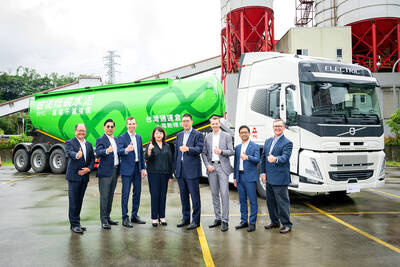
Taiwan Transport and Storage Corp (TTS, 台灣通運倉儲) yesterday unveiled its first electric tractor unit — manufactured by Volvo Trucks — in a ceremony in Taipei, and said the unit would soon be used to transport cement produced by Taiwan Cement Corp (TCC, 台灣水泥). Both TTS and TCC belong to TCC International Holdings Ltd (台泥國際集團). With the electric tractor unit, the Taipei-based cement firm would become the first in Taiwan to use electric vehicles to transport construction materials. TTS chairman Koo Kung-yi (辜公怡), Volvo Trucks vice president of sales and marketing Johan Selven, TCC president Roman Cheng (程耀輝) and Taikoo Motors Group

Among the rows of vibrators, rubber torsos and leather harnesses at a Chinese sex toys exhibition in Shanghai this weekend, the beginnings of an artificial intelligence (AI)-driven shift in the industry quietly pulsed. China manufactures about 70 percent of the world’s sex toys, most of it the “hardware” on display at the fair — whether that be technicolor tentacled dildos or hyper-realistic personalized silicone dolls. Yet smart toys have been rising in popularity for some time. Many major European and US brands already offer tech-enhanced products that can enable long-distance love, monitor well-being and even bring people one step closer to

RECORD-BREAKING: TSMC’s net profit last quarter beat market expectations by expanding 8.9% and it was the best first-quarter profit in the chipmaker’s history Taiwan Semiconductor Manufacturing Co (TSMC, 台積電), which counts Nvidia Corp as a key customer, yesterday said that artificial intelligence (AI) server chip revenue is set to more than double this year from last year amid rising demand. The chipmaker expects the growth momentum to continue in the next five years with an annual compound growth rate of 50 percent, TSMC chief executive officer C.C. Wei (魏哲家) told investors yesterday. By 2028, AI chips’ contribution to revenue would climb to about 20 percent from a percentage in the low teens, Wei said. “Almost all the AI innovators are working with TSMC to address the

Malaysia’s leader yesterday announced plans to build a massive semiconductor design park, aiming to boost the Southeast Asian nation’s role in the global chip industry. A prominent player in the semiconductor industry for decades, Malaysia accounts for an estimated 13 percent of global back-end manufacturing, according to German tech giant Bosch. Now it wants to go beyond production and emerge as a chip design powerhouse too, Malaysian Prime Minister Anwar Ibrahim said. “I am pleased to announce the largest IC (integrated circuit) Design Park in Southeast Asia, that will house world-class anchor tenants and collaborate with global companies such as Arm [Holdings PLC],”


 RSS
RSS