


The nation's central bank is expected to hike interest rates twice more before the year's end in light of looming inflationary pressure, which is likely to be boosted by high energy costs and wholesale prices, analysts said.
"There is still room for rate increases from a middle or long-term perspective," Chen Miao (
High oil prices remained a concern, while a rise in electricity prices next month could further spur inflation, Chen said.
Starting on Saturday, electricity prices will be raised for the first time in 23 years, with commercial users of more than 330 kilowatt-hours per month paying an additional 4.99 percent, and industrial users bearing extra costs of up to 7.98 percent regardless of their power consumption.
Also, the wholesale price index, a leading indicator for the consumer price index (CPI), which hit 6.24 percent last month -- compared with a CPI of around 1.58 percent -- could be passed on by manufacturers or vendors, who are suffering narrower margins given high raw materials prices, Chen said.
The analyst anticipated two more interest-rate increases by the end of this year.
The central bank is scheduled to hold its quarterly meeting on Thursday to discuss possible changes in monetary policy.
The market consensus expects the bank to raise interest rates for the eighth straight quarter by 0.125 percentage points this week, bringing the rediscount rate charged to commercial lenders to 2.5 percent. The US Federal Reserve is also expected to hike rates for the 17th consecutive time by a quarter percentage point to 5.25 percent on Thursday.
Standard Chartered Bank said last week that the nation's central bank could boost interest rates three more times before the end of this year, by 0.125 percentage points each time, to narrow its rate spread with the US and move negative real interest rates into the positive after factoring in inflation.
Meanwhile, TIER's monthly survey released yesterday indicated that local manufacturers are increasingly bullish about the nation's economic prospects.
Up to 44.9 percent of those polled last month said the economy would be in an upturn during the next six months, up from 28.6 percent in April, according to the survey.
By comparison, those in the manufacturing sector who had a pessimistic outlook dropped significantly to 14.3 percent, down from 28.5 percent, the poll said.
The sector contributes about 24 percent of the nation's GDP.
The optimism was driven by the coming traditional high season for the manufacturing industry in the second half, in light of relatively stable global demand, Chen said.
The Taipei-based research institute said it may update its forecast for Taiwan's economic growth next month. TIER in April cut its GDP forecast for this year to 3.91 percent, down from 4.02 percent predicted in January, because of low domestic demand.
"We may remain conservative about economic growth this year, if private consumption and investment stay weak in the current quarter," TIER vice chairman Kung Ming-hsin (
Earlier this month, Lehman Brothers downgraded its GDP forecast for Taiwan this year for the second time, to 3.5 percent from 4 percent, citing concerns over prolonged political uncertainty, which could hurt investment, and the sharp rise in household debt, which, coupled with rising interest rates, would constrain consumption.

Among the rows of vibrators, rubber torsos and leather harnesses at a Chinese sex toys exhibition in Shanghai this weekend, the beginnings of an artificial intelligence (AI)-driven shift in the industry quietly pulsed. China manufactures about 70 percent of the world’s sex toys, most of it the “hardware” on display at the fair — whether that be technicolor tentacled dildos or hyper-realistic personalized silicone dolls. Yet smart toys have been rising in popularity for some time. Many major European and US brands already offer tech-enhanced products that can enable long-distance love, monitor well-being and even bring people one step closer to

Malaysia’s leader yesterday announced plans to build a massive semiconductor design park, aiming to boost the Southeast Asian nation’s role in the global chip industry. A prominent player in the semiconductor industry for decades, Malaysia accounts for an estimated 13 percent of global back-end manufacturing, according to German tech giant Bosch. Now it wants to go beyond production and emerge as a chip design powerhouse too, Malaysian Prime Minister Anwar Ibrahim said. “I am pleased to announce the largest IC (integrated circuit) Design Park in Southeast Asia, that will house world-class anchor tenants and collaborate with global companies such as Arm [Holdings PLC],”

Sales in the retail, and food and beverage sectors last month continued to rise, increasing 0.7 percent and 13.6 percent respectively from a year earlier, setting record highs for the month of March, the Ministry of Economic Affairs said yesterday. Sales in the wholesale sector also grew last month by 4.6 annually, mainly due to the business opportunities for emerging applications related to artificial intelligence (AI) and high-performance computing technologies, the ministry said in a report. The ministry forecast that retail, and food and beverage sales this month would retain their growth momentum as the former would benefit from Tomb Sweeping Day
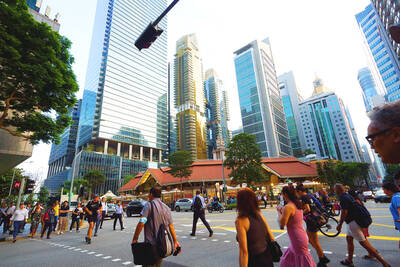
Thousands of parents in Singapore are furious after a Cordlife Group Ltd (康盛人生集團), a major operator of cord blood banks in Asia, irreparably damaged their children’s samples through improper handling, with some now pursuing legal action. The ongoing case, one of the worst to hit the largely untested industry, has renewed concerns over companies marketing themselves to anxious parents with mostly unproven assurances. This has implications across the region, given Cordlife’s operations in Hong Kong, Macau, Indonesia, the Philippines and India. The parents paid for years to have their infants’ cord blood stored, with the understanding that the stem cells they contained


 RSS
RSS