


White-hot competition in the convenience store sector has led to what a smaller operator tagged vicious rivalry that undermines already difficult operations, an executive with OK Convenience Stores said yesterday.
The market is dominated by President Chain Store Corp (
For a nation of 23 million people, each convenience store serves a pool of less than 3,000 people, a level which operators see as crucial to sustaining profitability.
But the No. 4 player, OK Convenience Stores, yesterday pointed the finger at the market leader, accusing President Chain of unfair practices.
"A number of our better performing stores were forced to close down as President Chain offered higher rents to win over the landlords' contracts. In some cases, they also deliberately opened new outlets near our stores" just to slash OK market share, said Roy Wu (吳光昌), vice president of the firm's corporate strategy division, on the sidelines of a press conference.
OK, with 910 stores, yesterday launched its second large-scale NT$170 million (US$5.2 million) marketing campaign featuring colored Disney-themed miniature soccer figure giveaways, hoping to boost revenue by 30 percent by the end of September.
Wu said that in Japan's more mature market for convenience stores, operators would not launch such oppressive strategies, but instead evaluate whether a certain region holds potential before making the decision to expand.
"[President Chain] has enough capital to support money-losing stores for drawn-out tug-of-wars," he added.
Executives of President Chain and No. 2 player Taiwan FamilyMart Co (
"Securing good locations with higher rents seems a normality as we've been also treated by competitors in the same way. But if companies fail to offer better-quality services and product mix, I don't think consumers will be lured back to spend money in bigger players," said Lillian Lin (林立莉), public relations manager of President Chain.
Taiwan FamilyMart vice president Yeh Jung-ting (
This meant that "extreme" strategies would be just be one of the types employed, he said.
Since last year, when the convenience store market saw the total number of chained outlets topping 8,000, major operators have seen their expansion slowing and revenue growth weakening.
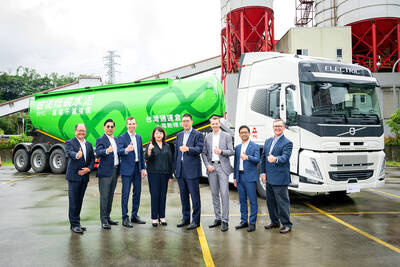
Taiwan Transport and Storage Corp (TTS, 台灣通運倉儲) yesterday unveiled its first electric tractor unit — manufactured by Volvo Trucks — in a ceremony in Taipei, and said the unit would soon be used to transport cement produced by Taiwan Cement Corp (TCC, 台灣水泥). Both TTS and TCC belong to TCC International Holdings Ltd (台泥國際集團). With the electric tractor unit, the Taipei-based cement firm would become the first in Taiwan to use electric vehicles to transport construction materials. TTS chairman Koo Kung-yi (辜公怡), Volvo Trucks vice president of sales and marketing Johan Selven, TCC president Roman Cheng (程耀輝) and Taikoo Motors Group

Among the rows of vibrators, rubber torsos and leather harnesses at a Chinese sex toys exhibition in Shanghai this weekend, the beginnings of an artificial intelligence (AI)-driven shift in the industry quietly pulsed. China manufactures about 70 percent of the world’s sex toys, most of it the “hardware” on display at the fair — whether that be technicolor tentacled dildos or hyper-realistic personalized silicone dolls. Yet smart toys have been rising in popularity for some time. Many major European and US brands already offer tech-enhanced products that can enable long-distance love, monitor well-being and even bring people one step closer to

RECORD-BREAKING: TSMC’s net profit last quarter beat market expectations by expanding 8.9% and it was the best first-quarter profit in the chipmaker’s history Taiwan Semiconductor Manufacturing Co (TSMC, 台積電), which counts Nvidia Corp as a key customer, yesterday said that artificial intelligence (AI) server chip revenue is set to more than double this year from last year amid rising demand. The chipmaker expects the growth momentum to continue in the next five years with an annual compound growth rate of 50 percent, TSMC chief executive officer C.C. Wei (魏哲家) told investors yesterday. By 2028, AI chips’ contribution to revenue would climb to about 20 percent from a percentage in the low teens, Wei said. “Almost all the AI innovators are working with TSMC to address the

Malaysia’s leader yesterday announced plans to build a massive semiconductor design park, aiming to boost the Southeast Asian nation’s role in the global chip industry. A prominent player in the semiconductor industry for decades, Malaysia accounts for an estimated 13 percent of global back-end manufacturing, according to German tech giant Bosch. Now it wants to go beyond production and emerge as a chip design powerhouse too, Malaysian Prime Minister Anwar Ibrahim said. “I am pleased to announce the largest IC (integrated circuit) Design Park in Southeast Asia, that will house world-class anchor tenants and collaborate with global companies such as Arm [Holdings PLC],”


 RSS
RSS