


When Chinese firms like the state-owned oil company PetroChina Co (
But that's not what the Bank of China (
The IPO is part of a recent wave of Chinese firms that are skipping New York entirely. Hong Kong's new popularity for the mega IPOs is seen by some as the latest trend in globalization -- the rise of a new world with many financial capitals.

PHOTO: AP
"The fact that so much foreign money and institutional investment is placed in the Hong Kong stock market proves the confidence of international investors in our system," Hong Kong's Secretary for Financial Services Frederick Ma (
But skeptics argue that the Chinese firms -- called "red chips" and "H-shares" in local lingo -- don't dare list in the US because their finances are as murky as a bowl of sweet-and-sour soup. The critics say Hong Kong's less rigorous financial disclosure regulations mean fewer headaches for the firms.
David Webb, a retired investment banker and shareholder activist, said Hong Kong's stock exchange has some serious catching up to do with other global markets. He said new rules are needed to protect shareholders' rights and to require faster reporting.
"Hong Kong is the last market in Asia that doesn't require large companies to report quarterly. It's because of resistance from the tycoons. That can't last much longer," said Webb, who serves as an elected non-executive director of the Hong Kong Exchanges & Clearing Ltd, the listed firm that operates the stock exchange.
Webb said the rules also allow companies -- especially state-run Chinese firms -- to raise cash from a public listing and loan the money to an unlisted parent company or other related business in which the shareholder has no economic interest.
"So there's a risk that by co-mingling, by mixing up the money of the listed company and the parent, that you can end up with bad debt," he said.
Other issues critics say need to be addressed are:
One, companies can wait four months to report annual results when the international norm is 60 days.
Two, shareholders can't bring class action lawsuits in Hong Kong, so corporate collapses caused by wrongdoing rarely result in shareholder litigation.
Three, listing rules aren't statutory so a company's leaders can't be fined or jailed for breaking them.
But the exchange said in a statement that Hong Kong has adopted international accounting examples and its market is "open, fair, effective and transparent." The exchange added that it's also appealing to Chinese companies because of its proximity to the mainland and the large pool of investment bankers here.
"There are no foreign exchange controls. There is no capital gains tax," the statement said. "There is no withholding of income in respect of taxes."
Many of the Chinese firms have been scared away from US markets by the tough Sarbanes-Oxley anti-fraud law, said Steven Cheung (
The law went on the books in 2002 after a string of corporate scandals, including the Enron Corp meltdown. The measure's sweeping reforms require CEOs and chief financial officers to certify in sworn written statements the accuracy of the company's financial results -- with possible prison terms for signing statements they knew to be false.
"For these Chinese enterprises, it takes time to catch up with the latest developments in corporate governance practices," Cheung, said. "If they had to comply with the Sarbanes-Oxley act, I don't know how long it would take them."
Thirty-eight Chinese companies now trade on US stock exchanges, as do 19 companies with headquarters in Hong Kong, according to Associated Press data.
New York Stock Exchange (NYSE) chairman Marshall Carter testified before a congressional committee on April 26 that tougher regulations have hurt the exchange's pursuit of foreign IPOs.
Almost half of non-US companies going public did so on the NYSE or NASDAQ in 2000, but that number plunged to 5.7 percent last year because of "US regulatory rules and oversight," he said.
But the US won't relax its regulatory standards just to recapture any IPO business heading to foreign markets, Christopher Cox, chairman of the Securities and Exchange Commission, said April 25 in testimony to a Senate committee. He warned of "a race to the bottom" if the US were to do so.
Hong Kong ranked No. 5 in the world last year in share issuance, raising HK$292.5 billion (US$37 billion), after the New York Stock Exchange, Euronext (the Paris, Amsterdam, Brussels and Lisbon exchanges), the London Stock Exchange and Toronto's TSX Group, said the exchange, citing the World Federation of Exchanges.
Ma said those who only focus on governance and transparency issues don't understand the numerous other factors that make Hong Kong appealing to Chinese companies -- including the fact that professional and underwriting fees in the US are double the cost in Hong Kong.

Taiwan Transport and Storage Corp (TTS, 台灣通運倉儲) yesterday unveiled its first electric tractor unit — manufactured by Volvo Trucks — in a ceremony in Taipei, and said the unit would soon be used to transport cement produced by Taiwan Cement Corp (TCC, 台灣水泥). Both TTS and TCC belong to TCC International Holdings Ltd (台泥國際集團). With the electric tractor unit, the Taipei-based cement firm would become the first in Taiwan to use electric vehicles to transport construction materials. TTS chairman Koo Kung-yi (辜公怡), Volvo Trucks vice president of sales and marketing Johan Selven, TCC president Roman Cheng (程耀輝) and Taikoo Motors Group

Among the rows of vibrators, rubber torsos and leather harnesses at a Chinese sex toys exhibition in Shanghai this weekend, the beginnings of an artificial intelligence (AI)-driven shift in the industry quietly pulsed. China manufactures about 70 percent of the world’s sex toys, most of it the “hardware” on display at the fair — whether that be technicolor tentacled dildos or hyper-realistic personalized silicone dolls. Yet smart toys have been rising in popularity for some time. Many major European and US brands already offer tech-enhanced products that can enable long-distance love, monitor well-being and even bring people one step closer to
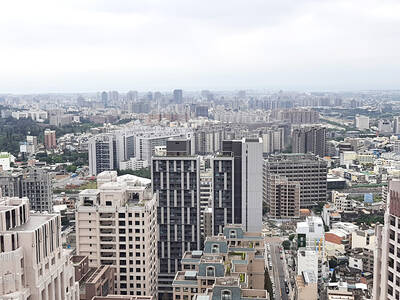
New apartments in Taiwan’s major cities are getting smaller, while old apartments are increasingly occupied by older people, many of whom live alone, government data showed. The phenomenon has to do with sharpening unaffordable property prices and an aging population, property brokers said. Apartments with one bedroom that are two years old or older have gained a noticeable presence in the nation’s six special municipalities as well as Hsinchu county and city in the past five years, Evertrust Rehouse Co (永慶房產集團) found, citing data from the government’s real-price transaction platform. In Taipei, apartments with one bedroom accounted for 19 percent of deals last
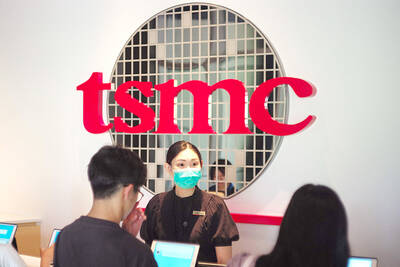
RECORD-BREAKING: TSMC’s net profit last quarter beat market expectations by expanding 8.9% and it was the best first-quarter profit in the chipmaker’s history Taiwan Semiconductor Manufacturing Co (TSMC, 台積電), which counts Nvidia Corp as a key customer, yesterday said that artificial intelligence (AI) server chip revenue is set to more than double this year from last year amid rising demand. The chipmaker expects the growth momentum to continue in the next five years with an annual compound growth rate of 50 percent, TSMC chief executive officer C.C. Wei (魏哲家) told investors yesterday. By 2028, AI chips’ contribution to revenue would climb to about 20 percent from a percentage in the low teens, Wei said. “Almost all the AI innovators are working with TSMC to address the


 RSS
RSS