


The US business community again urged the government to lift bans on direct cross-strait links yesterday, saying that this could make free trade agreement (FTA) talks with the US possible.
The opening of direct links would generate significant US interest in an FTA with Taiwan, as this would mean that Taiwan had been "globalized," Richard Vuylsteke, chief executive officer of the American Chamber of Commerce in Taipei (AmCham), told a press conference yesterday.
Direct links would relieve political jitters, drawing support for FTA talks from US businesses keen to explore synergistic opportunities in economies on either side of the Taiwan Strait, he said.
The foreign business community could move swiftly to help make the FTA a reality once the government had hammered out an economic policy to address longstanding issues, such as compliance with government procurement principles and pharmaceutical counterfeiting, Vuylsteke added.
AmCham, which represents the interests of more than 500 US companies in Taiwan, yesterday released its 2006 Taiwan White Paper. The report again stressed the importance of quick action to facilitate cross-strait trade and investment through the opening-up of direct passenger and cargo flights.
In the absence of direct links, Taiwan is creating barriers to cross-strait economic integration and separating itself from the global economy, according to AmCham president Tom Johnson.
Also, since a large proportion of multinational companies have operations on both sides of the strait, the ban has increased their costs -- something which could deter foreign investors who would otherwise choose to invest in Taiwan, which provides better intellectual property rights (IPR) protection and living standards, Vuylsteke added.
AmCham has called for direct links with China since the early 1990s.
The organization expressed optimism that early progress on the issue could be possible, citing opinion polls that showed 70 percent of the population was now in favor of direct flights. Government officials also seem more open to the idea, AmCham said.
AmCham said it was optimistic that direct links could become a reality during the Chen administration, as it perceived that the issue was being divorced from concerns over sovereignty, citing the encouraging precedent of charter flights during holidays.
Meanwhile, the chamber identified seven priority items in its white paper, including eliminating government restrictions on hiring (such as work-permit restrictions), liberalizing Taiwan's public health and healthcare environment to make it easier for innovative drugs and medical devices to come to market, tightening IPR protection in terms of Internet piracy and textbook copying and rooting out government corruption by enhancing transparency in the legislative process.
Furthermore, the chamber said that the current corruption allegations against President Chen Shui-bian's (
Instead, the current investigation process was a positive development in that political figures and their relatives were subject to scrutiny -- as they should be in a democratic and open society, the chamber said.

Among the rows of vibrators, rubber torsos and leather harnesses at a Chinese sex toys exhibition in Shanghai this weekend, the beginnings of an artificial intelligence (AI)-driven shift in the industry quietly pulsed. China manufactures about 70 percent of the world’s sex toys, most of it the “hardware” on display at the fair — whether that be technicolor tentacled dildos or hyper-realistic personalized silicone dolls. Yet smart toys have been rising in popularity for some time. Many major European and US brands already offer tech-enhanced products that can enable long-distance love, monitor well-being and even bring people one step closer to

Malaysia’s leader yesterday announced plans to build a massive semiconductor design park, aiming to boost the Southeast Asian nation’s role in the global chip industry. A prominent player in the semiconductor industry for decades, Malaysia accounts for an estimated 13 percent of global back-end manufacturing, according to German tech giant Bosch. Now it wants to go beyond production and emerge as a chip design powerhouse too, Malaysian Prime Minister Anwar Ibrahim said. “I am pleased to announce the largest IC (integrated circuit) Design Park in Southeast Asia, that will house world-class anchor tenants and collaborate with global companies such as Arm [Holdings PLC],”

Sales in the retail, and food and beverage sectors last month continued to rise, increasing 0.7 percent and 13.6 percent respectively from a year earlier, setting record highs for the month of March, the Ministry of Economic Affairs said yesterday. Sales in the wholesale sector also grew last month by 4.6 annually, mainly due to the business opportunities for emerging applications related to artificial intelligence (AI) and high-performance computing technologies, the ministry said in a report. The ministry forecast that retail, and food and beverage sales this month would retain their growth momentum as the former would benefit from Tomb Sweeping Day
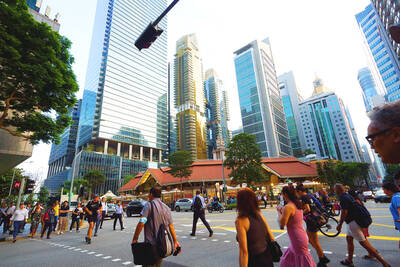
Thousands of parents in Singapore are furious after a Cordlife Group Ltd (康盛人生集團), a major operator of cord blood banks in Asia, irreparably damaged their children’s samples through improper handling, with some now pursuing legal action. The ongoing case, one of the worst to hit the largely untested industry, has renewed concerns over companies marketing themselves to anxious parents with mostly unproven assurances. This has implications across the region, given Cordlife’s operations in Hong Kong, Macau, Indonesia, the Philippines and India. The parents paid for years to have their infants’ cord blood stored, with the understanding that the stem cells they contained


 RSS
RSS