


Wall Street's rally came to an abrupt halt over the past week, with stocks turning sharply lower on mounting concerns that inflation is making a comeback.
The Dow Jones Industrial Average, which came within 100 points of its all-time high at midweek, slumped 1.7 percent in the week to Friday to end at 11,380.99.
The tech-heavy NASDAQ meanwhile plunged 4.2 percent for the week to 2,243.78, while the broad-market Standard and Poor's 500 index gave back 2.6 percent to 1,291.24.
The turning point for Wall Street came on Wednesday after the Federal Reserve disappointed many investors by failing to signal it was ready to pause or halt its cycle of rate increases. The central bank announced its 16th consecutive rate hike, lifting the base rate to 5.0 percent, while leaving the door open to additional increases.
Against a background of near-record prices for many commodities including crude oil, this heightened jitters about inflation.
Lynn Reaser, Bank of America economist, said the nervousness may persist.
"These concerns about higher inflation threaten equities in two ways. First, they could prompt the Federal Reserve to continue raising interest rates, ultimately jeopardizing the economic expansion. Second, they could put further pressure on long-term interest rates, raising discount rates on stock valuations," Reaser said.
"Next week's reports on underlying inflation will test investors' mettle. Some of the market's recent sell-off probably represents profit taking, but investors now need confirmation that productivity gains and global competition are keeping a lid on inflation, Reaser said.
"Financial markets are exceptionally volatile across the entire spectrum of instruments," said Andrew Busch, an analyst at BMO Nesbitt Burns.
"Good for trading, bad for economies. Dangerous for finance officials. Rumors of a hedge fund blowup in commodities could be [the] start of bigger problems," he said.
Lehman Brothers economist Ethan Harris said he expects volatility in the markets as each bit of economic data is released, since the Fed and new chairman Ben Bernanke have pledged to be "data dependent" in deciding on monetary policy.
"The markets continue to hang on every word from the Fed. The latest directive confirms that policy is data-dependent, with a particular focus on inflation risks," he said.
"The Fed is grappling with two risks: that it has already tightened too much and that a sharp economic slowdown is in the works [or] that it has tightened too little and an acceleration of inflation is on the way," he said.
Bob Dickey, technical analyst at RBC Dain Rauscher, said he is not overly concerned about what appears to be "a normal correction period" after a series of rallies in recent weeks.
"The advance was fairly orderly, and we believe that a pullback will also be modest by historical standards. The support on the Dow is very good around 11,000, and we expect the index to test that support over the next two months, which is about a five percent risk from current levels ... We are not looking for any kind of substantially serious decline, but do think that it will be tradable for the more aggressive investor," he said.
Bonds were pressured by concerns about inflation and the Federal Reserve's next moves on interest rates.

Stephen Garrett, a 27-year-old graduate student, always thought he would study in China, but first the country’s restrictive COVID-19 policies made it nearly impossible and now he has other concerns. The cost is one deterrent, but Garrett is more worried about restrictions on academic freedom and the personal risk of being stranded in China. He is not alone. Only about 700 American students are studying at Chinese universities, down from a peak of nearly 25,000 a decade ago, while there are nearly 300,000 Chinese students at US schools. Some young Americans are discouraged from investing their time in China by what they see

MAJOR DROP: CEO Tim Cook, who is visiting Hanoi, pledged the firm was committed to Vietnam after its smartphone shipments declined 9.6% annually in the first quarter Apple Inc yesterday said it would increase spending on suppliers in Vietnam, a key production hub, as CEO Tim Cook arrived in the country for a two-day visit. The iPhone maker announced the news in a statement on its Web site, but gave no details of how much it would spend or where the money would go. Cook is expected to meet programmers, content creators and students during his visit, online newspaper VnExpress reported. The visit comes as US President Joe Biden’s administration seeks to ramp up Vietnam’s role in the global tech supply chain to reduce the US’ dependence on China. Images on

Taiwan Transport and Storage Corp (TTS, 台灣通運倉儲) yesterday unveiled its first electric tractor unit — manufactured by Volvo Trucks — in a ceremony in Taipei, and said the unit would soon be used to transport cement produced by Taiwan Cement Corp (TCC, 台灣水泥). Both TTS and TCC belong to TCC International Holdings Ltd (台泥國際集團). With the electric tractor unit, the Taipei-based cement firm would become the first in Taiwan to use electric vehicles to transport construction materials. TTS chairman Koo Kung-yi (辜公怡), Volvo Trucks vice president of sales and marketing Johan Selven, TCC president Roman Cheng (程耀輝) and Taikoo Motors Group
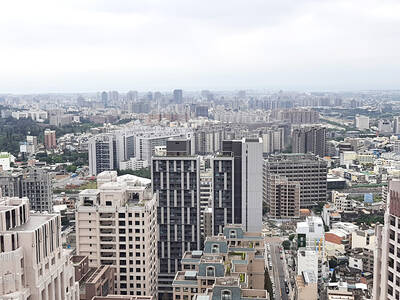
New apartments in Taiwan’s major cities are getting smaller, while old apartments are increasingly occupied by older people, many of whom live alone, government data showed. The phenomenon has to do with sharpening unaffordable property prices and an aging population, property brokers said. Apartments with one bedroom that are two years old or older have gained a noticeable presence in the nation’s six special municipalities as well as Hsinchu county and city in the past five years, Evertrust Rehouse Co (永慶房產集團) found, citing data from the government’s real-price transaction platform. In Taipei, apartments with one bedroom accounted for 19 percent of deals last


 RSS
RSS