


With a towel wrapped around his head, Chen Jen greets his friends as he slips into a pool of hot water and hums his favorite song.
Like many men visiting this hot spring in Beitou (
Nostalgically, Chen closes his eyes and hums a song called "Yunojima elegy," about a man seeking comfort in a bathhouse after he is ditched by his lover.
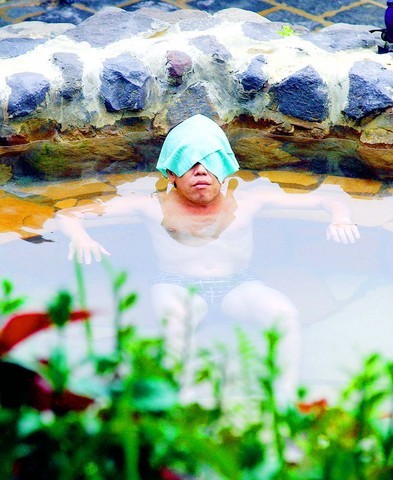
PHOTO: AFP
"That was a Japanese song very popular more than half a century ago," 72-year-old Chen recalls as sweat drops down his face while steam with the smell of sulfur rises from the pool.
"At that time, it took only three cents to have a hot spring bath," he adds wistfully.
The spartan public bathrooms in Beitou are the most famous in Taiwan, where hot spring culture is more than a century old. Its development dates back to 1893 when a German businessman discovered hot springs there and set up a spa.
When Japan began its colonization of Taiwan two years later, the culture of hot springs started to spread across the island and during the 50-year occupation, Beitou flourished as the premiere spa destination.
Even so, housewives and children from outside the area were reluctant to stay in hot spring hotels.
"Beitou used to be a place for men only. They came here mainly for drinking and having sex while enjoying hot springs," says 46-year-old Yeh Su-hung, a Beitou resident.
But things have changed since the late 1990s, with Beitou emerging as a popular leisure spot for families.
"Time flies and everything has changed," says Chen, as he sits in the tub of 40oC water.
The pools are now surrounded by several luxurious high-rise hot spring hotels nestling on the foothills of the Tatun (
Windy Yang (
"Japan's onsen [hot spring] culture has had a far-reaching influence on the development of the local hot spring industry," she says, adding that it has become something of a heath fad in more recent times.
"I suffered from some injuries like tennis elbow and wrist strains, but these have greatly improved over the past five years," says Yeh, who pays just NT$40 for each stay of up to 150 minutes at his favorite Beitou spa.
"However, it only works if you do it regularly. I do it five days a week," he says.
A driving factor behind the gentrification of spas was the government's adoption of a five-day work week in 2000, says Chen Hui-tsung of the Hot Spring Tourism Association of Taiwan (中華民國溫泉觀光協會).
"With parents having more time, they now look for good places suitable for whole families. Parents would never consider taking their children to hot springs where sex services are available," he says.
Television programs about Japan's famous hot spring resorts are also fuelling the interests of leisure seekers and entrepreneurs.
"Spa and hot springs investors have found huge business opportunities from the changes [in the perception of hot springs]," Chen says.
The sector has attracted investment worth billions of dollars to construct some 150 large resorts, hotels and restaurants in the nation's 20 hot spring areas, he says. In Beitou alone, there are more than 20 hotels.
For those who prefer to soak in privacy rather than a communal public bath, there are luxury resorts in Beitou and places such as Wulai (
"Once they are here, our clients will definitely appreciate the value of our service," says Jesse Cheng (
The upscale resort has had an occupancy rate of around 70 percent since it opened in 2001, despite a price tag of NT$26,000 per night in one of its suites.
Private baths suit "Spa Lady" Yang who says she likes "nude bathing" because "it helps strip off the burden of daily living, and gives me a feeling like being in a mother's womb."
Unlike Japan, where hot spring tourists stay overnight or longer, most Taiwanese usually drop in for just an hour or two.
"That's because in Japan, hot springs are located in remote areas and it may take several hours to reach them. In Taiwan, hot spring areas are on Taipei's doorstep," the association's Chen says.
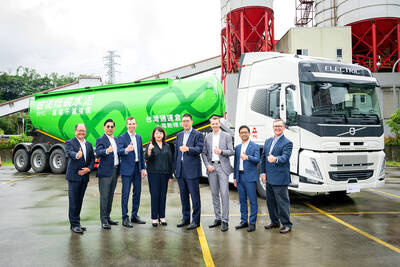
Taiwan Transport and Storage Corp (TTS, 台灣通運倉儲) yesterday unveiled its first electric tractor unit — manufactured by Volvo Trucks — in a ceremony in Taipei, and said the unit would soon be used to transport cement produced by Taiwan Cement Corp (TCC, 台灣水泥). Both TTS and TCC belong to TCC International Holdings Ltd (台泥國際集團). With the electric tractor unit, the Taipei-based cement firm would become the first in Taiwan to use electric vehicles to transport construction materials. TTS chairman Koo Kung-yi (辜公怡), Volvo Trucks vice president of sales and marketing Johan Selven, TCC president Roman Cheng (程耀輝) and Taikoo Motors Group

Among the rows of vibrators, rubber torsos and leather harnesses at a Chinese sex toys exhibition in Shanghai this weekend, the beginnings of an artificial intelligence (AI)-driven shift in the industry quietly pulsed. China manufactures about 70 percent of the world’s sex toys, most of it the “hardware” on display at the fair — whether that be technicolor tentacled dildos or hyper-realistic personalized silicone dolls. Yet smart toys have been rising in popularity for some time. Many major European and US brands already offer tech-enhanced products that can enable long-distance love, monitor well-being and even bring people one step closer to

RECORD-BREAKING: TSMC’s net profit last quarter beat market expectations by expanding 8.9% and it was the best first-quarter profit in the chipmaker’s history Taiwan Semiconductor Manufacturing Co (TSMC, 台積電), which counts Nvidia Corp as a key customer, yesterday said that artificial intelligence (AI) server chip revenue is set to more than double this year from last year amid rising demand. The chipmaker expects the growth momentum to continue in the next five years with an annual compound growth rate of 50 percent, TSMC chief executive officer C.C. Wei (魏哲家) told investors yesterday. By 2028, AI chips’ contribution to revenue would climb to about 20 percent from a percentage in the low teens, Wei said. “Almost all the AI innovators are working with TSMC to address the
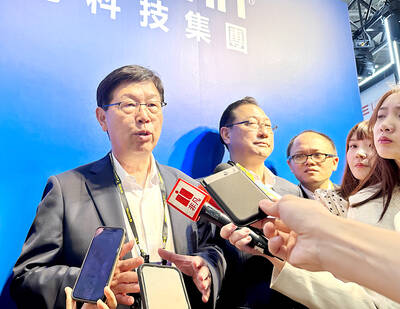
FUTURE PLANS: Although the electric vehicle market is getting more competitive, Hon Hai would stick to its goal of seizing a 5 percent share globally, Young Liu said Hon Hai Precision Industry Co (鴻海精密), a major iPhone assembler and supplier of artificial intelligence (AI) servers powered by Nvidia Corp’s chips, yesterday said it has introduced a rotating chief executive structure as part of the company’s efforts to cultivate future leaders and to enhance corporate governance. The 50-year-old contract electronics maker reported sizable revenue of NT$6.16 trillion (US$189.67 billion) last year. Hon Hai, also known as Foxconn Technology Group (富士康科技集團), has been under the control of one man almost since its inception. A rotating CEO system is a rarity among Taiwanese businesses. Hon Hai has given leaders of the company’s six


 RSS
RSS