


In recent years, Taiwan has experienced several frustrations in the road to proper -- or sustainable -- economic development, such as massive industry migration to low-cost countries and a declining trade surplus.
Being overtaken by South Korea in per capita gross national product (GNP) for the first time is the latest blow.
According to the statistics recently released by the Bank of Korea, South Korea's per capita GNP last year was US$16,291, compared to US$14,193 in 2004.
Taiwan's GNP per capita for last year was US$15,676, the lowest among Asia's "four little dragons."
South Korea's per capita GNP was reported to have surpassed Taiwan in 2004, but the government took comfort in the fact that the two countries used different calculating systems. After adopting the same system used by Seoul, Taiwan still led South Korea by about US$500 in per capita GNP in 2004.
The Council for Economic Planning and Development attributed Taiwan's lower standing to the appreciation of the Korean won against the US dollar.
The Korean won has risen by 11.8 percent against the greenback, while the New Taiwan dollar has appreciated by less than 3.9 percent due the central bank's intervention, said Chang Chieh-yi (張建一), a deputy director at the Taiwan Institute of Economic Research (台經院).
However, behind the stronger won is a stronger economy, showing that South Korea's economic power has greatly expanded in the past year, Chang said.
The government is still reluctant to admit failure. Council Chairman Hu Sheng-cheng (
He said that Taiwan's purchasing power parity (PPP) reached US$24,676 in 2004, US$5,990 more than South Korea's US$18,686, citing statistics compiled by the Swiss International Institute of Management and Development.
The rapid growth of South Korea's economy can be largely attributed to government policies that injected a huge amount of money to help its companies grow. Successful product branding, global marketing and control of key components made the country a formidable rival, said Chu Yun-peng (朱雲鵬), who is head of National Central University's Taiwan Economic Development Research Center.
Several years ago, few people could name major South Korean brands, but now Samsung and LG have made inroads to the world market and eclipsed Japanese electronics giants' market shares. Cars bearing South Korean brands such as KIA and Hyundai have become popular in other countries.
With government support, South Korea has also become the largest exporter of online PC games that have swept through Taiwan and China. South Korean pop-culture, including soap operas, movies and songs have captured the attention of young people around Asia.
All this has happened in a short period of time, so that many people can hardly believe that this is the same country that suffered so badly in the 1997-1998 Asian financial crisis and from a credit bubble burst in 2002.
Meanwhile, Taiwan is still struggling to shift from an original equipment manufacturing based economy to branding and marketing, with few international brands created so far.
"Taiwan's competitiveness comes from its resilient private companies, showing it can still advance with proper industry policies in place," Chang said.
Chang noted that Taiwan remains fairly competitive in terms of world ranking, and was rated No. 5 by the Geneva-based World Economic Forum (WEF) in its Global Competitiveness Report 2005-2006. It trailed only Finland, the US, Sweden and Denmark.
Technology is Taiwan's biggest asset, while unstable policies, an inefficient bureaucracy, the threat of government instability or coups are liabilities, the WEF report said.
"South Korea's leap should be a warning to Taiwan, which should stop feeling so smug about being barely ahead of South Korea in terms of GDP growth and PPP," Chang said.
"But if the government continues to focus on internal or cross-strait conflicts as it has done for the past six years, we will soon lose out to South Korea," he said.
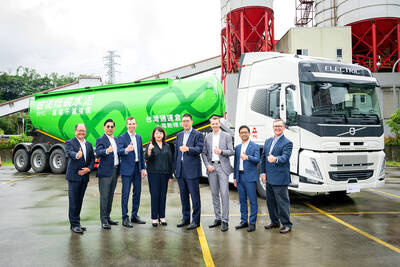
Taiwan Transport and Storage Corp (TTS, 台灣通運倉儲) yesterday unveiled its first electric tractor unit — manufactured by Volvo Trucks — in a ceremony in Taipei, and said the unit would soon be used to transport cement produced by Taiwan Cement Corp (TCC, 台灣水泥). Both TTS and TCC belong to TCC International Holdings Ltd (台泥國際集團). With the electric tractor unit, the Taipei-based cement firm would become the first in Taiwan to use electric vehicles to transport construction materials. TTS chairman Koo Kung-yi (辜公怡), Volvo Trucks vice president of sales and marketing Johan Selven, TCC president Roman Cheng (程耀輝) and Taikoo Motors Group

Among the rows of vibrators, rubber torsos and leather harnesses at a Chinese sex toys exhibition in Shanghai this weekend, the beginnings of an artificial intelligence (AI)-driven shift in the industry quietly pulsed. China manufactures about 70 percent of the world’s sex toys, most of it the “hardware” on display at the fair — whether that be technicolor tentacled dildos or hyper-realistic personalized silicone dolls. Yet smart toys have been rising in popularity for some time. Many major European and US brands already offer tech-enhanced products that can enable long-distance love, monitor well-being and even bring people one step closer to
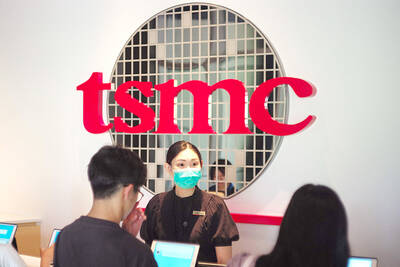
RECORD-BREAKING: TSMC’s net profit last quarter beat market expectations by expanding 8.9% and it was the best first-quarter profit in the chipmaker’s history Taiwan Semiconductor Manufacturing Co (TSMC, 台積電), which counts Nvidia Corp as a key customer, yesterday said that artificial intelligence (AI) server chip revenue is set to more than double this year from last year amid rising demand. The chipmaker expects the growth momentum to continue in the next five years with an annual compound growth rate of 50 percent, TSMC chief executive officer C.C. Wei (魏哲家) told investors yesterday. By 2028, AI chips’ contribution to revenue would climb to about 20 percent from a percentage in the low teens, Wei said. “Almost all the AI innovators are working with TSMC to address the

Malaysia’s leader yesterday announced plans to build a massive semiconductor design park, aiming to boost the Southeast Asian nation’s role in the global chip industry. A prominent player in the semiconductor industry for decades, Malaysia accounts for an estimated 13 percent of global back-end manufacturing, according to German tech giant Bosch. Now it wants to go beyond production and emerge as a chip design powerhouse too, Malaysian Prime Minister Anwar Ibrahim said. “I am pleased to announce the largest IC (integrated circuit) Design Park in Southeast Asia, that will house world-class anchor tenants and collaborate with global companies such as Arm [Holdings PLC],”


 RSS
RSS