


The Massachusetts Institute of Technology professor who hopes to distribute US$100 laptops to the world's children dismissed recent criticisms on Tuesday and said his project could begin distributing the computers by early next year.
Kicking off the LinuxWorld conference in Boston, Nicholas Negroponte said he was undeterred by skepticism from two of the leading forces in computing, Intel Corp and Microsoft Corp.
"When you have both Intel and Microsoft on your case, you know you're doing something right," Negroponte said, prompting applause from the audience of several hundred open-source software devotees.
Negroponte, founder of the One Laptop Per Child nonprofit association, also revealed a few new tweaks to the design of the computers.
One distinctive element of the original design was for a hand crank to provide power to the laptops, which are being engineered to use just 2 watts of electricity, less than a 10th of what conventional portable computers generally consume.
But having a hand crank stuck to the device likely would have subjected the machine to too many wrenching forces, so it will now be connected to the AC electrical adapter.
In fact, because the adapter can rest on the ground, the power generator might take the form of a foot pedal rather than a hand crank altogether.
Negroponte had previously said the flexible devices will have a 7 inch (18cm) screen that can be read in sunlight.
It will save on costs by using the Linux operating system, peer-to-peer wireless connectivity and a 500 megahertz processor -- which was top of the line in the late 1990s.
One Laptop Per Child has big-name partners, including search leader Google Inc, chipmaker Advanced Micro Devices Inc, Linux distributor Red Hat Inc, Taiwanese laptop maker Quanta Computer Inc (
All have helped finance the project, which Negroponte said has raised US$29 million.
However, skeptics have questioned whether the device can meet Negroponte's goal of inspiring huge educational gains in the developing world.
Microsoft chairman Bill Gates has criticized the computers' design, including its lack of a hard disk drive -- though many people in the tech world believed he was more irked by the laptops' use of Linux, the free, open-source system that competes with Gates' proprietary Windows systems.
Intel executives, meanwhile, have suggested that Negroponte's laptop is a mere gadget that will lack too many PC functions.
Last week, Intel announced its own plans to sell an inexpensive desktop PC for beginners in developing countries.
Negroponte expressed frustration with Gates in particular, saying that the US$100 laptop designers are still working with Microsoft to develop a version of the Windows CE operating system that could run the machines.
"Geez, so why criticize me in public?" Negroponte asked.
Negroponte's plan is to begin distributing 5 million to 10 million of the laptops in China, India, Egypt, Brazil, Thailand, Nigeria and Argentina by early 2007.
Governments or donors will buy the laptops for children to own and use in and out of school, and the UN will help distribute the machines.
Eventually, Negroponte expects many other governments -- and not just those in technology-deprived places -- to come on board.
For example, Massachusetts Governor Mitt Romney has expressed interest in buying the machines for schoolchildren.
In time, Negroponte expects the US$100 laptop to be a misnomer. For one thing, he believes the cost -- which is actually about US$135 now and isn't expected to hit US$100 until 2008 -- can drop to US$50 by 2010 as more and more are produced.
"The hundred-dollar laptop is an education project," he said. "It's not a laptop project."

Taiwan Transport and Storage Corp (TTS, 台灣通運倉儲) yesterday unveiled its first electric tractor unit — manufactured by Volvo Trucks — in a ceremony in Taipei, and said the unit would soon be used to transport cement produced by Taiwan Cement Corp (TCC, 台灣水泥). Both TTS and TCC belong to TCC International Holdings Ltd (台泥國際集團). With the electric tractor unit, the Taipei-based cement firm would become the first in Taiwan to use electric vehicles to transport construction materials. TTS chairman Koo Kung-yi (辜公怡), Volvo Trucks vice president of sales and marketing Johan Selven, TCC president Roman Cheng (程耀輝) and Taikoo Motors Group

Among the rows of vibrators, rubber torsos and leather harnesses at a Chinese sex toys exhibition in Shanghai this weekend, the beginnings of an artificial intelligence (AI)-driven shift in the industry quietly pulsed. China manufactures about 70 percent of the world’s sex toys, most of it the “hardware” on display at the fair — whether that be technicolor tentacled dildos or hyper-realistic personalized silicone dolls. Yet smart toys have been rising in popularity for some time. Many major European and US brands already offer tech-enhanced products that can enable long-distance love, monitor well-being and even bring people one step closer to

RECORD-BREAKING: TSMC’s net profit last quarter beat market expectations by expanding 8.9% and it was the best first-quarter profit in the chipmaker’s history Taiwan Semiconductor Manufacturing Co (TSMC, 台積電), which counts Nvidia Corp as a key customer, yesterday said that artificial intelligence (AI) server chip revenue is set to more than double this year from last year amid rising demand. The chipmaker expects the growth momentum to continue in the next five years with an annual compound growth rate of 50 percent, TSMC chief executive officer C.C. Wei (魏哲家) told investors yesterday. By 2028, AI chips’ contribution to revenue would climb to about 20 percent from a percentage in the low teens, Wei said. “Almost all the AI innovators are working with TSMC to address the
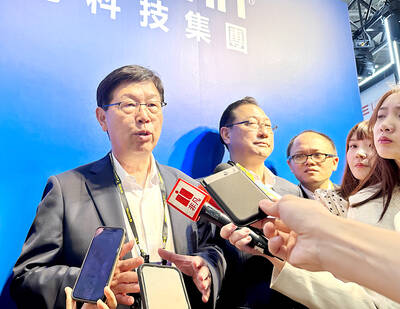
FUTURE PLANS: Although the electric vehicle market is getting more competitive, Hon Hai would stick to its goal of seizing a 5 percent share globally, Young Liu said Hon Hai Precision Industry Co (鴻海精密), a major iPhone assembler and supplier of artificial intelligence (AI) servers powered by Nvidia Corp’s chips, yesterday said it has introduced a rotating chief executive structure as part of the company’s efforts to cultivate future leaders and to enhance corporate governance. The 50-year-old contract electronics maker reported sizable revenue of NT$6.16 trillion (US$189.67 billion) last year. Hon Hai, also known as Foxconn Technology Group (富士康科技集團), has been under the control of one man almost since its inception. A rotating CEO system is a rarity among Taiwanese businesses. Hon Hai has given leaders of the company’s six


 RSS
RSS