


In light of the significant drop in domestic air travel in recent years and the expected inauguration of the high-speed railway in October, four domestic carriers have decided to gradually cut flights to reduce costs.
Starting this month, TransAsia Airways (復興航空), Uni Airways Corp (立榮航空) and Mandarin Airlines (華信航空) are providing only one flight each per week on the Taipei-Hengchun route, down from two flights each per week. Last month, flights on the Taipei-Makung route, and even the busiest Taipei-Kaohsiung route were cut.
Further flight reductions on Taipei-Taitung, Taichung-Taitung and Taipei-Taichung routes are on the way, the carriers said.
"The large-scale industry migration in recent years and economic factors are behind the downturn," said Chen Tien-shih (陳天識), director of the Civil Aeronautics Administration's Air Transport Division.
For the first two months of the year 2.79 million passengers traveled on domestic routes, a 10.9 percent decline from a year ago, according to the latest statistics released by the Directorate General of Budget, Accounting and Statistics.
The number of domestic flights in January, for example, also dropped by 7.7 percent to 11,389 from the same period last year, Chen said, citing administration statistics.
"The domestic flight business will slump to its lowest level after the high-speed railway starts service, which is expected to replace 50 percent to 70 percent of air transportation, especially on the Western routes," Hanson Chang (張有朋), senior public relations manager at Far Eastern Air (遠東航空), said in a telephone interview yesterday.
One big lifeline for the industry would be direct air links with China, but until the long-awaited policy is implemented, domestic carriers have been keen to expand international flights, Chang said.
Far Eastern started flights between Taipei and Jeju, South Korea in January 2003, with the number of passengers increasing five-fold to date. The company added connecting flights to Shanghai and Beijing, and both have attracted considerable volume, Chang said.
Later this year, Far Eastern also plans to operate flights between Kaohsiung and Incheon, South Korea, as well as to Bali and Cambodia's Angkor Wat, Chang said.
International routes accounted for less than 30 percent of Far Eastern's revenue last year.
Chang said the company plans to boost that to 40 percent this year, and to more than 50 percent next year.
Domestically, the four carriers are carrying out joint operations, allowing passengers to fly with any of the four firms, no matter which airline they use to book their ticket.
The four carriers are also mulling setting up joint counters at domestic airports, with the first one already established at Taitung Airport, Chen said.
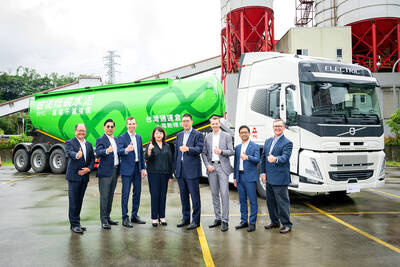
Taiwan Transport and Storage Corp (TTS, 台灣通運倉儲) yesterday unveiled its first electric tractor unit — manufactured by Volvo Trucks — in a ceremony in Taipei, and said the unit would soon be used to transport cement produced by Taiwan Cement Corp (TCC, 台灣水泥). Both TTS and TCC belong to TCC International Holdings Ltd (台泥國際集團). With the electric tractor unit, the Taipei-based cement firm would become the first in Taiwan to use electric vehicles to transport construction materials. TTS chairman Koo Kung-yi (辜公怡), Volvo Trucks vice president of sales and marketing Johan Selven, TCC president Roman Cheng (程耀輝) and Taikoo Motors Group

Among the rows of vibrators, rubber torsos and leather harnesses at a Chinese sex toys exhibition in Shanghai this weekend, the beginnings of an artificial intelligence (AI)-driven shift in the industry quietly pulsed. China manufactures about 70 percent of the world’s sex toys, most of it the “hardware” on display at the fair — whether that be technicolor tentacled dildos or hyper-realistic personalized silicone dolls. Yet smart toys have been rising in popularity for some time. Many major European and US brands already offer tech-enhanced products that can enable long-distance love, monitor well-being and even bring people one step closer to

RECORD-BREAKING: TSMC’s net profit last quarter beat market expectations by expanding 8.9% and it was the best first-quarter profit in the chipmaker’s history Taiwan Semiconductor Manufacturing Co (TSMC, 台積電), which counts Nvidia Corp as a key customer, yesterday said that artificial intelligence (AI) server chip revenue is set to more than double this year from last year amid rising demand. The chipmaker expects the growth momentum to continue in the next five years with an annual compound growth rate of 50 percent, TSMC chief executive officer C.C. Wei (魏哲家) told investors yesterday. By 2028, AI chips’ contribution to revenue would climb to about 20 percent from a percentage in the low teens, Wei said. “Almost all the AI innovators are working with TSMC to address the

Malaysia’s leader yesterday announced plans to build a massive semiconductor design park, aiming to boost the Southeast Asian nation’s role in the global chip industry. A prominent player in the semiconductor industry for decades, Malaysia accounts for an estimated 13 percent of global back-end manufacturing, according to German tech giant Bosch. Now it wants to go beyond production and emerge as a chip design powerhouse too, Malaysian Prime Minister Anwar Ibrahim said. “I am pleased to announce the largest IC (integrated circuit) Design Park in Southeast Asia, that will house world-class anchor tenants and collaborate with global companies such as Arm [Holdings PLC],”


 RSS
RSS