


The nation's unprecedented consumer bad loan problem is expected to start easing off in the second half of the year following the speedy efforts of banks to tighten their lending policies and write off bad loans, Fitch Ratings Taiwan said yesterday.
The quality of Taiwan's unsecured consumer lending deteriorated sharply in the second half of last year due to excessive competition, with the charge-off ratio on credit and cash-advance cards doubling from a 6-percent annual rate to a 12 to 15 percent rate by the end of last year.
A charge-off ratio refers to the total amount of bad debt written off during a period as a percentage of the total credit or cash card receivables at the end of that period.
"Card debts peaked in the fourth and first quarters but now the problem has been kept under control," said Jonathan Lee (
The total revolving credit balance for credit cards decreased for the second straight month in January, falling by 0.26 percent to NT$493.4 billion (US$15.17 billion). At the same time, the cash-card lending balance slid for a fourth month, shrinking by 3.12 percent to NT$298.2 billion, according to the Financial Supervisory Commission's latest statistics.
"If there's no `moral hazard' occurring among retail borrowers when the government pushes forth debt restructuring schemes and plans amendments to the bankruptcy law, banks' profitability is expected to return to the normal level next year," he added.
Most banks will still see their profits compressed this year from the consumer loan fallout.
Although many have warned that Taiwan might repeat South Korea's credit card debacle, Lee expressed optimism, citing the small scale of card loans compared with overall lending. Currently, debts incurred from credit and cash cards account for less than 5 percent of the total lending of NT$17 trillion in the financial market.
Even if banks choose to write off the unsecured loans altogether, the overall delinquency ratio would merely top 7 percent by adding the general non-performing loan (NPL) ratio of 2.5 percent -- still much lower than the 12-percent default ratio Taiwan suffered in 2002, he noted.
"Taiwan's situation is, in substance, quite stable and there's little probability of a `storm' taking shape. But the financial regulator and banking operators should strengthen supervision and risk management capability to ensure a healthy environment," he said.
Although the government has presented a card-debt negotiation mechanism to help debtors, many have adopted a wait-and-see attitude, naively thinking that there might be more favorable bailout measures or that a new version of the bankruptcy law will serve as their panacea.
Lee warned that Taiwan must be well prepared to implement the draft consumer debt clean-up bill, which DPP Legislator Jerry Tsai (
Hong Kong amended its bankruptcy law in 1998 and had seen the number of bankruptcy filings surge from dozens to several thousands of cases a day, leaving the judicial authorities incapable of handling the situation.
Lee said that the government must determine whether its judicial system is staffed with a sufficient number of professionals, and map out ways to avoid moral hazard while upholding justice and equity.

Stephen Garrett, a 27-year-old graduate student, always thought he would study in China, but first the country’s restrictive COVID-19 policies made it nearly impossible and now he has other concerns. The cost is one deterrent, but Garrett is more worried about restrictions on academic freedom and the personal risk of being stranded in China. He is not alone. Only about 700 American students are studying at Chinese universities, down from a peak of nearly 25,000 a decade ago, while there are nearly 300,000 Chinese students at US schools. Some young Americans are discouraged from investing their time in China by what they see

MAJOR DROP: CEO Tim Cook, who is visiting Hanoi, pledged the firm was committed to Vietnam after its smartphone shipments declined 9.6% annually in the first quarter Apple Inc yesterday said it would increase spending on suppliers in Vietnam, a key production hub, as CEO Tim Cook arrived in the country for a two-day visit. The iPhone maker announced the news in a statement on its Web site, but gave no details of how much it would spend or where the money would go. Cook is expected to meet programmers, content creators and students during his visit, online newspaper VnExpress reported. The visit comes as US President Joe Biden’s administration seeks to ramp up Vietnam’s role in the global tech supply chain to reduce the US’ dependence on China. Images on
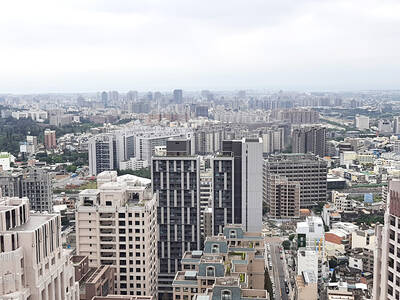
New apartments in Taiwan’s major cities are getting smaller, while old apartments are increasingly occupied by older people, many of whom live alone, government data showed. The phenomenon has to do with sharpening unaffordable property prices and an aging population, property brokers said. Apartments with one bedroom that are two years old or older have gained a noticeable presence in the nation’s six special municipalities as well as Hsinchu county and city in the past five years, Evertrust Rehouse Co (永慶房產集團) found, citing data from the government’s real-price transaction platform. In Taipei, apartments with one bedroom accounted for 19 percent of deals last

US CONSCULTANT: The US Department of Commerce’s Ursula Burns is a rarely seen US government consultant to be put forward to sit on the board, nominated as an independent director Taiwan Semiconductor Manufacturing Co (TSMC, 台積電), the world’s largest contract chipmaker, yesterday nominated 10 candidates for its new board of directors, including Ursula Burns from the US Department of Commerce. It is rare that TSMC has nominated a US government consultant to sit on its board. Burns was nominated as one of seven independent directors. She is vice chair of the department’s Advisory Council on Supply Chain Competitiveness. Burns is to stand for election at TSMC’s annual shareholders’ meeting on June 4 along with the rest of the candidates. TSMC chairman Mark Liu (劉德音) was not on the list after in December last


 RSS
RSS