


A series of complementary bailout measures should be implemented to solve the snowballing social problem of credit and cash card debt, a consumer advocacy group said yesterday.
Currently, the nation's estimated 500,000 to 700,000 "card abusers" can make use of the card-debt negotiation mechanism, put in place by the Financial Supervisory Commission and the Bankers Association of the ROC (銀行公會), with several lower interest-rate payback programs available for those heavily in debt.
From Jan. 1 to March 1, the mechanism received more than 14,000 applications, in which 8,773 cases were qualified for debt negotiations and 7,323 cases reached an agreement on a payback plan, representing a success rate of 80 percent, the commission said last week.
However, only a small percentage of the nation's debtors have been helped, according to the Consumers' Foundation (
"Police figures show that, every month, more than 40 people nationwide commit suicide due to their escalating debts," said Consumers' Foundation chairman Jason Lee (
"Of course debtors are obliged to pay back the money they owe. But we must give them a chance by offering better-designed [repayment] mechanisms," he said.
The foundation suggested that the card-debt negotiation mechanism lower its thresholds to encourage more debtors to submit applications.
In order to offer a "one-stop service," the Bankers Association plans to set up a permanent committee in May to take charge of the card-debt negotiation mechanism, which is currently operated by the nation's eight major banks.
The Consumers' Foundation suggested that the committee invite members of the Consumer Protection Commission and consumer advocacy groups to participate.
In addition, relying on a single relief plan is by no means sufficient, Lee said.
Lee cited the existence of support bodies in the US, such as the Consumer Credit Counseling Service, which was set up to provide budget counseling, educational programs, debt management assistance and housing counseling, and the Maryland-based National Foundation for Consumer Credit, established in 1951.
Lee said that Taiwan should learn from the US and set up private institutions which can assist debtors and help to instill better budgeting policies.
Visa International and MasterCard International have both launched interactive Chinese-language Web sites to enable consumers to give themselves a thorough financial check-up and to help them deal with their debt issues. The companies are also scheduled to hold a series of forums on university campuses around the nation, with the first seminar hosted by MasterCard taking place in National Chengchi University today.
The Consumers' Foundation also urged lawmakers to pass the amendments to the Bankruptcy Law (

Stephen Garrett, a 27-year-old graduate student, always thought he would study in China, but first the country’s restrictive COVID-19 policies made it nearly impossible and now he has other concerns. The cost is one deterrent, but Garrett is more worried about restrictions on academic freedom and the personal risk of being stranded in China. He is not alone. Only about 700 American students are studying at Chinese universities, down from a peak of nearly 25,000 a decade ago, while there are nearly 300,000 Chinese students at US schools. Some young Americans are discouraged from investing their time in China by what they see
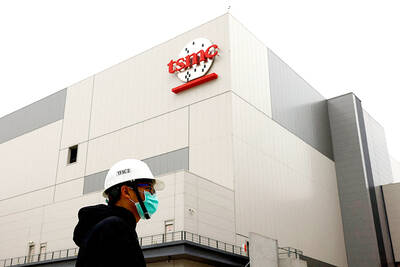
Taiwan Semiconductor Manufacturing Co (TSMC, 台積電), the world’s largest contract chipmaker, yesterday reported record sales for the first quarter, which analysts attributed to solid demand for emerging technologies. Consolidated revenue totaled NT$592.64 billion (US$18.51 billion) in the January-to-March period, up 16.5 percent from a year earlier, but down 5.26 percent from the previous quarter, TSMC said in a statement. The first-quarter revenue beat analysts’ average projection of NT$579.5 billion, Bloomberg News reported. That performance lends weight to expectations that the world’s most valuable chipmaker would return to solid growth this year after weathering a post-COVID-19-pandemic cratering of smartphone and computer sales. TSMC is budgeting

MAJOR DROP: CEO Tim Cook, who is visiting Hanoi, pledged the firm was committed to Vietnam after its smartphone shipments declined 9.6% annually in the first quarter Apple Inc yesterday said it would increase spending on suppliers in Vietnam, a key production hub, as CEO Tim Cook arrived in the country for a two-day visit. The iPhone maker announced the news in a statement on its Web site, but gave no details of how much it would spend or where the money would go. Cook is expected to meet programmers, content creators and students during his visit, online newspaper VnExpress reported. The visit comes as US President Joe Biden’s administration seeks to ramp up Vietnam’s role in the global tech supply chain to reduce the US’ dependence on China. Images on

US CONSCULTANT: The US Department of Commerce’s Ursula Burns is a rarely seen US government consultant to be put forward to sit on the board, nominated as an independent director Taiwan Semiconductor Manufacturing Co (TSMC, 台積電), the world’s largest contract chipmaker, yesterday nominated 10 candidates for its new board of directors, including Ursula Burns from the US Department of Commerce. It is rare that TSMC has nominated a US government consultant to sit on its board. Burns was nominated as one of seven independent directors. She is vice chair of the department’s Advisory Council on Supply Chain Competitiveness. Burns is to stand for election at TSMC’s annual shareholders’ meeting on June 4 along with the rest of the candidates. TSMC chairman Mark Liu (劉德音) was not on the list after in December last


 RSS
RSS