


■ TAIEX falls on political concerns
Share prices closed 1.52 percent lower yesterday, extending losses on concerns at President Chen Shui-bian's (陳水扁) stand on China and after Wall Street's downturn, dealers said. The TAIEX lost 100.81 points at 6,530.70, on turnover of NT$95.72 billion (US$2.95 billion). Decliners led risers 960 to 113, with 87 stocks unchanged. "In our house, there were far more sell than buy orders," said Oliver Fang, Yuanta Core Pacific Securities (元大京華證券) assistant vice president. "There was a conspicuous increase in short [sell] contracts, reflecting a desire to hedge against the prospect of a further decline ... in the near-term." Semiconductor and LCD-panel makers led the technology sector lower, with Nanya Technology Corp (南亞科技) falling NT$0.50 to NT$20.10, AU Optronics Corp (友達) down NT$1.80 to NT$52.90, Chi Mei Optoelectronics Corp (奇美) off NT$2.30 to NT$48.80 and Taiwan Semiconductor Manufacturing Co (台積電) down NT$0.20 at NT$61.90.
■ JPMorgan settles transactions
JPMorgan Chase & Co, the third-biggest US bank, said it has become the first overseas company to help settle futures transactions in the Taiwan Futures Exchange. The company has started functioning as a clearing-house member of the exchange, Jonathan Glass, managing director and head of futures and options in Asia at JPMorgan, said yesterday.
"We are confident that foreign investor participation in Taiwan's futures and options market will reach the levels of other mature Asian markets as the local environment continues to improve," Glass said in a statement. JPMorgan joined the futures exchange in December 2004, the first foreign broker to do so.
■ DRAM makers raise prices
Computer memory chipmakers raised prices of the product by an average of 10 percent because of a shortage, Dramexchange.com said, without citing sources. The contract price boost for the so-called DDR2 type of dynamic random access memory for the second half of the month follows an increase at the beginning of the month, Taiwan-based Dramexchange, Asia's biggest spot market for chips, said in a note to clients late yesterday. Most computer memory chipmakers are "bullish" on prices for next month because of a supply shortage, according to the report.
■ Semiconductor factory use rises
Global semiconductor companies raised their factory use for a third straight quarter as demand rose for personal computers, cellphones and other electronic gadgets, according to industry figures. Factory use rose to 91.8 percent in the three months ended Dec. 31, from 90.1 percent in the previous quarter and 86 percent a year ago, according to Netherlands-based Semiconductor International Capacity Statistics, a data-gathering program set up in 1994 by 41 chipmakers. Chipmakers worldwide produced the equivalent of 1.5 million 200mm wafers a week in the fourth quarter, a 5.4 percent gain from the previous period, when production rose 4.5 percent, according to Semiconductor International Capacity Statistics. Maximum production capacity in the second quarter rose 3.5 percent from the previous period to 1.64 million wafers a week. That compares with a 3.3 percent gain in the previous period and a 1.4 percent increase in the second quarter, the report showed.
■ NT dollar continues slide
The New Taiwan dollar continued to lose ground against its US counterpart, declining NT$0.163 to close at NT$32.646 on the Taipei foreign exchange market yesterday. Turnover was US$1.342 billion, up from Tuesday's US$977.
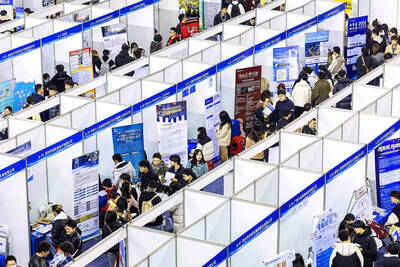
Stephen Garrett, a 27-year-old graduate student, always thought he would study in China, but first the country’s restrictive COVID-19 policies made it nearly impossible and now he has other concerns. The cost is one deterrent, but Garrett is more worried about restrictions on academic freedom and the personal risk of being stranded in China. He is not alone. Only about 700 American students are studying at Chinese universities, down from a peak of nearly 25,000 a decade ago, while there are nearly 300,000 Chinese students at US schools. Some young Americans are discouraged from investing their time in China by what they see

Taiwan Transport and Storage Corp (TTS, 台灣通運倉儲) yesterday unveiled its first electric tractor unit — manufactured by Volvo Trucks — in a ceremony in Taipei, and said the unit would soon be used to transport cement produced by Taiwan Cement Corp (TCC, 台灣水泥). Both TTS and TCC belong to TCC International Holdings Ltd (台泥國際集團). With the electric tractor unit, the Taipei-based cement firm would become the first in Taiwan to use electric vehicles to transport construction materials. TTS chairman Koo Kung-yi (辜公怡), Volvo Trucks vice president of sales and marketing Johan Selven, TCC president Roman Cheng (程耀輝) and Taikoo Motors Group

MAJOR DROP: CEO Tim Cook, who is visiting Hanoi, pledged the firm was committed to Vietnam after its smartphone shipments declined 9.6% annually in the first quarter Apple Inc yesterday said it would increase spending on suppliers in Vietnam, a key production hub, as CEO Tim Cook arrived in the country for a two-day visit. The iPhone maker announced the news in a statement on its Web site, but gave no details of how much it would spend or where the money would go. Cook is expected to meet programmers, content creators and students during his visit, online newspaper VnExpress reported. The visit comes as US President Joe Biden’s administration seeks to ramp up Vietnam’s role in the global tech supply chain to reduce the US’ dependence on China. Images on
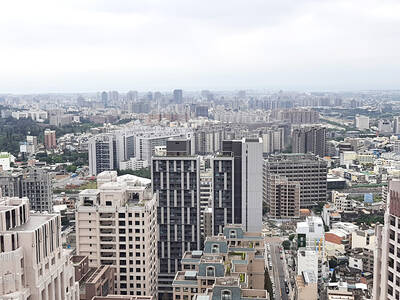
New apartments in Taiwan’s major cities are getting smaller, while old apartments are increasingly occupied by older people, many of whom live alone, government data showed. The phenomenon has to do with sharpening unaffordable property prices and an aging population, property brokers said. Apartments with one bedroom that are two years old or older have gained a noticeable presence in the nation’s six special municipalities as well as Hsinchu county and city in the past five years, Evertrust Rehouse Co (永慶房產集團) found, citing data from the government’s real-price transaction platform. In Taipei, apartments with one bedroom accounted for 19 percent of deals last


 RSS
RSS