


Friday's file-destroying worm goes by "Mywife" at Microsoft Corp and McAfee Inc, "Blackmal" at Symantec Corp and CA Inc and "Kama Sutra" in most media reports. At F-Secure Corp, it is version "E" of "Nyxem," while Sophos PLC says it is version "D." Others variably refer to it as "Kapser," "KillAV," "Grew" or "Blackworm."
The official name? "CME-24."
The moniker may seem much ado about nothing, but security researchers worry that the variance could confuse consumers.
Customers of one vendor's product, for instance, may believe they are protected against "Nyxem.D" when in fact that vendor uses "E." Or they may hear about "Kama Sutra" but don't realize their product already protects them from "Kapser," prompting phone inquiries that overload support desks.
The confusion partly results from the speed with which worms spread.
"Anti-virus companies when they get a sample need to act on that quickly," said Ken Dunham, director of the rapid response team for VeriSign Inc.'s iDefense. "They don't have time in their competitive environment to be able to go out and coordinate and have a nice little talk" about naming.
Security researchers face many decisions coming up with that initial name. Often, a new outbreak is a variation of an existing worm, so the vendor will use the next letter in the series.
But sometimes the variation is so small that not every vendor calls it a separate version, said Mikko Hypponen, chief research officer for F-Secure. Or the variation may be a bit larger, prompting some vendors to use a new name, while others use the next letter, he said.
That's why some vendors began referring to Kama Sutra as "Grew.A"; it destroys files rather than try to overload Web sites with fake traffic, as previous versions did. But they share code and techniques with predecessors, so F-Secure went with "Nyxem.E," rearranged from the acronym for the New York Mercantile Exchange, whose Web site was targeted by the initial variant.
The US Department of Homeland Security is attempting to unify naming through the Common Malware Enumeration, or CME. The larger outbreaks are assigned a random number -- in this case "24" -- to bring the various names under a single umbrella. A Web site making that information public launched in October.
But "CME-24" doesn't quite have the same ring as "Kama Sutra," so named after the Hindu love manual because of the pornographic come-ons in e-mails spreading it. Media outlets began adopting Kama Sutra, even though no major security company calls it that.
"It's primarily a media term," Dunham said. "It's something people are going to read about."
Companies and individuals heeded warnings on the worm, helping minimize its damage on Friday, security experts said.
One Italian city shut down its computers as a precaution, but otherwise the worm's trigger date arrived with relatively few reports of problems.
Hundreds of thousands of computers were believed to be infected, but security vendors say many companies and individuals had time to clean up their machines following the alarm, carried by scores of media outlets.

Stephen Garrett, a 27-year-old graduate student, always thought he would study in China, but first the country’s restrictive COVID-19 policies made it nearly impossible and now he has other concerns. The cost is one deterrent, but Garrett is more worried about restrictions on academic freedom and the personal risk of being stranded in China. He is not alone. Only about 700 American students are studying at Chinese universities, down from a peak of nearly 25,000 a decade ago, while there are nearly 300,000 Chinese students at US schools. Some young Americans are discouraged from investing their time in China by what they see

MAJOR DROP: CEO Tim Cook, who is visiting Hanoi, pledged the firm was committed to Vietnam after its smartphone shipments declined 9.6% annually in the first quarter Apple Inc yesterday said it would increase spending on suppliers in Vietnam, a key production hub, as CEO Tim Cook arrived in the country for a two-day visit. The iPhone maker announced the news in a statement on its Web site, but gave no details of how much it would spend or where the money would go. Cook is expected to meet programmers, content creators and students during his visit, online newspaper VnExpress reported. The visit comes as US President Joe Biden’s administration seeks to ramp up Vietnam’s role in the global tech supply chain to reduce the US’ dependence on China. Images on

New apartments in Taiwan’s major cities are getting smaller, while old apartments are increasingly occupied by older people, many of whom live alone, government data showed. The phenomenon has to do with sharpening unaffordable property prices and an aging population, property brokers said. Apartments with one bedroom that are two years old or older have gained a noticeable presence in the nation’s six special municipalities as well as Hsinchu county and city in the past five years, Evertrust Rehouse Co (永慶房產集團) found, citing data from the government’s real-price transaction platform. In Taipei, apartments with one bedroom accounted for 19 percent of deals last
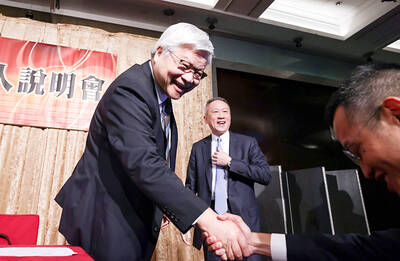
US CONSCULTANT: The US Department of Commerce’s Ursula Burns is a rarely seen US government consultant to be put forward to sit on the board, nominated as an independent director Taiwan Semiconductor Manufacturing Co (TSMC, 台積電), the world’s largest contract chipmaker, yesterday nominated 10 candidates for its new board of directors, including Ursula Burns from the US Department of Commerce. It is rare that TSMC has nominated a US government consultant to sit on its board. Burns was nominated as one of seven independent directors. She is vice chair of the department’s Advisory Council on Supply Chain Competitiveness. Burns is to stand for election at TSMC’s annual shareholders’ meeting on June 4 along with the rest of the candidates. TSMC chairman Mark Liu (劉德音) was not on the list after in December last


 RSS
RSS