


When founding Quanta Computer Inc (
This was a bold move, considering that the 1980s was the age of the rise of desktop computers, especially with IBM Corp betting heavily on their desktop machines to be tomorrow's stars.
"People laughed at us and viewed Quanta's first portable products as a piece of junk at that time," Lam said at a Jan. 5 media roundtable on Taiwan's competitiveness.
But the contempt did not deter Quanta's determination to pursue laptop production, and the firm's far-sightedness has turned it into the world's largest notebook contract maker, with volumes hitting around 18 million units last year. The company's customers include computer vendors such as Apple Computer Inc, Dell Inc, Hewlett-Packard Co, Matsushita Electric Industrial Co and Sony Corp.
No bed of roses
However, the notebook production business is not a bed of roses for Quanta, as it is faced with the issue of lower margins, along with other makers.
"In fact, most notebook contract makers are now posting much lower profit margins than the 5 to 6 percent reported. A five-percent margin is already a good deal to most," said Albert Chen (
This probably challenges makers to think of their next "winning formula," and Quanta is no exception.
"What's next after notebooks? Computers are only accessible to fewer than 20 percent of the world's population. How can we provide different forms of devices to make mobile computing possible to most?" Lam asked.
This probably explains the rationale behind Quanta's participation in the "One Laptop per Child" project.
Launched in January last year by Nicholas Negroponte, chairman and co-founder of the Massachusetts Institute of Technology's Media Lab, the scheme aims to develop computers for children around the world priced at US$100, far lower than the current cheap notebooks sold at US$500.
While industry watchers question the viability of the project, which is set to churn out 5 million to 15 million units of budget laptops by the end of this year, Quanta seems to be unperturbed and is again convinced that it is on the right track.
Quanta is just one of the cases where local PC makers are attempting to diversify into new market segments, or "blue oceans," to maintain future competitiveness.
"Blue ocean strategy," a hot term in Taiwan's IT industry last year, refers to competition in an uncontested market space, while companies adopting "red ocean strategy" are those competing in an existing market and undercutting each other as most do now.
Acer Inc also realized that instead of concentrating all its efforts on the contract manufacturing business, it should dip into the blue ocean for growth.
The company, founded 30 years ago, thus spun off its manufacturing operations in 2000 to focus on globally marketing its brandname products including desktop and portable computers.
The efforts bore fruit last year as Acer successfully became the world's fourth largest branded computer maker, pushing it one step closer to joining the top-three club next year.
What consumers want
However, understanding what consumers really want is the toughest job for contract makers venturing into brandname business, as they have long been designing and manufacturing products based on clients' requirements, said Simon Yang (
"They need to enhance after-sales services to listen to consumers' voices, and focus on various markets with smaller volumes as a start," Yang said.
By dedicating resources to more markets, the volumes added up in total would be significant, which would help to boost a company's market share, Yang added.
In addition to adopting a "blue ocean" strategy, Taiwanese makers have been quick to relocate assembly lines offshore, including to China, to improve margins, taking advantage of the lower labor and production costs there.
Last year, First International Computer Co (
"Now, over 90 percent of Taiwanese notebook production is being churned out in China," MIC's Chen said.
Shipments of notebook computers are expected to climb 18 percent to US$35.8 billion this year, according to the institute's forecast.
But the heart of their research and development (R&D) remains in Taiwan, at least for now.
"However, we see the trend of R&D moving gradually to the mainland over these few years, depending on the maturity of the engineers there," Chen added.
A case in point is the nation's largest laptop maker Asustek Computer Inc (
Quanta's Lam said that the number of local engineering graduates every year is insufficient to deal with the industry demand and that companies have to turn to China.
"But the quality of local engineers here is still better compared to their Chinese counterparts," Lam said.
In Chen's opininon, it is irrelevant whether notebook manufacturing or R&D is done locally or offshore because it is not equivalent to the competitiveness of the industry.
"Companies will eventually find their own `blue ocean strategy' to embrace the competition, as they always did in the past," he said.
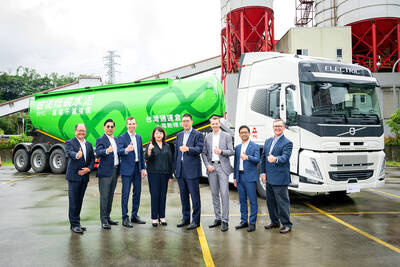
Taiwan Transport and Storage Corp (TTS, 台灣通運倉儲) yesterday unveiled its first electric tractor unit — manufactured by Volvo Trucks — in a ceremony in Taipei, and said the unit would soon be used to transport cement produced by Taiwan Cement Corp (TCC, 台灣水泥). Both TTS and TCC belong to TCC International Holdings Ltd (台泥國際集團). With the electric tractor unit, the Taipei-based cement firm would become the first in Taiwan to use electric vehicles to transport construction materials. TTS chairman Koo Kung-yi (辜公怡), Volvo Trucks vice president of sales and marketing Johan Selven, TCC president Roman Cheng (程耀輝) and Taikoo Motors Group

Among the rows of vibrators, rubber torsos and leather harnesses at a Chinese sex toys exhibition in Shanghai this weekend, the beginnings of an artificial intelligence (AI)-driven shift in the industry quietly pulsed. China manufactures about 70 percent of the world’s sex toys, most of it the “hardware” on display at the fair — whether that be technicolor tentacled dildos or hyper-realistic personalized silicone dolls. Yet smart toys have been rising in popularity for some time. Many major European and US brands already offer tech-enhanced products that can enable long-distance love, monitor well-being and even bring people one step closer to
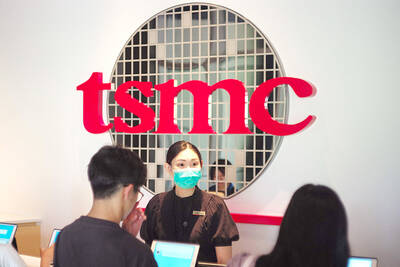
RECORD-BREAKING: TSMC’s net profit last quarter beat market expectations by expanding 8.9% and it was the best first-quarter profit in the chipmaker’s history Taiwan Semiconductor Manufacturing Co (TSMC, 台積電), which counts Nvidia Corp as a key customer, yesterday said that artificial intelligence (AI) server chip revenue is set to more than double this year from last year amid rising demand. The chipmaker expects the growth momentum to continue in the next five years with an annual compound growth rate of 50 percent, TSMC chief executive officer C.C. Wei (魏哲家) told investors yesterday. By 2028, AI chips’ contribution to revenue would climb to about 20 percent from a percentage in the low teens, Wei said. “Almost all the AI innovators are working with TSMC to address the

Malaysia’s leader yesterday announced plans to build a massive semiconductor design park, aiming to boost the Southeast Asian nation’s role in the global chip industry. A prominent player in the semiconductor industry for decades, Malaysia accounts for an estimated 13 percent of global back-end manufacturing, according to German tech giant Bosch. Now it wants to go beyond production and emerge as a chip design powerhouse too, Malaysian Prime Minister Anwar Ibrahim said. “I am pleased to announce the largest IC (integrated circuit) Design Park in Southeast Asia, that will house world-class anchor tenants and collaborate with global companies such as Arm [Holdings PLC],”


 RSS
RSS