


Billionaire investor Warren Buffett and the biggest banks in the currency market, Deutsche Bank AG, UBS AG and Citigroup Inc, missed the US dollar's rally this year. They're sticking with their predictions for 2006.
Buffett, the chairman and chief executive officer of Berkshire Hathaway Inc, lost almost US$1 billion, betting on a decline in the US dollar against currencies including the British pound, which suffered its biggest loss since 1992.
Deutsche Bank, UBS and Citigroup analysts forecast the US dollar would weaken to an all-time low of US$1.40 to the euro. Instead, it rose 14.5 percent.
They missed the gain by focusing on the record US current account deficit instead of a widening interest-rate gap driven by the Federal Reserve's eight interest-rate increases.
"Who cares about the current account now," said Christoph Suetterlin, a currency trader in Zurich at Bank Sarasin and Cie AG, which manages about US$44 billion.
"It's a side issue. The dollar's a good investment with rising interest rates and it's likely to stay that way," he said.
Buffett and the analysts say they weren't wrong, just early. The US currency traded at US$1.1838 per euro, and at ?117.35 at 11:04am in London, up 14.5 percent for the year.
"There are signs the Fed may stop raising rates so the dollar may go down," said Benedikt Germanier, a currency strategist in Zurich at UBS, the second-biggest foreign exchange trading bank. This year had "been a headache for dollar bears," he said.
Bankim Chadha, head of macro currency research in New York at Deutsche Bank, forecasts a drop to US$1.27 per euro by the end of next year.
Mansoor Mohi-Uddin, head of currency strategy at UBS in London, expects US$1.30, and Steven Saywell, chief currency strategist at Citigroup in London, is the most bearish at US$1.36.
Together, the banks account for about 37.1 percent of trading in the US$1.9 trillion-a-day market for foreign exchange, according to an April survey by Euromoney magazine.
Buffett, who has been selling the US dollar since 2002, said the currency should fall because the trade deficit, which increased to a record US$68.9 billion in October, keeps widening.
The Omaha, Nebraska-based investor said the US must introduce tariffs to make imports more costly and do more to promote exports.
A wider deficit means more dollars have to be exchanged for foreign currencies to pay for imports.
"I am a bull on sterling versus the US dollar," Buffett told reporters in London on a May 24 conference call.
The pound has since dropped 5.8 percent.
Buffett reduced his bets on the US dollar's decline to US$16.5 billion from US$21.5 billion in June, according to a Nov. 4 statement from Berkshire Hathaway.
"The policies that we're following are likely to lead to a weaker dollar over a long period of years," Buffett said at news conference in Boise, Idaho, on June 20.
"It's not a forecast for next week, or next month or even next year," he said.
The Fed this year raised rates eight times totaling 2 percentage points, more than any central bank except Indonesia. It signaled on Dec. 13 that more increases may be coming.
European Central Bank policymakers lifted their benchmark by a quarter point, the first increase in five years. The Bank of England cut rates and Japan's central bank held borrowing costs at zero percent for a fourth year.
Analysts disagree with traders such as Bank Sarasin's Suetterlin on the outlook for interest rates next year. When the Fed increased its benchmark rate to 4.25 percent on Dec. 13, it said that interest rates no longer stimulate economic growth.
US 10-year Treasuries yield 1.03 percentage points more than similar-maturity German debt. The gap has averaged 0.44 percentage points over the past decade. It has widened to 1.23 percentage points on Oct. 25, the most since 2000.
Yields on US notes rose above British government debt for the first time since July 2003 and now pay a quarter percentage point more. The US notes yield 2.86 percentage points more than Japan's government bonds.
The New York Board of Trade's Dollar Index, which measures the US currency against the euro, yen, pound, Swiss franc, Swedish krona and Canadian dollar, gained 12.7 percent, the most since 1997.
The record US$198.7 billion current account deficit in the first quarter did nothing to slow the dollar's march. By the third quarter, the dollar extended its gains as the shortfall narrowed to US$195.8 billion.
The current account is the broadest measure of trade because it includes services, tourism and income from investments.
"The story of the current account deficit allowed traders and analysts to justify any currency prices," said Steve Pearson, chief currency strategist in London at HBOS Plc, the UK's fourth-largest lender.
"Sentiment got overly bearish on the dollar," he said.
Pearson was the most accurate forecaster of exchange rates in the year to Sept. 30, according to Bloomberg calculations. He expects a rally to US$1.08 per euro and ?125 next year.

Stephen Garrett, a 27-year-old graduate student, always thought he would study in China, but first the country’s restrictive COVID-19 policies made it nearly impossible and now he has other concerns. The cost is one deterrent, but Garrett is more worried about restrictions on academic freedom and the personal risk of being stranded in China. He is not alone. Only about 700 American students are studying at Chinese universities, down from a peak of nearly 25,000 a decade ago, while there are nearly 300,000 Chinese students at US schools. Some young Americans are discouraged from investing their time in China by what they see
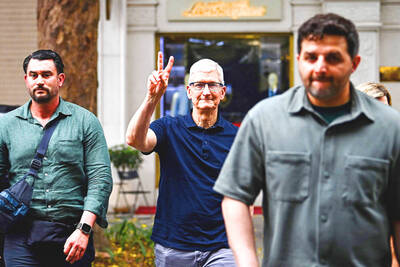
MAJOR DROP: CEO Tim Cook, who is visiting Hanoi, pledged the firm was committed to Vietnam after its smartphone shipments declined 9.6% annually in the first quarter Apple Inc yesterday said it would increase spending on suppliers in Vietnam, a key production hub, as CEO Tim Cook arrived in the country for a two-day visit. The iPhone maker announced the news in a statement on its Web site, but gave no details of how much it would spend or where the money would go. Cook is expected to meet programmers, content creators and students during his visit, online newspaper VnExpress reported. The visit comes as US President Joe Biden’s administration seeks to ramp up Vietnam’s role in the global tech supply chain to reduce the US’ dependence on China. Images on
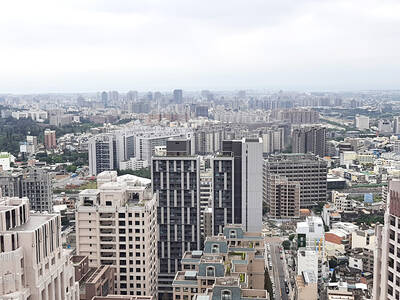
New apartments in Taiwan’s major cities are getting smaller, while old apartments are increasingly occupied by older people, many of whom live alone, government data showed. The phenomenon has to do with sharpening unaffordable property prices and an aging population, property brokers said. Apartments with one bedroom that are two years old or older have gained a noticeable presence in the nation’s six special municipalities as well as Hsinchu county and city in the past five years, Evertrust Rehouse Co (永慶房產集團) found, citing data from the government’s real-price transaction platform. In Taipei, apartments with one bedroom accounted for 19 percent of deals last
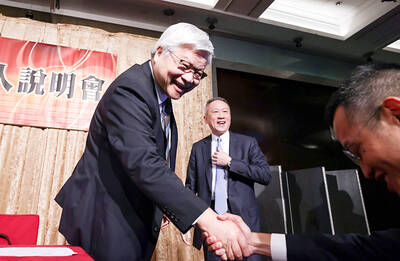
US CONSCULTANT: The US Department of Commerce’s Ursula Burns is a rarely seen US government consultant to be put forward to sit on the board, nominated as an independent director Taiwan Semiconductor Manufacturing Co (TSMC, 台積電), the world’s largest contract chipmaker, yesterday nominated 10 candidates for its new board of directors, including Ursula Burns from the US Department of Commerce. It is rare that TSMC has nominated a US government consultant to sit on its board. Burns was nominated as one of seven independent directors. She is vice chair of the department’s Advisory Council on Supply Chain Competitiveness. Burns is to stand for election at TSMC’s annual shareholders’ meeting on June 4 along with the rest of the candidates. TSMC chairman Mark Liu (劉德音) was not on the list after in December last


 RSS
RSS