


The Financial Supervisory Com-mission said yesterday that it will investigate whether United Microelectronics Corp (UMC,
"The Taiwan Stock Exchange (TSE) has found that, after receiving the US Securities and Exchange Commission's letter [on Sept. 26], some of [UMC's] management sold the company's shares at a `sensitive' time, which was inconsistent with the company's statement," the commission spokesman Lin Chung-cheng (
"We will find out if there was any insider trading involved," Lin said.
Lin pointed to a steep rise in UMC share prices between late September and early October in a graphic handed out to reporters.
The commission, however, was mum on details about the UMC officials who sold shares, how many they sold, and whether or when the investigation will be turned over to prosecutors, citing confidentially during the ongoing probe.
public letter
The financial watchdog made the remarks after UMC, the world's second largest made-to-order chipmaker, released a public letter yesterday to protest a fine it received for a late disclosure. In the letter, UMC explained that its late disclosure was a result of the US regulator's demand for the company to revise its financial statements.
UMC said on Dec. 14 that the firm's losses last year under US accounting standards were three times more than originally reported. It revised its shortfall to NT$14.2 billion from NT$4.7 billion because of erroneous assessments of charges, goodwill, share bonuses and derivatives. UMC's results for last year under Taiwanese standards -- showing a profit of NT$32 billion -- will remain intact, the chipmaker said.
The announcement was first made in the US, where the company's American Depositary Receipts trade, at around 5.30am local time. The company did not make a similar filing until five hours later -- about 10:30am local time -- at the demand of the TSE. The exchange fined UMC NT$50,000 for that late disclosure.
Protesting that fine, UMC said in yesterday's letter that the revision did not impact on the chipmaker's financial results under Taiwan's standards and therefore was not relevant to local investors.
This was the company's fourth advertisement voicing protest against the authority's punishment. UMC is currently under investigation for alleged illegal investments in China.
The SEC's letter, dated Sept. 23, did not explicitly ask UMC to revise its financial statements and therefore the company did not feel obligated to report to local financial regulators, UMC said.
Describing itself as a simple, self-disciplined and law-abiding firm, whose management is banned from trading shares, the company said in the letter that, "if Taiwan has become a country of disorder" that maybe "we should delist from Taiwan and move to other decent markets."
rebuttal
The commission refuted the chipmaker's claims, saying that there were close ties between the US and Taiwan markets and that the company's late disclosure, which led to a dip of UMC's share price by NT$1 within minutes, demonstrated that local investors agreed.
Moreover, the SEC letter dated Sept 23 stated that "you should revise your documents in future filings in response to this comment" and UMC's audit committee viewed the large revision as significant information, which both contradict the company's statements, the commission said.
A lack of simultaneous and fair disclosure in Taiwan following the US disclosure "is discriminatory toward local investors," Lin said.
The Taiwan Stock Exchange said yesterday that UMC's move will affect shareholders' views of the firms' credibility, and that this will be reflected in its share price.
"It is UMC chairman Robert Tsao's (
In the letter, UMC said that since it had uploaded the disclosure on Business Wire -- a US Web site disseminating full-text announcements from companies and organizations worldwide -- it had effectively spread the same information simultaneously to the TSE as well as local media.
But Wu said that this does not mean that UMC sent its message "in parallel" to Taiwanese shareholders, especially to those who do not understand English.
Wu said that listed companies should not be lax as self-regulation is of paramount importance.
"TSE will apply the same standards to all listed companies, which is the same as what overseas regulators do. Stricter regulation is a global trend," Wu said.
future demand
The financial authorities are planning to demand in the future that locally-listed companies that are also publicly traded in foreign markets should simultaneously report to the nation's regulators when they make crucial announcements to foreign market regulators said Wu Tang-chieh (
Earlier yesterday, the nation's lawmakers unanimously voiced their support of the commission taking a "tough" stance on UMC's public statement. They said that the chipmaker's neglect of the rights and interests of domestic investors and its disrespect for local financial regulators was unacceptable.
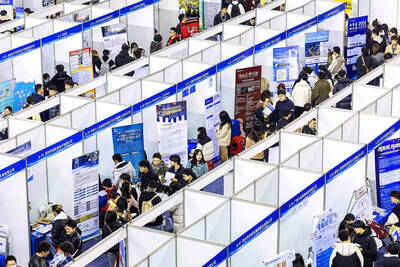
Stephen Garrett, a 27-year-old graduate student, always thought he would study in China, but first the country’s restrictive COVID-19 policies made it nearly impossible and now he has other concerns. The cost is one deterrent, but Garrett is more worried about restrictions on academic freedom and the personal risk of being stranded in China. He is not alone. Only about 700 American students are studying at Chinese universities, down from a peak of nearly 25,000 a decade ago, while there are nearly 300,000 Chinese students at US schools. Some young Americans are discouraged from investing their time in China by what they see

Taiwan Transport and Storage Corp (TTS, 台灣通運倉儲) yesterday unveiled its first electric tractor unit — manufactured by Volvo Trucks — in a ceremony in Taipei, and said the unit would soon be used to transport cement produced by Taiwan Cement Corp (TCC, 台灣水泥). Both TTS and TCC belong to TCC International Holdings Ltd (台泥國際集團). With the electric tractor unit, the Taipei-based cement firm would become the first in Taiwan to use electric vehicles to transport construction materials. TTS chairman Koo Kung-yi (辜公怡), Volvo Trucks vice president of sales and marketing Johan Selven, TCC president Roman Cheng (程耀輝) and Taikoo Motors Group

MAJOR DROP: CEO Tim Cook, who is visiting Hanoi, pledged the firm was committed to Vietnam after its smartphone shipments declined 9.6% annually in the first quarter Apple Inc yesterday said it would increase spending on suppliers in Vietnam, a key production hub, as CEO Tim Cook arrived in the country for a two-day visit. The iPhone maker announced the news in a statement on its Web site, but gave no details of how much it would spend or where the money would go. Cook is expected to meet programmers, content creators and students during his visit, online newspaper VnExpress reported. The visit comes as US President Joe Biden’s administration seeks to ramp up Vietnam’s role in the global tech supply chain to reduce the US’ dependence on China. Images on
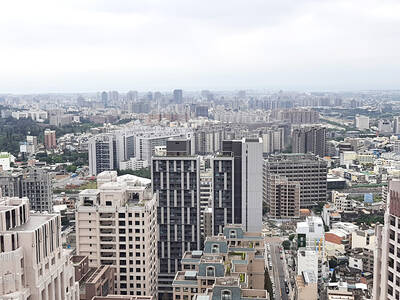
New apartments in Taiwan’s major cities are getting smaller, while old apartments are increasingly occupied by older people, many of whom live alone, government data showed. The phenomenon has to do with sharpening unaffordable property prices and an aging population, property brokers said. Apartments with one bedroom that are two years old or older have gained a noticeable presence in the nation’s six special municipalities as well as Hsinchu county and city in the past five years, Evertrust Rehouse Co (永慶房產集團) found, citing data from the government’s real-price transaction platform. In Taipei, apartments with one bedroom accounted for 19 percent of deals last


 RSS
RSS