


One day after the Ministry of Finance announced a delay in revoking tax incentives amid a mounting backlash, business leaders met with Minister of Finance Lin Chuan (林全) yesterday to express hopes that the government can strike a balance between economic development and tax reform.
The government had originally planned to make tech firms choose between a five-year tax holiday or tax exemption on selected types of investment. Currently companies can claim both, leading to some firms enjoying tremendous tax savings.
"It's very important that the government create an investor friendly environment from a macroscopic point of view," Rock Hsu (許勝雄), chairman of the Taiwan Electrical and Electronic Manufacturers Association (電電公會), told the Taipei Times yesterday.
Hsu joined Theodore Huang (黃茂雄), chairman of the Chinese National Association of Industry and Commerce (工商協進會), Morris Chang (張忠謀), chairman of Taiwan Semiconductor Manufacturing Co (台積電) and other industry heavyweights in exchanging opinions with Lin during a two-hour long closed-doors meeting.
Hsu said following heated discussions, Lin agreed that firms investing in so-called "emerging strategic industries" should enjoy both the five-year tax exemption and tax reductions on functional investment items, including research and development and purchases of new machines and equipment.
Details from the finance ministry were not available as of press time.
After a barrage of strong protests and fierce criticism from tech firms, the ministry had originally proposed a compromise scheme, requiring that companies give up tax breaks on each single investment item.
Tech firms insisted that the government should revise related laws before imposing the changes.
"The finance ministry's proposal clearly goes against the law. Industrial circles are opposed to the ministry's hasty decision, as companies will have no rules to follow when deciding on large-scale investment projects," said Frank Huang (黃崇仁), chairman of the Taiwan Semiconductor Industry Association (台灣半導體協會) and the Taipei Computer Association (台北市電腦公會). The two associations represent about 5,000 local electronics manufacturers.
While the ministry eventually decided to scrap the proposal on Monday night, Lin said the Statute for Upgrading Industries (促進產業升級條例), which provides both functional and industry-based incentives, would require adjustments to revoke any excessive stimuli.
During yesterday's meeting, Hsu said that industry leaders had also suggested that the government consider adjusting business income tax and personal income tax down, after the alternative minimum tax takes effect next month.
They also hoped that the government would discuss the possibility of revoking the 10-percent tax rate on the "undistributed surplus earnings" of companies soon and carefully consider how to strike a balance between pursuing economic development and pushing forward tax reform, Hsu said.
Separately, Ho Mei-yueh (何美玥), Minister of Economic Affairs, said yesterday that if the government wants to go ahead and cut tax incentives, then it should offer a grace period for local companies to allow them to come up with effective strategies.
It would create a heavy burden for local companies if the government simultaneously shrinks tax incentives and launches the renewed minimum tax scheme, Ho said.
"We hope to have more discussions about the tax changes," Ho said, adding that the government should provide stable tax rules for companies to follow.
The ministry now gives local companies, mostly high-tech firms, tax credits for purchasing new machines as well as tax exemption for five years.
Ho said that the ministry has already tightened the qualifications for tax preference and reduced the percentage of tax credits to 7 percent from the previous rate of 11 percent.
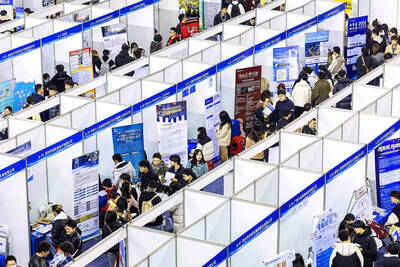
Stephen Garrett, a 27-year-old graduate student, always thought he would study in China, but first the country’s restrictive COVID-19 policies made it nearly impossible and now he has other concerns. The cost is one deterrent, but Garrett is more worried about restrictions on academic freedom and the personal risk of being stranded in China. He is not alone. Only about 700 American students are studying at Chinese universities, down from a peak of nearly 25,000 a decade ago, while there are nearly 300,000 Chinese students at US schools. Some young Americans are discouraged from investing their time in China by what they see

MAJOR DROP: CEO Tim Cook, who is visiting Hanoi, pledged the firm was committed to Vietnam after its smartphone shipments declined 9.6% annually in the first quarter Apple Inc yesterday said it would increase spending on suppliers in Vietnam, a key production hub, as CEO Tim Cook arrived in the country for a two-day visit. The iPhone maker announced the news in a statement on its Web site, but gave no details of how much it would spend or where the money would go. Cook is expected to meet programmers, content creators and students during his visit, online newspaper VnExpress reported. The visit comes as US President Joe Biden’s administration seeks to ramp up Vietnam’s role in the global tech supply chain to reduce the US’ dependence on China. Images on
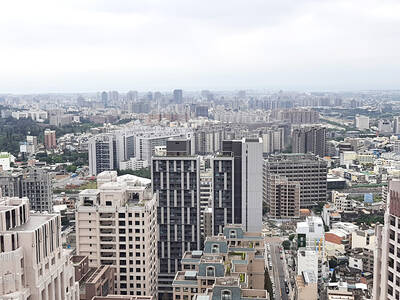
New apartments in Taiwan’s major cities are getting smaller, while old apartments are increasingly occupied by older people, many of whom live alone, government data showed. The phenomenon has to do with sharpening unaffordable property prices and an aging population, property brokers said. Apartments with one bedroom that are two years old or older have gained a noticeable presence in the nation’s six special municipalities as well as Hsinchu county and city in the past five years, Evertrust Rehouse Co (永慶房產集團) found, citing data from the government’s real-price transaction platform. In Taipei, apartments with one bedroom accounted for 19 percent of deals last
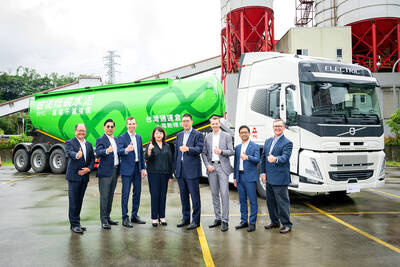
Taiwan Transport and Storage Corp (TTS, 台灣通運倉儲) yesterday unveiled its first electric tractor unit — manufactured by Volvo Trucks — in a ceremony in Taipei, and said the unit would soon be used to transport cement produced by Taiwan Cement Corp (TCC, 台灣水泥). Both TTS and TCC belong to TCC International Holdings Ltd (台泥國際集團). With the electric tractor unit, the Taipei-based cement firm would become the first in Taiwan to use electric vehicles to transport construction materials. TTS chairman Koo Kung-yi (辜公怡), Volvo Trucks vice president of sales and marketing Johan Selven, TCC president Roman Cheng (程耀輝) and Taikoo Motors Group


 RSS
RSS