


The dispute between the transportation authorities and a private electronic toll collection system operator escalated yesterday, with the contractor, Far Eastern Electronic Toll Collection Co (遠通電收), claiming the inauguration of the system will go ahead early next year as scheduled, while the Ministry of Transportation and Communications said absolutely not.
The automatic toll-ticketing system was originally slated to enter trials starting Jan. 1. However, questions over the cost of installing an on-board unit (OBU) in vehicles for use with the system look likely to cause a delay.
"We have delivered on our part of the deal in under a year, in line with the government's strict demands," said Far Eastern Electronic Chairman Douglas Hsu (徐旭東), adding that the government should now live up to the promises it made in the contract.
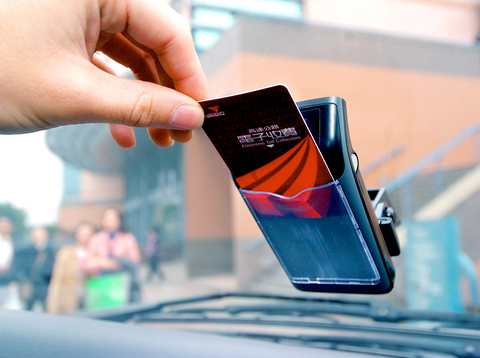
PHOTO: FANG PIN-CHAO, TAIPEI TIMES
In a ceremony yesterday to show that the company is ready to introduce the ETC system, Hsu said his company just could not understand why the authorities had changed their mind, especially after the regulator had approved the pricing when the firm outbid seven rivals to win the NT$6 billion (US$181 million) build-operate-transfer project in April of last year.
"`Frustration' does not begin to describe [our feelings]," Hsu said.
Taiwanese drivers will have to pay NT$2,249 for the e-toll equipment to be installed in their cars. The charge includes the price of an OBU and an integrated circuit credit card, as well as the installation fee and a security deposit.
Hsu said it is not a mandatory system and that the company hasn't forced anyone to buy the on-board unit. He emphasized that the price of the company's e-toll equipment is reasonable and cheap when compared with Hong Kong's fee of NT$6,800, Japan's fee of NT$5,800 and Singapore's NT$3,000.
So far, around 30,000 motorists have applied for installation, while over 3,000 drivers have already installed the equipment, the company said.
Even so, Minister of Transportation and Communications Lin Ling-san (林陵三) told reporters that the system trials, due to start on Jan. 1, were not going to go ahead, USTV reported yesterday.
The ministry plans to invite a third, independent party to review the cost in response to lawmakers' questions about unreasonable pricing. The contract stipulates that the price of the OBU and implementation date should be ratified by the ministry's National Freeway Bureau before the ETC system hits the road, Lin said.
"You should know who governs the freeways," the TV quoted Lin as saying when the minister was asked about the contractor's claim that it would start operating the system as scheduled.
Far Eastern Electronics, however, appeared persistent, with president Chang Yung-chang (張永昌) saying they will keep communicating with the freeway bureau and hope to sort out any outstanding issues by the Lunar New Year holiday late next month.
The company is still calculating the losses that it will incur by any delay in introduction, but they have not thought about asking for government compensation, Chang said.
Far Eastern Electronics has invested NT$2.5 billion in the project and is expected to break even in 2010, according to the executive.
Price cuts will not happen unless the government offers subsidies, the company's project assistant-manager Arthur Ong (翁士峻) said, citing the Singaporean government's subsidy policy.
It would cost NT$130 million to give away 100,000 OBUs for free, which would be a heavy financial burden on the contract with paid-in capital amounting to NT$2.8 billion, Ong said.
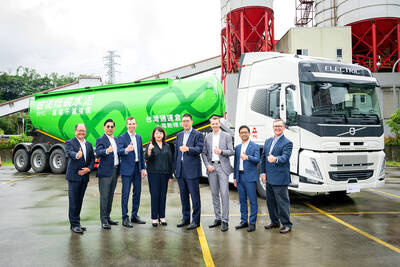
Taiwan Transport and Storage Corp (TTS, 台灣通運倉儲) yesterday unveiled its first electric tractor unit — manufactured by Volvo Trucks — in a ceremony in Taipei, and said the unit would soon be used to transport cement produced by Taiwan Cement Corp (TCC, 台灣水泥). Both TTS and TCC belong to TCC International Holdings Ltd (台泥國際集團). With the electric tractor unit, the Taipei-based cement firm would become the first in Taiwan to use electric vehicles to transport construction materials. TTS chairman Koo Kung-yi (辜公怡), Volvo Trucks vice president of sales and marketing Johan Selven, TCC president Roman Cheng (程耀輝) and Taikoo Motors Group

Among the rows of vibrators, rubber torsos and leather harnesses at a Chinese sex toys exhibition in Shanghai this weekend, the beginnings of an artificial intelligence (AI)-driven shift in the industry quietly pulsed. China manufactures about 70 percent of the world’s sex toys, most of it the “hardware” on display at the fair — whether that be technicolor tentacled dildos or hyper-realistic personalized silicone dolls. Yet smart toys have been rising in popularity for some time. Many major European and US brands already offer tech-enhanced products that can enable long-distance love, monitor well-being and even bring people one step closer to

RECORD-BREAKING: TSMC’s net profit last quarter beat market expectations by expanding 8.9% and it was the best first-quarter profit in the chipmaker’s history Taiwan Semiconductor Manufacturing Co (TSMC, 台積電), which counts Nvidia Corp as a key customer, yesterday said that artificial intelligence (AI) server chip revenue is set to more than double this year from last year amid rising demand. The chipmaker expects the growth momentum to continue in the next five years with an annual compound growth rate of 50 percent, TSMC chief executive officer C.C. Wei (魏哲家) told investors yesterday. By 2028, AI chips’ contribution to revenue would climb to about 20 percent from a percentage in the low teens, Wei said. “Almost all the AI innovators are working with TSMC to address the

Malaysia’s leader yesterday announced plans to build a massive semiconductor design park, aiming to boost the Southeast Asian nation’s role in the global chip industry. A prominent player in the semiconductor industry for decades, Malaysia accounts for an estimated 13 percent of global back-end manufacturing, according to German tech giant Bosch. Now it wants to go beyond production and emerge as a chip design powerhouse too, Malaysian Prime Minister Anwar Ibrahim said. “I am pleased to announce the largest IC (integrated circuit) Design Park in Southeast Asia, that will house world-class anchor tenants and collaborate with global companies such as Arm [Holdings PLC],”


 RSS
RSS