


Starting next month, all televisions measuring 29 inches (73.6cm) or more will have to bear an identification tag signifying whether the set contains an embedded digital TV tuner.
The Cabinet introduced the tag on Tuesday as the first step in moving toward the digital broadcasting era.
The government plans to replace analog broadcasting with a digital system by 2008. Analog signals are to be completely phased out by 2010. To reach this goal, all TV sets measuring 29 inches or more sold in Taiwan from next month must be equipped with built-in digital TV tuners.
The rule will apply to TVs measuring between 21 and 29 inches in 2007, and to sets of all sizes in 2008, the Cabinet said in a statement.
TV manufacturers and importers that fail to meet the requirements can be fined from NT$250,000 to NT$2.5 million (US$7,500 to US$75,000), said Wang Cheng-hui (王正輝), deputy director of the Bureau of Standards, Metrology and Inspection under the Ministry of Economic Affairs.
Companies that avoid official examinations to ensure compliance can be fined from NT$200,000 to NT$2 million, Wang added.
Although consumers can choose from a wide array of TVs or monitors, such as high-definition TVs and liquid-crystal displays (LCDs), only sets equipped with digital TV tuners will be able to receive digital broadcasts in future, said Wang Ting-an (
The identification tag will give a clear indication of whether a certain product will be compatible with digital broadcasts, Wang said.
Regarding concerns that the new measure will make millions of analog TV sets obsolete, Wang Ting-an said that consumers with analog televisions will be able to watch digital broadcasts after installing a digital-to-analog set-top box.
The government plans to gradually recall broadcast frequencies for analog signals, starting from 2008 in Penghu, Kinmen and Matsu, the east of the country in 2009, and the west in 2010, he said.
It is estimated that more than 6 million households will replace their cathode-ray-tube TVs or buy set-top boxes during the next three years, he added.
To bridge the digital divide, the Ministry of the Interior will budget NT$300 million to subsidize lower and middle-income families to buy set-top boxes, Wang Ting-an said.
While the hardware to facilitate digital broadcasting is in place, the software aspect is still lagging behind, an insider in the digital broadcasting sector said.
"The government is not coming up with incentives for digital content providers," said a public official of China Network Systems Co (中嘉網路) who asked not to be named.
Despite having promoted its digital broadcasting service for years, China Network Systems has only managed to secure around 40,000 subscribers, due mainly to the scarcity of programs that are not available on cable channels, he said.
In the absence of incentives, the nation's digital broadcasting operators, including China Network Systems, Eastern Multimedia Co (東森媒體科技) and Taiwan Broadband, can only lure subscribers by developing value-added services such as cable telephony and on-demand shopping, he said.
Expecting business to boom as a result of the move to digital broadcasting, Macquarie Media Group, Australia's biggest commercial radio operator, tapped into the market by acquiring Taiwan Broadband Communications (
While the hardware to facilitate digital broadcasting is in place, the
software aspect is still lagging behind, an insider in the digital
broadcasting sector said.
“The government is not coming up with incentives for digital content
providers,” said a public official of China Network Systems Co (中嘉網路)
who requested not to be named.
Despite having promoted its digital broadcasting service for years, China
Network Systems has only managed to secure around 40,000 subscribers, due
mainly to the scarcity of programs that are not available on current cable
channels, he said.
In the absence of incentives, the nation's digital broadcasting operators,
including China Network Systems, Eastern Multimedia Co (東森媒體科技) and
Taiwan Broadband, can only lure subscribers by developing value-added
services such as cable telephony and on-demand shopping, he said.

Stephen Garrett, a 27-year-old graduate student, always thought he would study in China, but first the country’s restrictive COVID-19 policies made it nearly impossible and now he has other concerns. The cost is one deterrent, but Garrett is more worried about restrictions on academic freedom and the personal risk of being stranded in China. He is not alone. Only about 700 American students are studying at Chinese universities, down from a peak of nearly 25,000 a decade ago, while there are nearly 300,000 Chinese students at US schools. Some young Americans are discouraged from investing their time in China by what they see
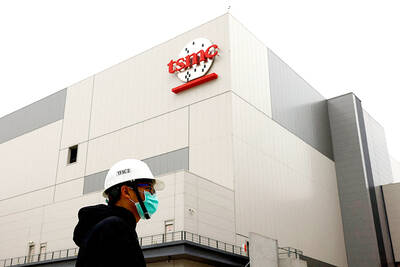
Taiwan Semiconductor Manufacturing Co (TSMC, 台積電), the world’s largest contract chipmaker, yesterday reported record sales for the first quarter, which analysts attributed to solid demand for emerging technologies. Consolidated revenue totaled NT$592.64 billion (US$18.51 billion) in the January-to-March period, up 16.5 percent from a year earlier, but down 5.26 percent from the previous quarter, TSMC said in a statement. The first-quarter revenue beat analysts’ average projection of NT$579.5 billion, Bloomberg News reported. That performance lends weight to expectations that the world’s most valuable chipmaker would return to solid growth this year after weathering a post-COVID-19-pandemic cratering of smartphone and computer sales. TSMC is budgeting
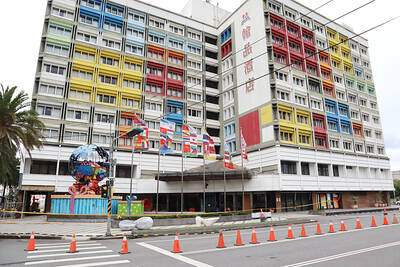
HUALIEN BRANCH: The company had been planning to rebuild the hotel before it was damaged in the quake and vowed to give affected employees the option to transfer The owner of Chateau de Chine Hualien (花蓮翰品酒店) is planning to lay off 86 workers after shutting down the hotel due to damage it sustained in a powerful earthquake on Wednesday last week, the Ministry of Labor said yesterday. The hotel has submitted a layoff report to the Hualien County Government and expects to let 69 workers go this month and 17 next month, the ministry said. LDC Hotels & Resorts Group (雲朗觀光集團), the owner of Chateau de Chine Hualien, confirmed the layoff plan in a statement yesterday. LDC said the hotel has been closed since Wednesday last week when the temblor occurred

US CONSCULTANT: The US Department of Commerce’s Ursula Burns is a rarely seen US government consultant to be put forward to sit on the board, nominated as an independent director Taiwan Semiconductor Manufacturing Co (TSMC, 台積電), the world’s largest contract chipmaker, yesterday nominated 10 candidates for its new board of directors, including Ursula Burns from the US Department of Commerce. It is rare that TSMC has nominated a US government consultant to sit on its board. Burns was nominated as one of seven independent directors. She is vice chair of the department’s Advisory Council on Supply Chain Competitiveness. Burns is to stand for election at TSMC’s annual shareholders’ meeting on June 4 along with the rest of the candidates. TSMC chairman Mark Liu (劉德音) was not on the list after in December last


 RSS
RSS