


Nokia Oyj is betting BlackBerry addicts are looking for a new fix.
The world's largest mobile-phone maker is courting customers of Research In Motion Ltd's (RIM) BlackBerry for a combination phone and e-mail device, coming out next quarter.
Nokia is exploiting concern that the service may be shut down in the US amid a patent dispute.
"People are looking for some alternatives," Mary McDowell, a Nokia senior vice president, said in an interview in New York.
The patent lawsuit has "been a cloud over RIM," she said.
Nokia wants to create its own class of fans, similar to the users from Wall Street to Silicon Valley that nicknamed RIM's device the "CrackBerry" and crouch over the pagers on trains and airplanes.
McDowell says the Finland-based company's E61 device will win over some of the 650 million people with business e-mail accounts worldwide, by giving them access to messages on the go.
The opportunity may be better now than ever. Research In Motion, with about 4 million users, may be forced to shut down service in the US, its biggest market.
US District Judge James Spencer in Richmond, Virginia, on Nov. 30 rejected a US$450 million settlement between RIM and NTP Inc, which claims the BlackBerry unfairly uses its patents.
Nokia isn't the only one eying BlackBerry. Motorola is set to unveil a phone with built-in e-mail.
Dubbed the Q, after the so-called Qwerty keyboard such devices feature, the machine is due out in the first quarter.
Illinois-based Motorola expects some business users to buy the Q, spokesman Alan Buddendeck said.
The company also is aiming for "prosumers," a combination of professionals and consumers, or customers who want personal and business e-mail. Those clients would use the device instead of a laptop.
Mobile-phone sales across the industry are set to increase more than 10 percent next year from an estimated 780 million units this year, Nokia said last week.
Nokia, which had about a third of the handset market last quarter, expects to gain share, executives said after introducing three more high-end models that run on faster networks. Nokia has a long-term target of 40 percent market share.
Last month, the company predicted the market for smartphones, the handsets with computer-like functions such as e-mail, will double to 100 million units next year.
Nokia, which runs a version of the BlackBerry software on some of its devices, has a license from Virginia-based NTP to continue running the program on its products should there be an injunction, McDowell said.
She declined to be specific about the details of the license.
"There are no patent issues related to running BlackBerry software," McDowell said.
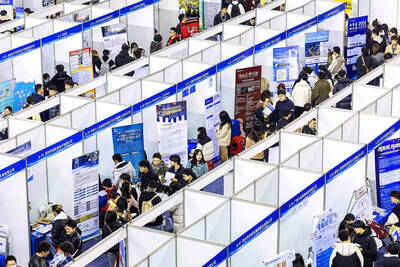
Stephen Garrett, a 27-year-old graduate student, always thought he would study in China, but first the country’s restrictive COVID-19 policies made it nearly impossible and now he has other concerns. The cost is one deterrent, but Garrett is more worried about restrictions on academic freedom and the personal risk of being stranded in China. He is not alone. Only about 700 American students are studying at Chinese universities, down from a peak of nearly 25,000 a decade ago, while there are nearly 300,000 Chinese students at US schools. Some young Americans are discouraged from investing their time in China by what they see
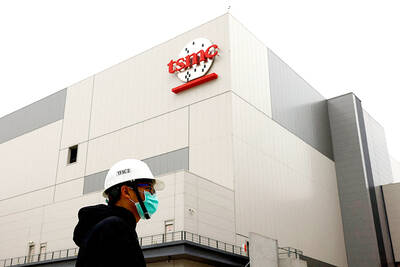
Taiwan Semiconductor Manufacturing Co (TSMC, 台積電), the world’s largest contract chipmaker, yesterday reported record sales for the first quarter, which analysts attributed to solid demand for emerging technologies. Consolidated revenue totaled NT$592.64 billion (US$18.51 billion) in the January-to-March period, up 16.5 percent from a year earlier, but down 5.26 percent from the previous quarter, TSMC said in a statement. The first-quarter revenue beat analysts’ average projection of NT$579.5 billion, Bloomberg News reported. That performance lends weight to expectations that the world’s most valuable chipmaker would return to solid growth this year after weathering a post-COVID-19-pandemic cratering of smartphone and computer sales. TSMC is budgeting

MAJOR DROP: CEO Tim Cook, who is visiting Hanoi, pledged the firm was committed to Vietnam after its smartphone shipments declined 9.6% annually in the first quarter Apple Inc yesterday said it would increase spending on suppliers in Vietnam, a key production hub, as CEO Tim Cook arrived in the country for a two-day visit. The iPhone maker announced the news in a statement on its Web site, but gave no details of how much it would spend or where the money would go. Cook is expected to meet programmers, content creators and students during his visit, online newspaper VnExpress reported. The visit comes as US President Joe Biden’s administration seeks to ramp up Vietnam’s role in the global tech supply chain to reduce the US’ dependence on China. Images on
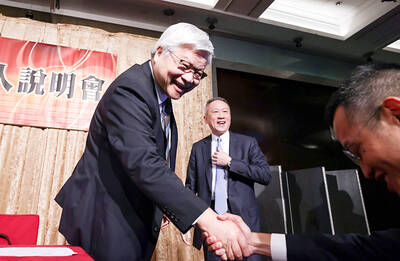
US CONSCULTANT: The US Department of Commerce’s Ursula Burns is a rarely seen US government consultant to be put forward to sit on the board, nominated as an independent director Taiwan Semiconductor Manufacturing Co (TSMC, 台積電), the world’s largest contract chipmaker, yesterday nominated 10 candidates for its new board of directors, including Ursula Burns from the US Department of Commerce. It is rare that TSMC has nominated a US government consultant to sit on its board. Burns was nominated as one of seven independent directors. She is vice chair of the department’s Advisory Council on Supply Chain Competitiveness. Burns is to stand for election at TSMC’s annual shareholders’ meeting on June 4 along with the rest of the candidates. TSMC chairman Mark Liu (劉德音) was not on the list after in December last


 RSS
RSS