


Taiwan's economic growth is expected to climb steadily to 4.25 percent next year from 3.83 percent this year, driven by stronger demand as the global economy recovers, according to a report released by the Academia Sinica yesterday.
While domestic consumption made the largest contribution to economic growth this year, the export sector, which will grow by 9.87 percent from this year, will be the main growth engine next year, said Wu Chung-shu (
The impact of rising oil prices, which was given as the reason for this year's lackluster economic performance, will be reduced next year as countries are braced for it, Wu said.
Because oil prices are expected to fluctuate around their current level, the US Federal Reserve may suspend its policy of hiking its benchmark interest rates, a move that will gradually fuel global economic growth, he said.
The nation's export sector has shown signs of weakening as local manufacturers exported increasing volumes of goods from their factories in China, which also contributed to a shrinking trade surplus.
The Ministry of Finance yesterday reported that the national trade surplus reached US$4.87 billion for the first 11 months of the year, a drop of 32.7 percent from the same period last year.
Nonetheless, the nation's export activities are in line with the world economy, Wu said.
The value of imports increased as a result of the high oil prices, which dragged the trade surplus down further, he added.
Taiwan's domestic consumption and investment are expected to dwindle slightly next year due to the minimum tax scheme that is expected to take effect next year, Wu said.
The legislature last month passed the first reading of the tax scheme, which proposes a tax rate of 10 percent to 12 percent for businesses with annual profits exceeding NT$2 million (US$59,700) after government subsidies have been taken into account, and a tax rate of 20 percent for individuals with annual earnings of more than NT$6 million, including overseas income of more than NT$1 million.
After weathering the initial stage, the positive effects of the new tax measure will emerge and benefit the economy in the second half of next year, he said.
The institute forecast that the New Taiwan dollar will slide from an average of NT$32.19 against the US dollar this year to NT$32.68 next year.
Consumer prices are estimated to grow by 1.45 percent from this year.
A possible further relaxation of restrictions on Chinese tourists will benefit the service industry and improve the nation's unemployment rate, Wu said.
It is difficult to estimate what effect relaxed tourism restrictions will have, as the government is still mulling the details, he said.
One factor that might dampen the nation's economic performance is the drawn-out political rows between the ruling and opposition parties, the institute said.
"After the elections, the parties should seek to concentrate on how to push forward major policies and measures that would benefit the economy," said Lee Yuan-tseh (
Lee, who supported President Chen Shui-bian's (陳水扁) election campaigns in 2000 and last year, said that the Democratic Progressive Party's relatively poor performance in the local elections shows people have lost faith in the government.
"I'm disappointed at the result ... a Cabinet reshuffle is unavoidable," Lee said.
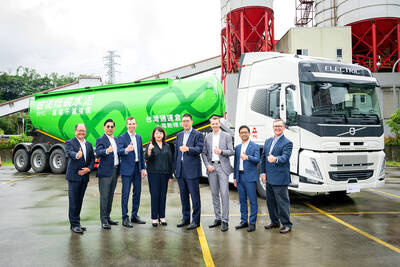
Taiwan Transport and Storage Corp (TTS, 台灣通運倉儲) yesterday unveiled its first electric tractor unit — manufactured by Volvo Trucks — in a ceremony in Taipei, and said the unit would soon be used to transport cement produced by Taiwan Cement Corp (TCC, 台灣水泥). Both TTS and TCC belong to TCC International Holdings Ltd (台泥國際集團). With the electric tractor unit, the Taipei-based cement firm would become the first in Taiwan to use electric vehicles to transport construction materials. TTS chairman Koo Kung-yi (辜公怡), Volvo Trucks vice president of sales and marketing Johan Selven, TCC president Roman Cheng (程耀輝) and Taikoo Motors Group

Among the rows of vibrators, rubber torsos and leather harnesses at a Chinese sex toys exhibition in Shanghai this weekend, the beginnings of an artificial intelligence (AI)-driven shift in the industry quietly pulsed. China manufactures about 70 percent of the world’s sex toys, most of it the “hardware” on display at the fair — whether that be technicolor tentacled dildos or hyper-realistic personalized silicone dolls. Yet smart toys have been rising in popularity for some time. Many major European and US brands already offer tech-enhanced products that can enable long-distance love, monitor well-being and even bring people one step closer to

RECORD-BREAKING: TSMC’s net profit last quarter beat market expectations by expanding 8.9% and it was the best first-quarter profit in the chipmaker’s history Taiwan Semiconductor Manufacturing Co (TSMC, 台積電), which counts Nvidia Corp as a key customer, yesterday said that artificial intelligence (AI) server chip revenue is set to more than double this year from last year amid rising demand. The chipmaker expects the growth momentum to continue in the next five years with an annual compound growth rate of 50 percent, TSMC chief executive officer C.C. Wei (魏哲家) told investors yesterday. By 2028, AI chips’ contribution to revenue would climb to about 20 percent from a percentage in the low teens, Wei said. “Almost all the AI innovators are working with TSMC to address the

Malaysia’s leader yesterday announced plans to build a massive semiconductor design park, aiming to boost the Southeast Asian nation’s role in the global chip industry. A prominent player in the semiconductor industry for decades, Malaysia accounts for an estimated 13 percent of global back-end manufacturing, according to German tech giant Bosch. Now it wants to go beyond production and emerge as a chip design powerhouse too, Malaysian Prime Minister Anwar Ibrahim said. “I am pleased to announce the largest IC (integrated circuit) Design Park in Southeast Asia, that will house world-class anchor tenants and collaborate with global companies such as Arm [Holdings PLC],”


 RSS
RSS