


European aircraft maker Airbus has signed a 12 billion-yuan (US$1.48 billion) deal to supply 20 A320 jets to private Chinese carrier East Star Airlines (
The new airline intends to buy 10 A320s from Airbus on credit offered by the aircraft manufacturer and lease the other 10 from General Electric's financing arm, GE Commercial Aviation Service, a joint statement said.
Following Boeing's US$4 billion signing a week ago to supply 70 737 aircraft to eight Chinese airlines, Airbus will deliver the first three planes in May next year when East Star Airlines is expected to launch its first flights.
"There is demand from the market and private airlines are a new market in the Chinese aviation market," Airbus spokesman Kevin Gu told reporters.
East Star Airlines, founded by three firms including the privately owned tourism and property investment company China East Star Group Co (
The airline, based in Wuhan, the capital of central Hubei province, won approval in June from the Civil Aviation Administration of China to begin operations. The carrier has registered capital of 80 million yuan.
"The A320 family aircraft is no doubt the best choice for our new airline," East Star Group president Lan Shili (
"It's unmatched low operating costs with the highest level of passenger comfort will help us take off smoothly and successfully."
As China's aviation market has boomed a number of private airlines such as United Eagle Airlines (
There are currently four registered Chinese private airlines attempting to break China's state-run monopoly of national and regional carriers.
Groups like Shanghai-based Spring hope that the budget business model which has flourished in Europe and the US will take off in China though tight regulation could clip its wings.
For one, Okay Airways (奧凱航空), Chinas first private airline, announced last month that it was being forced to revamp its low-cost business model because government restrictions have made it impossible for it to survive. After only seven months in operation the company conceded that as the first carrier to challenge state-owned carriers it would have to adopt a more conventional business model.
For its part, Airbus, which is 80 percent owned by the aerospace conglomerate EADS and 20 percent by British defense contractor BAE Systems, is locked in a dogfight with US rival Boeing to win greater market share in the world's third largest and fastest growing airline market. It holds 28 percent of the Chinese market but aims to ramp that figure up to 50 percent over the next eight years.
The stakes for both Airbus and Boeing are high in China, where Boeing predicts the industry will need 2,600 new planes, quadrupling the present fleet, over the next 20 years.

Among the rows of vibrators, rubber torsos and leather harnesses at a Chinese sex toys exhibition in Shanghai this weekend, the beginnings of an artificial intelligence (AI)-driven shift in the industry quietly pulsed. China manufactures about 70 percent of the world’s sex toys, most of it the “hardware” on display at the fair — whether that be technicolor tentacled dildos or hyper-realistic personalized silicone dolls. Yet smart toys have been rising in popularity for some time. Many major European and US brands already offer tech-enhanced products that can enable long-distance love, monitor well-being and even bring people one step closer to

Malaysia’s leader yesterday announced plans to build a massive semiconductor design park, aiming to boost the Southeast Asian nation’s role in the global chip industry. A prominent player in the semiconductor industry for decades, Malaysia accounts for an estimated 13 percent of global back-end manufacturing, according to German tech giant Bosch. Now it wants to go beyond production and emerge as a chip design powerhouse too, Malaysian Prime Minister Anwar Ibrahim said. “I am pleased to announce the largest IC (integrated circuit) Design Park in Southeast Asia, that will house world-class anchor tenants and collaborate with global companies such as Arm [Holdings PLC],”
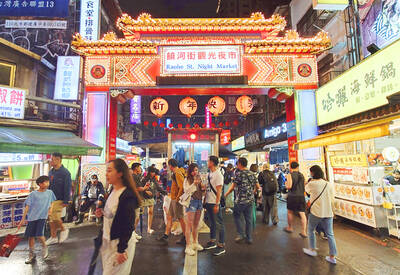
Sales in the retail, and food and beverage sectors last month continued to rise, increasing 0.7 percent and 13.6 percent respectively from a year earlier, setting record highs for the month of March, the Ministry of Economic Affairs said yesterday. Sales in the wholesale sector also grew last month by 4.6 annually, mainly due to the business opportunities for emerging applications related to artificial intelligence (AI) and high-performance computing technologies, the ministry said in a report. The ministry forecast that retail, and food and beverage sales this month would retain their growth momentum as the former would benefit from Tomb Sweeping Day
Thousands of parents in Singapore are furious after a Cordlife Group Ltd (康盛人生集團), a major operator of cord blood banks in Asia, irreparably damaged their children’s samples through improper handling, with some now pursuing legal action. The ongoing case, one of the worst to hit the largely untested industry, has renewed concerns over companies marketing themselves to anxious parents with mostly unproven assurances. This has implications across the region, given Cordlife’s operations in Hong Kong, Macau, Indonesia, the Philippines and India. The parents paid for years to have their infants’ cord blood stored, with the understanding that the stem cells they contained


 RSS
RSS