


Consolidation will remain a key trend in the Asian technology industry next year, as companies seek to expand their businesses and improve vertical-integration capabilities, according to a report.
"We expect more mergers and acquisitions as well as partnerships to be forged as companies seek to fill in their vertical-integration capabilities, or counter encroachment by new entrants pursuing a vertical-integration strategy," said the report released by Merrill Lynch last week.
Vertical integration is an increasingly popular strategy pursued by suppliers who seek greater customer penetration, enhanced economies of scale, greater revenues and profits, it said.
However, the US investment-research firm cautioned that a vertical-integration strategy is not risk free, as a wrong move by a key manufacturing division may jeopardize the contract under discussion.
It added that there may also be growing risks of overcapacity as specialized suppliers add capacity and new vertically integrated players put in capacity in competing for the same contracts.
Merrill Lynch released the report after concluding a two-week schedule visiting over 40 electronics manufacturing services providers, original-design manufacturers, component suppliers and handset vendors in South Korea, Taiwan, Hong Kong and China.
Its visits reinforced the positive views of companies with cost or technology leadership positions.
This includes Hon Hai Group (
While the firm does not envisage a "winner takes all" end-game, Hon Hai's success in the supply chain is putting pressure on others to expand economies of scale and scope to remain competitive.
"Hon Hai has set the standard for horizontal growth, as it penetrated all high-volume markets from PCs to handsets and networking to consumers. Its vertical integration spanned connectors, plastic casings and wire harnesses, which occurred in record time while maintaining high levels of profitability on the back of aggressive asset turns," the report said.
It added that networking and automotive are next on the company's agenda.
The success of Hon Hai's vertically integrated business model is being emulated by many other firms, Merrill Lynch said.
"We remain concerned that too many players are pursuing aggressive vertical-integration strategies in the electronics supply chain that could be disruptive to aggregate profitability," it said.
In a bid to generate favorable levels of profitability, a fresh product mix is gradually more critical to technology firms in Asia, according to the research firm.
"While high utilization rates and solid manufacturing yields continue to strengthen performance, commoditization of the manufacturing process means that a fresh product portfolio is becoming an increasingly important factor in profitability," the report said.
However, it is more difficult to ensure and thus predict a fresh product mix, which suggests that earnings volatility could increase for component vendors, it said.
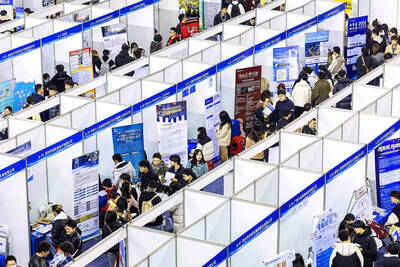
Stephen Garrett, a 27-year-old graduate student, always thought he would study in China, but first the country’s restrictive COVID-19 policies made it nearly impossible and now he has other concerns. The cost is one deterrent, but Garrett is more worried about restrictions on academic freedom and the personal risk of being stranded in China. He is not alone. Only about 700 American students are studying at Chinese universities, down from a peak of nearly 25,000 a decade ago, while there are nearly 300,000 Chinese students at US schools. Some young Americans are discouraged from investing their time in China by what they see
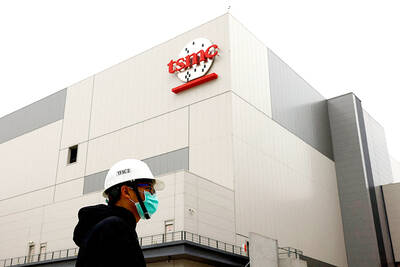
Taiwan Semiconductor Manufacturing Co (TSMC, 台積電), the world’s largest contract chipmaker, yesterday reported record sales for the first quarter, which analysts attributed to solid demand for emerging technologies. Consolidated revenue totaled NT$592.64 billion (US$18.51 billion) in the January-to-March period, up 16.5 percent from a year earlier, but down 5.26 percent from the previous quarter, TSMC said in a statement. The first-quarter revenue beat analysts’ average projection of NT$579.5 billion, Bloomberg News reported. That performance lends weight to expectations that the world’s most valuable chipmaker would return to solid growth this year after weathering a post-COVID-19-pandemic cratering of smartphone and computer sales. TSMC is budgeting
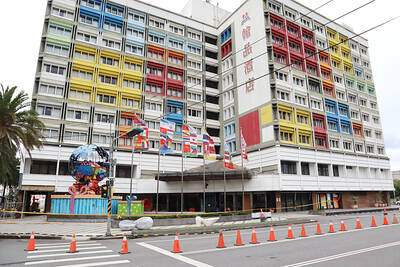
HUALIEN BRANCH: The company had been planning to rebuild the hotel before it was damaged in the quake and vowed to give affected employees the option to transfer The owner of Chateau de Chine Hualien (花蓮翰品酒店) is planning to lay off 86 workers after shutting down the hotel due to damage it sustained in a powerful earthquake on Wednesday last week, the Ministry of Labor said yesterday. The hotel has submitted a layoff report to the Hualien County Government and expects to let 69 workers go this month and 17 next month, the ministry said. LDC Hotels & Resorts Group (雲朗觀光集團), the owner of Chateau de Chine Hualien, confirmed the layoff plan in a statement yesterday. LDC said the hotel has been closed since Wednesday last week when the temblor occurred
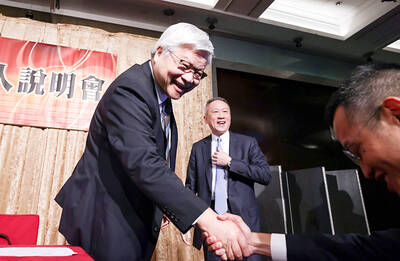
US CONSCULTANT: The US Department of Commerce’s Ursula Burns is a rarely seen US government consultant to be put forward to sit on the board, nominated as an independent director Taiwan Semiconductor Manufacturing Co (TSMC, 台積電), the world’s largest contract chipmaker, yesterday nominated 10 candidates for its new board of directors, including Ursula Burns from the US Department of Commerce. It is rare that TSMC has nominated a US government consultant to sit on its board. Burns was nominated as one of seven independent directors. She is vice chair of the department’s Advisory Council on Supply Chain Competitiveness. Burns is to stand for election at TSMC’s annual shareholders’ meeting on June 4 along with the rest of the candidates. TSMC chairman Mark Liu (劉德音) was not on the list after in December last


 RSS
RSS