


Taiwan is expected to do its best to expand its international visibility at the 13th APEC leadership summit in South Korea later this week, but it should change the tired tactic of playing victim to China to arouse sympathy -- which may simply come across as a tirade to other members and not likely have the desired result.
Under pressure from China, Taiwan's leaders have been rejected as representatives by each year's host nation, and even replacement candidates have needed to obtain the permission of Beijing to attend.
This year is no exception. President Chen Shui-bian (陳水扁) originally appointed Legislative Speaker Wang Jin-pyng (王金平) as his APEC envoy, but this was rejected. Chen then appointed Lin Hsin-yi (林信義), convener of the economic advisory group to the president and a former vice premier.
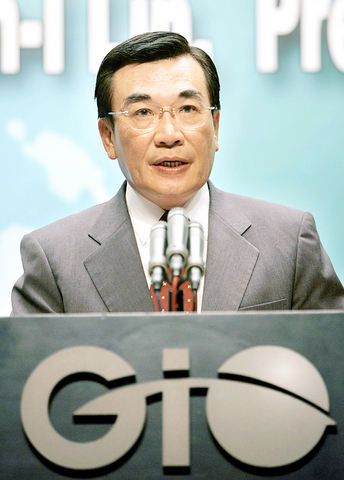
PHOTO: WALLY SANTANA, AP
It is a fact that China is trying to wear down Taiwan, but after 14 years of attendance at APEC, Taiwan should come up with something more than the same drama of Chinese persecution.
IMPORTANT AGENDA
"One important agenda for Taiwan is to push forward more free trade pacts under the structure of APEC, or else Taiwan may soon be marginalized, as the East Asian Summit is emerging to compete with APEC in influencing political and economic affairs in the region," said Tsai Horng-ming (蔡宏明), deputy general secretary of the Chinese National Federation of Industries (全國工業總會), at a seminar last week.
The first East Asian Summit, the annual gathering of ASEAN Plus Three (China, Japan and South Korea), will be held in Kuala Lumpur next month to discuss a free-trade agreement between member countries as the first step toward forming an economic bloc by 2020 or earlier.
Because of China's considerable influence, Taiwan will almost certainly be excluded from this giant Asian free-trade zone, which may also incorporate India, Australia and New Zealand.
The status of the group may also outgun APEC, a situation that would be even more unfavorable to Taiwan, said Lee Chiung-li (李瓊莉), an associate researcher at National Chengchi University's Institute of International Relations.
According to a report in the Hong Kong-based Wen Wei Po daily last Thursday, China is now pushing forward plans for the free-trade zone, and is leading a team composed of researchers from the various countries involved to develop strategies. A proposal is expected to be unveiled next year, the report said.
Total trade volume of the 10 ASEAN countries with China, Japan and South Korea hit US$3.6 trillion last year, and that amount will continue to soar for the next few years, the report said.
Fortunately, Taiwan still has time to minimize the impact, as the differences in economic development among the ASEAN Plus Three members are substantial. It will take a long time for underdeveloped countries such as Laos, Cambodia and Myanmar to catch up with other members, Tsai said.
Progress at the 21-member APEC forum, despite accounting for 57 percent of the world's GDP and 67 percent of world trade, is comparatively slow, said Johnny Chiang (
Unlike other inter-government institutions, APEC operates on the basis of non-binding commitments and has no treaty obligations. Furthermore, decisions made within APEC are reached by consensus and commitments are undertaken on a voluntary basis.
"This less efficient system has concerned some members," Chiang said. "They think it may be hard to reach the Bogor Goals under the process."
The Bogor Goals were set at the APEC leaders' meeting in 1994 and aim to realize free trade and investment across the APEC grouping by 2010 for developed economies and 2020 for developing economies. Renewing commitment to the Bogor Goals is an item on the top of the agenda at this year's meeting.
POWER SHIFT
Aside from the normal functions of APEC, the growing power of China and the diminishing power of the US and Japan in the bloc also affect the development of the organization, Lee said.
The US has shifted a lot of attention to the Middle East, while Japan is striving to turn around its long-struggling economy, Lee said.
Equipped with a strengthening economy, China has been gaining more influence in APEC in recent years. A predictable consequence of this is that Taiwan's room for reaching out to economic allies and concluding free-trade deals will narrow over time, Chiang said.
Taiwan should therefore seek to act as a more important pillar of APEC instead of placing excessive attention on cross-strait issues at annual meetings.
Against this backdrop, Taiwan must develop a means for proposing issues that could steer the APEC agenda in a beneficial direction, rather than haggling over seating arrangements or whether representatives from both sides are able to make eye contact or not.
Daniel Liao (廖東周), the deputy director-general of the Ministry of Foreign Affairs' Department of International Organizations, said initiatives that Taiwan has proposed over the years range from agricultural cooperation in earlier years to information technology support more recently.
One example of the latter was the establishment of the APEC Digital Opportunity Center (ADOC) in 2003 to help eliminate the "digital divide" among member economies by setting up centers for Vietnam, Chile, Peru, the Philippines, Indonesia and Papua New Guinea, an initiative which was welcomed by APEC leaders, Liao said.
Taiwan will propose that the project be expanded to create jobs for the six countries this year, in the next stage of the program entitled "ADOC Plus," he said.
Another contribution Taiwan will make this year involves the donation of US$500,000 to assist with regional efforts against the spread of bird flu, he said.
But Taiwan's efforts need to be more comprehensive.
"I think that no matter who represents Taiwan at the meeting, the most crucial task now is to send meaningful messages to the international community," Lee said.
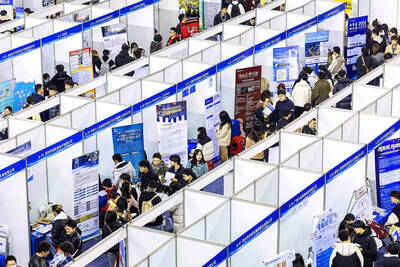
Stephen Garrett, a 27-year-old graduate student, always thought he would study in China, but first the country’s restrictive COVID-19 policies made it nearly impossible and now he has other concerns. The cost is one deterrent, but Garrett is more worried about restrictions on academic freedom and the personal risk of being stranded in China. He is not alone. Only about 700 American students are studying at Chinese universities, down from a peak of nearly 25,000 a decade ago, while there are nearly 300,000 Chinese students at US schools. Some young Americans are discouraged from investing their time in China by what they see

MAJOR DROP: CEO Tim Cook, who is visiting Hanoi, pledged the firm was committed to Vietnam after its smartphone shipments declined 9.6% annually in the first quarter Apple Inc yesterday said it would increase spending on suppliers in Vietnam, a key production hub, as CEO Tim Cook arrived in the country for a two-day visit. The iPhone maker announced the news in a statement on its Web site, but gave no details of how much it would spend or where the money would go. Cook is expected to meet programmers, content creators and students during his visit, online newspaper VnExpress reported. The visit comes as US President Joe Biden’s administration seeks to ramp up Vietnam’s role in the global tech supply chain to reduce the US’ dependence on China. Images on
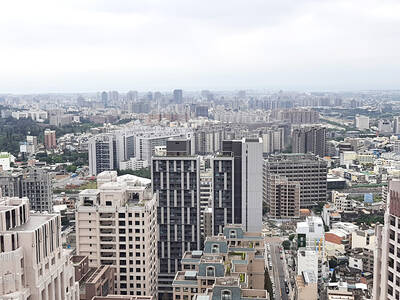
New apartments in Taiwan’s major cities are getting smaller, while old apartments are increasingly occupied by older people, many of whom live alone, government data showed. The phenomenon has to do with sharpening unaffordable property prices and an aging population, property brokers said. Apartments with one bedroom that are two years old or older have gained a noticeable presence in the nation’s six special municipalities as well as Hsinchu county and city in the past five years, Evertrust Rehouse Co (永慶房產集團) found, citing data from the government’s real-price transaction platform. In Taipei, apartments with one bedroom accounted for 19 percent of deals last
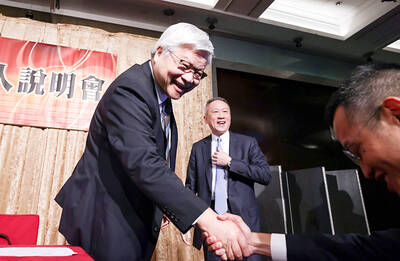
US CONSCULTANT: The US Department of Commerce’s Ursula Burns is a rarely seen US government consultant to be put forward to sit on the board, nominated as an independent director Taiwan Semiconductor Manufacturing Co (TSMC, 台積電), the world’s largest contract chipmaker, yesterday nominated 10 candidates for its new board of directors, including Ursula Burns from the US Department of Commerce. It is rare that TSMC has nominated a US government consultant to sit on its board. Burns was nominated as one of seven independent directors. She is vice chair of the department’s Advisory Council on Supply Chain Competitiveness. Burns is to stand for election at TSMC’s annual shareholders’ meeting on June 4 along with the rest of the candidates. TSMC chairman Mark Liu (劉德音) was not on the list after in December last


 RSS
RSS